

Executive Summary
A London-based Shopify ecommerce business experienced a significant decline in organic search performance after relying on an SEO strategy built around low-quality content and questionable backlink practices.
Mehadi Hasan was brought in to assess the situation, identify the causes of the decline, and rebuild the site’s SEO foundation using a more sustainable approach.
The project focused on technical SEO, site architecture, content quality, search intent, structured data, internal linking, and ecommerce user experience.
The reported outcome was substantial:
| SEO Metric | Improvement |
|---|---|
| Organic Clicks | +724% |
| Search Impressions | +351% |
| Keyword Visibility | Significant improvement across multiple target queries |
The project demonstrates how correcting technical problems and aligning an ecommerce website with user intent can restore organic visibility without relying on short-term or high-risk SEO tactics.
The Client
Industry: Ecommerce
Platform: Shopify
Market: London, United Kingdom
Project Type: Shopify SEO Recovery and Organic Growth
SEO Consultant: Mehadi Hasan
Project Start: July 2024
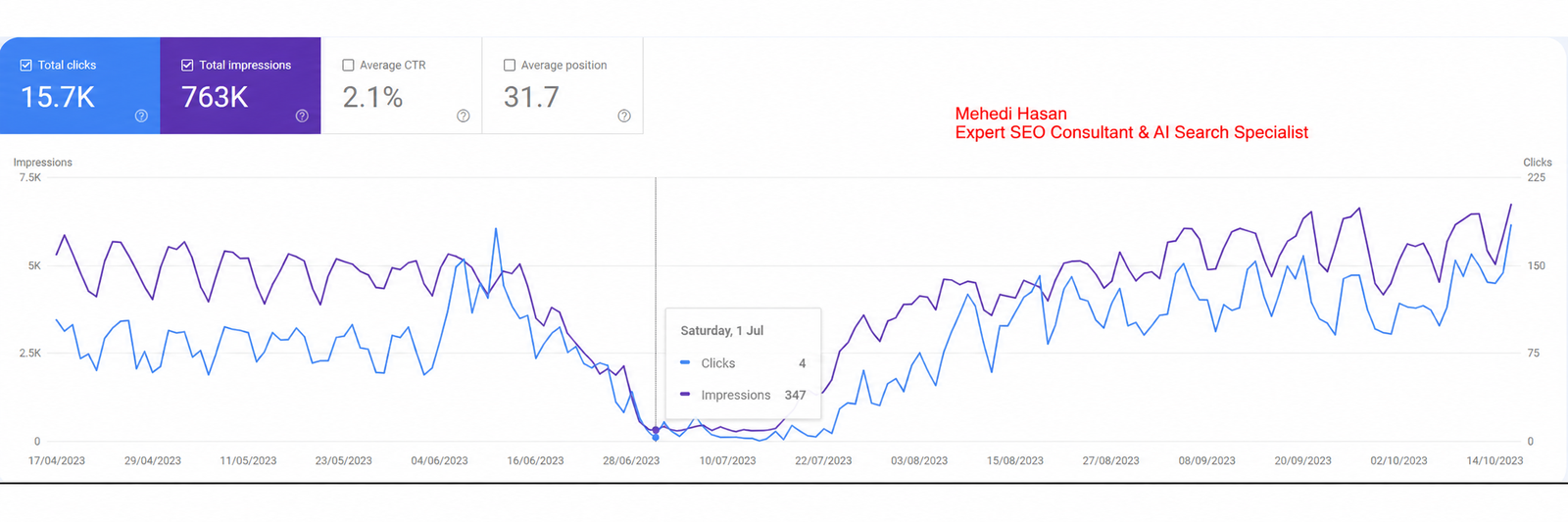
The business depended on organic search as an important customer acquisition channel. However, by June 2023, its website had experienced a noticeable decline in search traffic.
The objective was not simply to recover lost visibility. The larger goal was to create an SEO framework capable of supporting sustainable ecommerce growth.
The Challenge
An initial review indicated that the website had accumulated several SEO problems.
Previous SEO activity had focused heavily on low-quality content and aggressive backlink acquisition. Some backlinks appeared to come from low-value or artificial sources, creating unnecessary risk around the site’s backlink profile.
At the same time, the Shopify store had structural and content-related problems that limited its ability to compete effectively in organic search.
The website needed improvement across three areas:
Technical foundation, content relevance, and ecommerce user experience.
Rather than attempting to increase rankings through additional link building immediately, the priority was to repair the website itself.
SEO Audit and Diagnosis
Mehadi Hasan began with a comprehensive SEO health assessment.
The audit examined the website’s technical configuration, backlink profile, internal linking, indexation signals, content quality, search intent alignment, product pages, category pages, and overall site structure.
Several areas were identified for improvement:
- Potentially harmful or low-quality backlinks required review.
- Internal links needed to point consistently toward the correct canonical URLs.
- Existing content required stronger alignment with search intent.
- Important topics needed better topical coverage.
- Product pages needed more useful customer-focused information.
- Structured data required improvement.
- Category-page navigation and usability needed refinement.
These findings became the basis of the recovery strategy.
The SEO Strategy
1. Backlink Profile Review
The backlink profile was examined to identify links created through questionable or artificial link-building practices.
Where appropriate, problematic links were evaluated for removal or further action.
The objective was to reduce dependency on manipulative link-building tactics and establish a cleaner foundation for future authority growth.
2. Site Architecture and Canonicalization
The internal linking structure was reviewed to make sure important pages consistently pointed toward the preferred canonical URLs.
This helped reduce unnecessary URL duplication and created clearer signals regarding which versions of pages search engines should prioritize.
Internal linking was also improved to make important product, category, and informational pages easier for both users and search engines to discover.
3. Search-Intent-Based Content Optimization
Existing content was evaluated against the intent behind relevant search queries.
Pages were improved where the content did not adequately answer what users were searching for.
Instead of producing content purely to target keywords, the strategy focused on making each page more useful and relevant to the searcher’s objective.
4. Topic Cluster Development
New content was organized around related topics rather than isolated keywords.
Supporting articles were developed around important commercial themes and connected with relevant product and category pages.
This created stronger topical relationships across the website and helped search engines understand the site’s subject coverage more clearly.
5. Product Page FAQ Optimization
Frequently asked questions were incorporated into appropriate product pages.
These sections addressed questions potential customers might have before purchasing, allowing product pages to cover more informational and commercial search intent while also improving the shopping experience.
6. Structured Data Implementation
Relevant structured data was introduced and improved across the ecommerce website.
The purpose was to provide search engines with clearer information about products and page content and increase eligibility for enhanced search-result appearances where applicable.
7. Ecommerce UX Improvements
SEO was treated as more than a ranking exercise.
Navigation and interaction on product-category pages were reviewed from the user’s perspective.
The objective was to help visitors move more easily between categories, products, and supporting content while reducing friction during the buying journey.
Better usability also strengthened the commercial value of the additional organic traffic generated through SEO.
The Results
Following implementation of the SEO recovery strategy, the website recorded substantial improvements in Google Search performance.
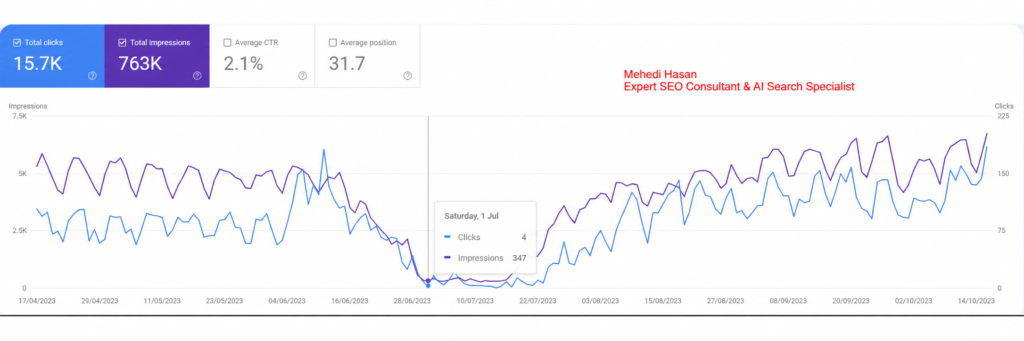
724% Increase in Organic Clicks
The number of users reaching the website through organic Google search increased significantly.
This was one of the clearest indications that the site had regained meaningful search visibility.
351% Increase in Search Impressions
The website also appeared substantially more frequently across Google search results.
Higher impressions indicated broader keyword visibility and increased exposure across relevant searches.
Improved Keyword Rankings
A range of target queries gained stronger positions in Google’s search results.
The combination of improved content relevance, stronger site architecture, better internal linking, and technical optimization helped the website compete for a wider range of commercially relevant searches.
Before vs. After
| Area | Before SEO Recovery | After SEO Recovery |
|---|---|---|
| Organic visibility | Declining | Strong growth |
| Content strategy | Low-quality / poorly aligned | Search-intent focused |
| Backlink strategy | High-risk / questionable links | More controlled approach |
| Internal linking | Canonical inconsistencies | Cleaner URL signals |
| Content architecture | Limited topical structure | Topic clusters implemented |
| Product pages | Limited customer information | FAQs and richer content |
| Structured data | Underutilized | Improved implementation |
| Category UX | Needed improvement | Better navigation and usability |
| Organic clicks | Weak / declining | +724% |
| Search impressions | Limited visibility | +351% |
Why the Strategy Worked
The recovery did not depend on one isolated SEO technique.
The improvement came from addressing several interconnected problems.
Technical corrections gave search engines clearer signals about the website. Content optimization increased relevance. Topic clusters expanded topical coverage. Internal linking strengthened important pages. Product FAQs answered real customer questions. Structured data improved how product information could be interpreted by search engines. UX improvements made the resulting traffic more valuable to the business.
Most importantly, the strategy shifted the website away from short-term SEO tactics and toward a more sustainable search foundation.
Key Takeaway
A decline in organic traffic doesn’t always mean a website needs more content or more backlinks.
Sometimes the correct response is to repair the foundation first.
For this Shopify store, the recovery strategy focused on understanding what limited organic performance, fixing those issues, and rebuilding the site around technical clarity, useful content, search intent, and customer experience.
The result was a reported 724% increase in organic clicks and a 351% increase in search impressions, together with stronger keyword visibility across Google Search.