

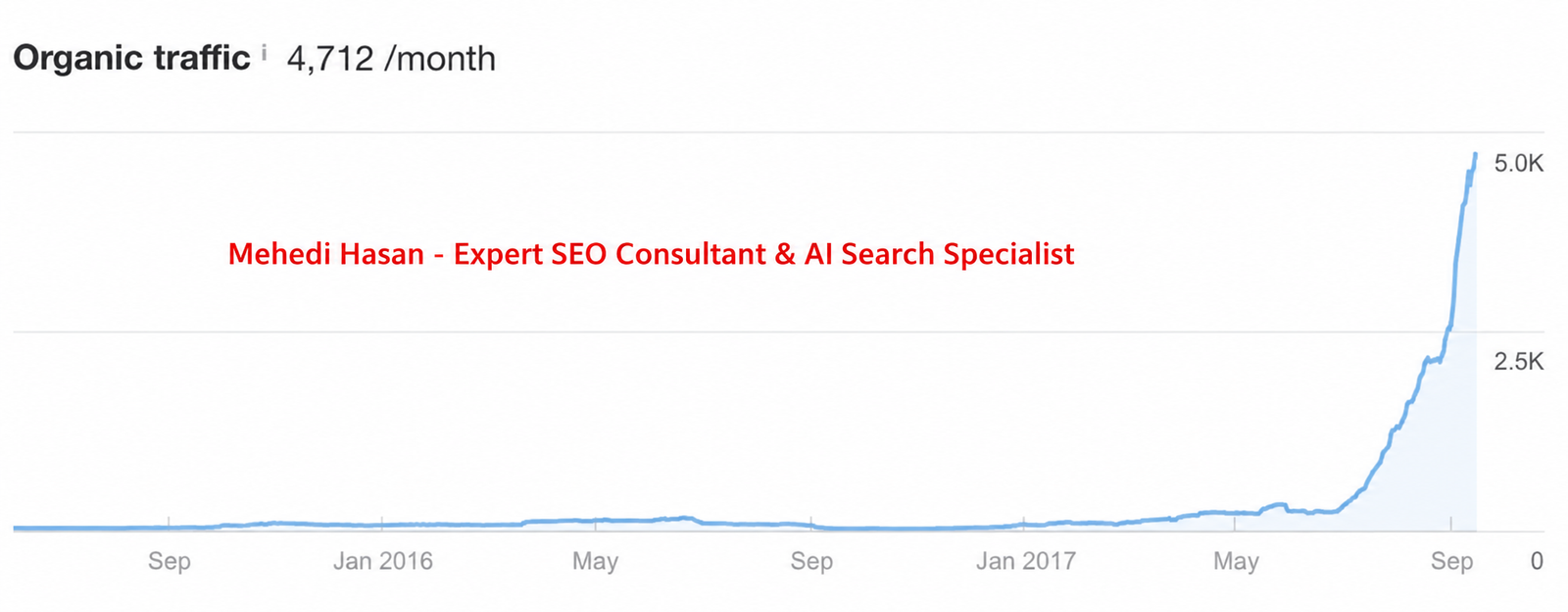
An established e-commerce website had been online since late 2013 and had accumulated a substantial amount of content. Despite its age and existing content footprint, the website was receiving limited organic visibility and struggling to rank competitively for commercially valuable search terms.
The objective was clear: identify the site’s untapped organic search opportunities, improve keyword rankings, strengthen content relevance, and build sufficient authority to generate sustainable search traffic.
Through a structured SEO campaign combining technical analysis, keyword research, content optimization, strategic content creation, and targeted link acquisition, the website ultimately reached 4,712 monthly organic visitors.
Campaign Snapshot
| Metric | Details |
| Industry | E-commerce |
| Website Type | Online Store |
| Campaign Duration | 12 Months |
| Monthly SEO Budget | $1,250 |
| Primary Goal | Increase organic traffic and keyword visibility |
| Organic Traffic Result | 4,712 monthly visitors |
| Core Strategy | Keyword targeting, content optimization, content creation and authority building |
The Challenge
The client had a significant advantage that many new websites do not have: an established domain and years of existing content.
However, that potential was not translating into meaningful organic traffic.
The website faced several problems:
- Important commercial keywords were not ranking on Google’s first page.
- Many target keywords were positioned outside the top search results.
- Existing content was not fully aligned with the strongest search opportunities.
- The site lacked enough authority around important commercial topics.
- Several keywords had ranking potential but needed additional optimization to move into traffic-generating positions.
The challenge was therefore not simply to publish more content.
The priority was to identify where the website already had SEO potential and concentrate resources on opportunities capable of producing measurable gains.
SEO Audit and Initial Analysis
The campaign began with a comprehensive SEO audit.
The purpose was to determine whether technical problems, search penalties, poor optimization, or authority issues were preventing the website from performing.
Key Audit Findings
The analysis found:
- No significant search engine penalties.
- No major evidence of excessive optimization.
- Weak first-page visibility for priority keywords.
- Many target keywords ranking outside Google’s top positions.
- Existing pages with potential to improve substantially through better targeting and authority signals.
This was an important finding.
Instead of rebuilding the website’s SEO strategy from scratch, the campaign could focus on improving assets that Google already recognized.
Finding the Highest-Value Keyword Opportunities
Keyword research became one of the most important parts of the campaign.
Rather than immediately targeting only the most competitive keywords in the industry, the strategy focused first on identifying “easy-win” opportunities.
These were keywords where the website already had some relevance or ranking visibility but had not yet reached positions capable of generating substantial traffic.
The research focused on:
Commercial Keywords
Search terms associated with products, purchasing decisions, and revenue opportunities.
Informational Keywords
Queries that could attract potential customers earlier in their buying journey.
Existing Ranking Opportunities
Keywords for which the site already had ranking signals but required additional optimization.
Content Gaps
Search topics competitors were ranking for but the client had either not covered or had covered insufficiently.
This approach made it possible to prioritize SEO work based on opportunity rather than simply search volume.
SEO Strategy
The campaign combined four major areas of SEO.
1. Existing Content Optimization
Existing pages were reviewed against the keywords they were ranking for.
Pages with significant ranking potential were improved to better match search intent and keyword relevance.
Optimization focused on:
- Search intent alignment
- Page targeting
- Keyword relevance
- Content depth
- Topic coverage
- Internal SEO signals
- Commercial relevance
The goal was to extract more value from content the client already owned before relying entirely on new content production.
2. Strategic Content Creation
New long-form content was created around carefully selected industry topics and keyword opportunities.
During the initial campaign stages, approximately 1,000-word content pieces were produced for targeted informational and commercial keywords.
Instead of publishing content simply to increase the number of indexed pages, each article had a specific search objective.
Content topics were selected according to:
- Keyword opportunity
- Search intent
- Commercial relevance
- Competitor gaps
- Ranking difficulty
- Existing website authority
3. Authority and Link Building
The campaign used targeted guest posting and link-building activities to strengthen the authority of priority pages.
Links were directed toward keywords and pages where improved authority could help move rankings into stronger positions.
Particular attention was paid to anchor-text diversity.
Rather than repeatedly using exact-match commercial anchors, the strategy incorporated:
- Branded anchors
- Natural anchors
- Keyword-relevant anchors
- Diverse linking patterns
This produced a more balanced backlink profile while supporting targeted pages.
4. Content Gap Optimization
Competitor and keyword analysis uncovered higher-volume topics that the website was not targeting effectively.
Existing content was adjusted where appropriate, while new content opportunities were added to the campaign roadmap.
This allowed the website to expand beyond its initial easy-win keywords as its organic visibility improved.
Campaign Execution
Month 1: Establishing the Foundation
The first month concentrated on building a foundation for ranking improvements.
Activities included:
- SEO and keyword opportunity analysis
- Identification of easy-win keywords
- Two targeted guest posts
- Diversified link and anchor-text development
- Creation of a 1,000-word industry-focused article
- Initial optimization of priority pages
The goal was to begin increasing relevance and authority without making aggressive changes across the entire website.
Month 2: Commercial Keyword Expansion
With the initial foundation established, the campaign placed greater emphasis on commercially valuable keywords.
Activities included:
- Additional guest-post placements
- Increased targeting of revenue-focused keywords
- Another approximately 1,000-word strategic article
- Optimization around selected commercial search terms
- Continued authority building
The website began strengthening its relevance around searches more closely connected to commercial intent.
Month 3: Scaling Winning Opportunities
By the third month, early campaign data provided a clearer picture of which areas had the strongest growth potential.
The strategy expanded through:
- Greater use of branded anchor text
- Additional authority-building activity
- Content optimization based on ranking movement
- Targeting of higher-volume search opportunities
- Content-gap adjustments
- Continued improvement of priority pages
Instead of applying the same SEO activity across every page, resources were increasingly concentrated on areas showing the strongest potential.
The Results
The combination of keyword targeting, content optimization, content creation, and authority building produced significant improvements in organic search performance.
Several target keywords moved into stronger search positions, including first-page visibility for priority terms.
As these rankings improved, organic traffic increased substantially.
4,712 Monthly Organic Visitors


The website ultimately reached 4,712 monthly organic visitors, representing a major increase compared with its previously limited organic visibility.
The campaign demonstrated how an established website with underperforming content can generate significantly more traffic when SEO resources are concentrated on pages and keywords with measurable ranking potential.
Why the Strategy Worked
Several factors contributed to the campaign’s performance.
Opportunity-Based Keyword Selection
The strategy did not focus exclusively on high-volume keywords.
Existing ranking opportunities were prioritized first, creating a more realistic path to early improvements.
Improving Existing Assets
Instead of treating new content as the only growth mechanism, existing pages were optimized to capture additional search demand.
Commercial and Informational Balance
The campaign targeted both revenue-driven keywords and informational searches, helping expand the website’s overall search footprint.
Strategic Authority Building
Links were used to support pages with measurable ranking opportunities rather than distributed without a clear objective.
Continuous Optimization
SEO decisions evolved as ranking and content-gap data became available.
This allowed the campaign to allocate more resources toward strategies that were producing results.
Key Takeaways
This campaign demonstrates an important SEO principle:
Significant organic growth does not always require rebuilding a website or publishing hundreds of new pages.
In this case, much of the opportunity already existed within the website.
The main task was identifying that potential and supporting it with:
- Better keyword targeting
- Stronger content relevance
- Strategic content creation
- Authority building
- Search-intent optimization
- Continuous performance analysis
The result was a substantially stronger organic search presence and growth to 4,712 monthly visitors.
Next Phase of Growth
With stronger rankings and organic visibility established, the next stage would focus on expanding the website’s search footprint.
Recommended priorities include:
- Targeting more competitive, higher-volume keywords.
- Expanding topical coverage around profitable product categories.
- Updating existing content based on current search intent.
- Strengthening internal linking between commercial and informational pages.
- Building authority to priority category and product pages.
- Improving conversion paths from informational content.
- Monitoring keyword movement and identifying new content gaps.
- Expanding long-tail keyword coverage.
- Strengthening topical authority within the client’s core niche.
- Connecting SEO performance more directly with leads, transactions and revenue.