

1. Executive Summary
An established Singapore-based e-commerce business specializing in baby shoes experienced a significant slowdown in organic search growth following changes in Google’s search algorithms.
The website had initially achieved an 80% increase in organic traffic within three months. However, its growth subsequently plateaued, creating a need to reassess the existing SEO strategy.
The project focused on strengthening product and category page optimization, improving content relevance, identifying high-potential pages, and expanding the website’s visibility across informational and commercial search queries.
According to the published project results, between March and October 2022:
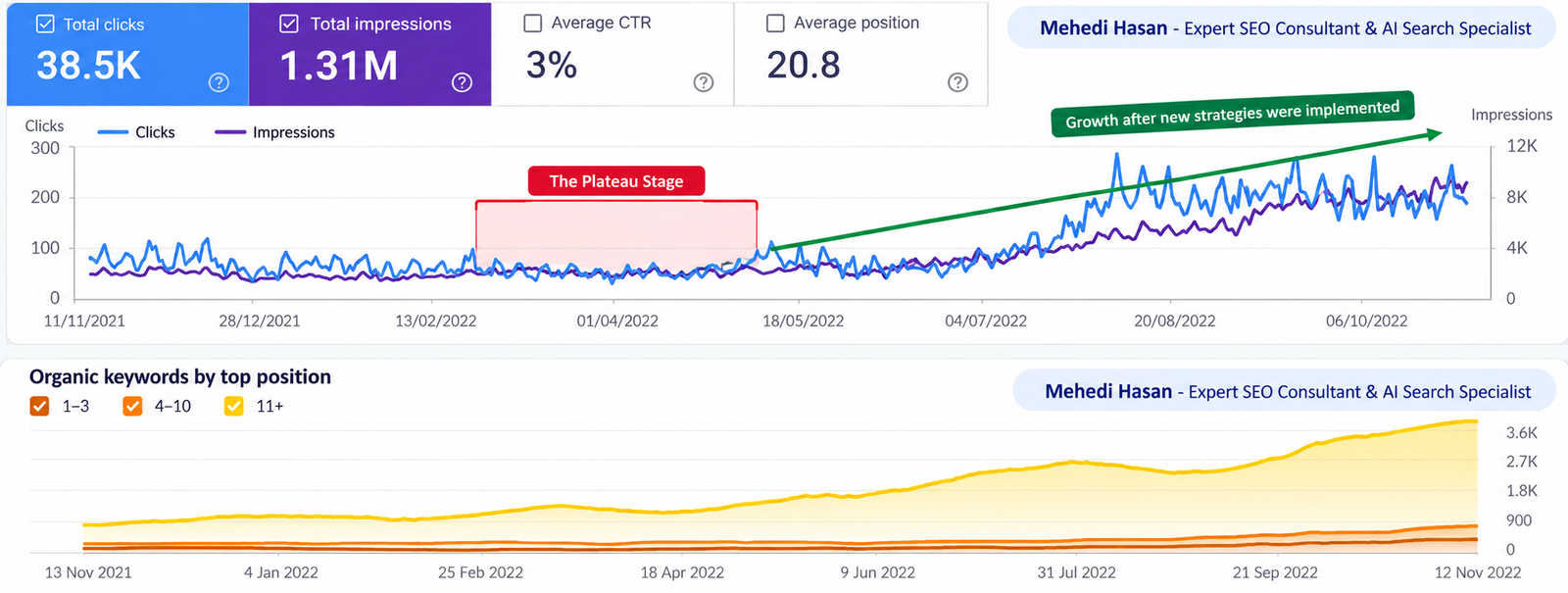
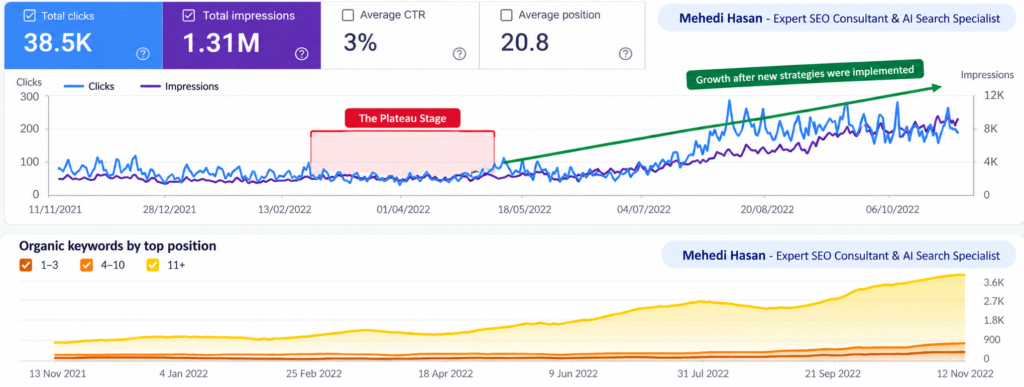
- Search impressions increased from 18,600 to 1.31 million.
- Organic search clicks increased from 441 to 38,500.
- The website expanded its visibility for non-branded informational keywords.
- The SEO strategy shifted toward a broader combination of product, category and informational content.
The case illustrates how targeted content improvements and ongoing SEO refinement can help an e-commerce website move beyond a period of stagnant search performance.
2. Client Background
The client operated an e-commerce platform in Singapore, offering baby footwear through an online storefront.
Organic search was an important channel for attracting potential customers who were actively researching baby shoes, comparing product options or looking for specific footwear products.
The website had already demonstrated growth potential through its initial SEO performance. However, maintaining that momentum required improvements to content quality, page relevance and keyword coverage.
Business context
- Business model: Direct-to-consumer e-commerce
- Product category: Baby shoes and related footwear
- Geographic market: Singapore
- Primary acquisition channel: Organic search
- SEO priorities: Product visibility, category rankings and informational keyword coverage
The client’s business name, website URL and commercial performance data were not disclosed in the original case study.
3. The Challenge: Organic Traffic Growth Had Stalled
The website initially experienced encouraging organic growth, recording an approximately 80% traffic increase during its first three months of SEO activity.
However, the original case study reports that growth subsequently slowed following Google’s Product Reviews Update in early 2022.
Although the available evidence does not establish that this update directly caused the plateau, the timing prompted a review of the website’s SEO approach.
The central challenge was to restore growth while improving the website’s ability to attract relevant visitors from a broader range of search queries.
Key challenges
3.1 Limited growth momentum
The website had reached a stage where its existing optimization approach was no longer producing the same rate of improvement.
3.2 Product and category page relevance
Product and category pages needed additional optimization to better match the language, questions and purchase intentions of potential customers.
3.3 Opportunities in non-branded search
The website needed to reach users searching for baby footwear information without already knowing the retailer’s brand.
3.4 Content depth and freshness
Existing pages required stronger informational content and updates to remain useful and competitive.
3.5 Search result visibility
The SEO strategy needed to improve the website’s eligibility for relevant search features and expand its coverage across different stages of the customer journey.
4. Project Objectives
The revised SEO strategy focused on five objectives:
- Restore positive organic search growth after the traffic plateau.
- Improve the search visibility of product and category pages.
- Expand rankings for relevant non-branded keywords.
- Strengthen informational content to reach potential customers earlier in their buying journey.
- Establish a more adaptable approach to ongoing content and SEO improvements.
These objectives supported the broader business goal of attracting relevant organic visitors without relying exclusively on paid advertising.
5. SEO Strategy and Implementation
The project used a coordinated SEO approach across commercial pages, existing content and new informational resources.
Phase 1: Product and Category Page Optimization
The first workstream focused on improving the SEO performance of existing product and category pages.
The reported work included redesigning and enhancing these pages to make them more relevant to search queries.
Key areas of optimization included:
- Improving the structure and relevance of commercial page content.
- Aligning page information with user search intent.
- Strengthening the usefulness of product descriptions.
- Improving the presentation of category-level information.
- Creating stronger connections between product information and purchase-oriented searches.
Strategic purpose: Help search engines understand the website’s commercial pages while making those pages more useful to potential buyers.
Phase 2: Identifying High-Potential SEO Pages
The project applied a process described in the original case study as Sweet Spot Analysis.
This involved identifying existing pages with opportunities to achieve stronger search visibility through further optimization.
Rather than treating every page as an equal priority, the strategy concentrated on pages that could potentially deliver greater organic search gains.
The approach aimed to:
- Identify pages with untapped ranking opportunities.
- Strengthen content on promising URLs.
- Improve alignment between existing pages and relevant search queries.
- Allocate optimization effort to pages with meaningful growth potential.
Strategic purpose: Concentrate resources on pages most likely to contribute to improved search visibility.
Phase 3: Search Intent-Based Content Expansion
The next stage focused on improving the depth and relevance of product page content.
Additional information was introduced to address the questions users might ask before purchasing baby footwear.
The content strategy also considered opportunities for greater visibility through review-related search results, featured snippets and frequently asked questions.
This work supported different stages of the buying journey, from initial research to product evaluation.
Strategic purpose: Make commercial pages more informative and improve their relevance to a wider range of searches.
Phase 4: Product Image Optimization
Product imagery was reviewed and updated to better align with the information users expected to find.
The project also connected relevant visual content with transactional pages, helping users move from product discovery toward purchasing opportunities.
For an e-commerce business, product imagery plays an important role in communicating product characteristics and supporting purchasing decisions.
Strategic purpose: Improve the relevance of visual content and strengthen the connection between product discovery and commercial landing pages.
Phase 5: Existing Content Refresh
The SEO strategy included updating existing website content to reflect current market information and improve its usefulness.
This work, described as content layering, focused on adding relevant information rather than relying exclusively on publishing new pages.
The approach helped the website build on existing content assets while expanding the topics and queries those pages could address.
Strategic purpose: Improve the relevance, completeness and ongoing usefulness of existing content.
Phase 6: Informational Blog Expansion
The final major workstream involved developing SEO-structured blog content targeting non-branded informational keywords.
These articles were intended to reach potential customers researching baby footwear before deciding which products to purchase.
This expanded the website’s keyword strategy beyond product-focused queries.
The informational content created additional opportunities to attract users during the awareness and consideration stages of the customer journey.
Strategic purpose: Increase the website’s organic reach and create additional entry points for potential customers.
6. Campaign Results and Performance Analysis
The original case study reports substantial improvements in search visibility and clicks during the March–October 2022 campaign period.
Search Performance Comparison
| Performance Metric | Starting Value | Ending Value | Calculated Growth |
| Organic search impressions | 18,600 | 1,310,000 | +6,943% |
| Organic search clicks | 441 | 38,500 | +8,630% |
| Non-branded keyword visibility | Not quantified | Expanded | Not available |
Note: Growth percentages are calculated from rounded published figures. The source does not identify the exact measurement windows or provide independently accessible Google Search Console data.
Result 1: Significant Increase in Search Impressions
The website’s reported search impressions increased from approximately 18,600 to 1.31 million.
This represents an increase of approximately 70.4 times the starting value.
The increase indicates that the website appeared in Google search results substantially more often during the reported comparison periods.
The broader content strategy and improved keyword coverage were consistent with this outcome, although the contribution of each individual SEO activity cannot be isolated from the available evidence.
Result 2: Substantial Growth in Organic Search Clicks
Reported organic search clicks increased from 441 to approximately 38,500.
This represents an increase of approximately 87.3 times the starting value.
The higher click volume suggests that increased search visibility was accompanied by a substantial rise in visits originating from Google Search.
The source does not provide revenue, orders or conversion data, so the commercial return from these additional clicks cannot be quantified.
Result 3: Expanded Non-Branded Keyword Coverage
The original case study reports that the website began ranking for a broader range of informational, non-branded keywords.
This was an important strategic outcome because it reduced the website’s dependence on searches involving its existing brand name.
The expanded keyword coverage created opportunities to reach customers who were researching relevant products but had not yet selected a retailer.
Result 4: Continued Visibility Through Algorithm Changes
The published account states that the revised strategy helped the website navigate Google’s May 2022 Core Update and subsequent search changes.
However, the available information does not include a detailed update-by-update performance breakdown.
The most defensible conclusion is that the website achieved strong reported growth during a period that included major Google algorithm changes.
7. Why the Strategy Was Effective
The project combined several complementary SEO activities instead of relying on a single optimization technique.
Commercial page improvements supported the website’s visibility for product-related searches.
High-potential page prioritization helped focus SEO resources on existing pages with opportunities for improvement.
Search intent alignment increased the relevance of content to customer questions and product research needs.
Content refreshing helped maintain the usefulness of existing pages.
Informational content expansion introduced additional opportunities to reach users outside the website’s existing branded search audience.
Together, these initiatives formed a more comprehensive organic search strategy that addressed both immediate visibility opportunities and longer-term content development.
8. Key Lessons and Strategic Insights
Lesson 1: Traffic plateaus require diagnosis, not simply more content
When organic growth slows, adding pages without reviewing existing performance may not address the underlying problem.
A structured assessment of page relevance, keyword coverage and search performance provides a stronger basis for deciding what to improve.
Lesson 2: Existing pages can offer meaningful growth opportunities
Optimizing current product, category and informational pages can be an important part of an SEO growth strategy.
Identifying pages with unrealized potential helps prioritize work that builds on existing website assets.
Lesson 3: Search intent should guide content development
Content should address the questions and decisions users make at different stages of their purchasing journey.
For e-commerce websites, this means supporting both direct product searches and earlier-stage informational queries.
Lesson 4: Organic growth requires continuous improvement
Search visibility changes as competitors, customer expectations and search algorithms evolve.
Regular content evaluation and optimization can help websites remain relevant rather than depending on a one-time SEO implementation.
Lesson 5: Search growth and business growth should be measured separately
Higher impressions and clicks show improved search visibility and traffic.
However, a complete assessment of business impact should also consider conversion rates, sales, customer acquisition costs and revenue attributed to organic search.
These commercial measures were not provided in the published case study.
9. Final Outcome
The Singapore-based baby footwear e-commerce website moved beyond its reported period of stagnant organic search growth and achieved substantial improvements in search visibility.
Between the published starting and ending measurements, organic search impressions increased from 18,600 to approximately 1.31 million, while search clicks increased from 441 to approximately 38,500.
The project also reported expanded visibility for informational, non-branded keywords.
The case demonstrates the potential value of combining commercial page optimization, targeted content improvements, high-opportunity page selection and informational content development.
For e-commerce businesses experiencing an organic traffic plateau, the central lesson is clear: sustainable SEO progress depends on regularly assessing what users search for, improving the pages that serve those searches and adjusting the strategy as performance changes.