

1. Executive Summary
Growing an ecommerce business through organic search requires more than increasing website visits. It requires attracting potential customers who are actively searching for relevant products and are likely to make a purchase.
This case study examines an SEO campaign for a Singapore-based ecommerce store specializing in baby shoes. The business faced significant competition from established footwear retailers and struggled to attract relevant non-branded organic traffic from its primary market.
Although the website received traffic from people searching for its brand, its visibility for broader product-related searches remained limited. A substantial portion of its traffic also originated outside Singapore, particularly from the United States.
The campaign addressed these challenges through technical SEO improvements, Singapore-focused keyword targeting, content optimization, internal linking, and informational content development.
The reported outcome was an increase of more than 80% in organic traffic, improved visibility for non-branded searches, and first-page Google rankings for multiple competitive keywords.
2. Client Background
The client operated an emerging ecommerce business specializing in baby footwear for customers in Singapore.
As a relatively new competitor, the business needed to establish its presence in a search market already occupied by established retailers with stronger online authority.
The website had an existing foundation of branded search traffic, suggesting that some consumers were already familiar with the business. However, it was not capturing enough traffic from people searching for baby footwear without mentioning a particular brand.
This limited its ability to reach new customers through organic search.
Business Objectives
The SEO campaign focused on five primary objectives:
- Increase organic visibility among Singapore-based consumers.
- Attract relevant non-branded traffic from product-related searches.
- Improve the search performance of important ecommerce pages.
- Strengthen the website’s technical foundation and internal linking.
- Build a more sustainable source of organic customer acquisition.
3. The SEO Challenges
Challenge 1: Competition from Established Ecommerce Brands
The baby footwear market included established competitors with stronger domain profiles, more extensive content, and existing keyword visibility.
For a newer website, competing against these businesses required carefully selecting achievable keyword opportunities rather than targeting only the most competitive search terms.
Challenge 2: Limited Non-Branded Search Visibility
The website attracted branded traffic but had difficulty ranking for broader searches related to baby shoes.
This restricted organic discovery among parents who were searching for products but were unfamiliar with the brand.
Challenge 3: Traffic from the Wrong Geographic Market
A significant share of website visits originated from the United States rather than Singapore.
Although international traffic can contribute to overall visitor numbers, it was less aligned with the client’s target customer base.
The SEO strategy therefore needed to prioritize Singaporean search demand and local purchasing intent.
Challenge 4: Underoptimized Website Content
The website already contained useful content, but its pages were not sufficiently aligned with relevant search terms and search intent.
This created opportunities to improve product and category page optimization, keyword relevance, and content structure.
Challenge 5: Technical and Internal Linking Limitations
The website required technical SEO improvements and a more effective internal linking structure.
Addressing these issues was important for improving crawlability, content discovery, and the distribution of internal page authority.
4. SEO Strategy and Implementation
The campaign combined technical improvements with targeted content and keyword optimization.
Phase 1: Technical SEO Audit and Optimization
The priority was assessing the website’s technical condition and identifying issues that could restrict organic search performance.
The technical review focused on improving the website’s overall SEO health and establishing a stronger foundation for subsequent optimization.
Technical considerations included crawlability, indexation, website architecture, and other factors affecting search engine access to important pages.
By addressing technical weaknesses, the website could better support its content and keyword strategy.
Phase 2: Singapore-Focused SEO Targeting
The next priority was aligning the website’s organic visibility with its actual customer market.
Instead of focusing on traffic volume alone, the strategy emphasized search queries relevant to Singapore-based shoppers.
This involved adapting keyword targeting and page optimization to the local market.
The objective was to improve the quality and geographic relevance of organic visitors while reducing dependence on less relevant international traffic.
Phase 3: Keyword Research and Competitor Analysis
Keyword research helped identify opportunities that the website was not fully capturing.
Competitor analysis provided additional insight into relevant search terms and content opportunities within the baby footwear market.
The keyword strategy considered different types of search intent:
- Transactional intent: Searches indicating that a customer may be ready to purchase baby shoes.
- Commercial investigation: Searches comparing products, styles, features, or options.
- Informational intent: Searches from parents researching baby footwear and related purchasing considerations.
This approach helped connect keyword opportunities with appropriate website pages and customer needs.
Phase 4: On-Page SEO and Content Optimization
Existing website content was refined to improve its relevance to targeted searches.
The optimization strategy focused on making important pages more useful to potential customers while aligning their content with relevant keywords.
Key considerations included page topics, search intent, content relevance, and the relationship between product-focused and informational pages.
Rather than relying solely on creating additional content, the campaign sought to improve the performance of assets the website already had.
Phase 5: Internal Linking Optimization
Internal linking was another important component of the campaign.
The website’s existing pages were reviewed to identify opportunities to connect related content more effectively.
A stronger internal linking structure can help search engines discover important pages and understand relationships between topics.
It also supports customer navigation by helping visitors move between relevant informational, category, and product pages.
Phase 6: SEO-Focused Informational Content
The campaign also introduced search-optimized blog content designed to address questions from potential customers.
Informational content served two purposes.
First, it helped the website reach audiences earlier in their purchasing journey.
Second, it created opportunities to direct interested readers toward relevant commercial pages.
This connected educational content with the ecommerce sales funnel and supported broader topical relevance within the baby footwear niche.
5. SEO Performance and Results
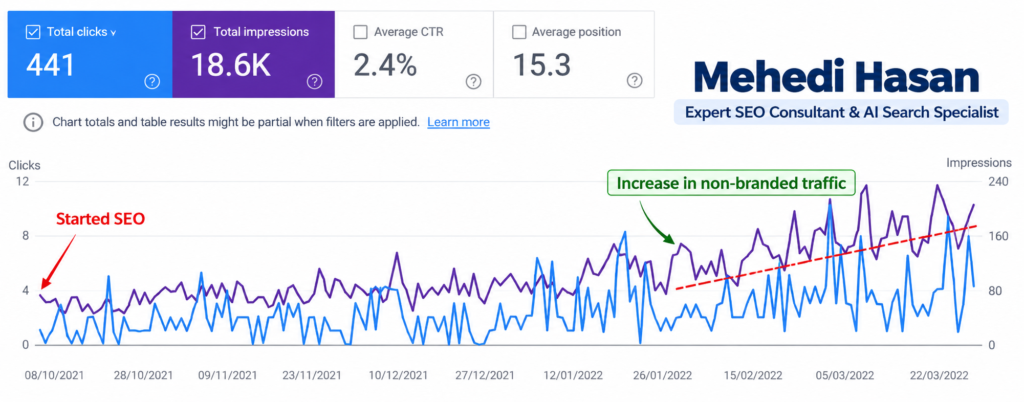
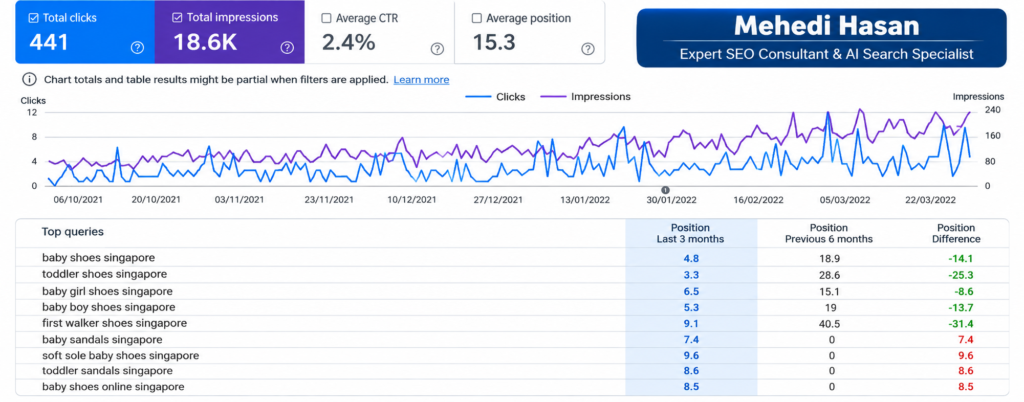
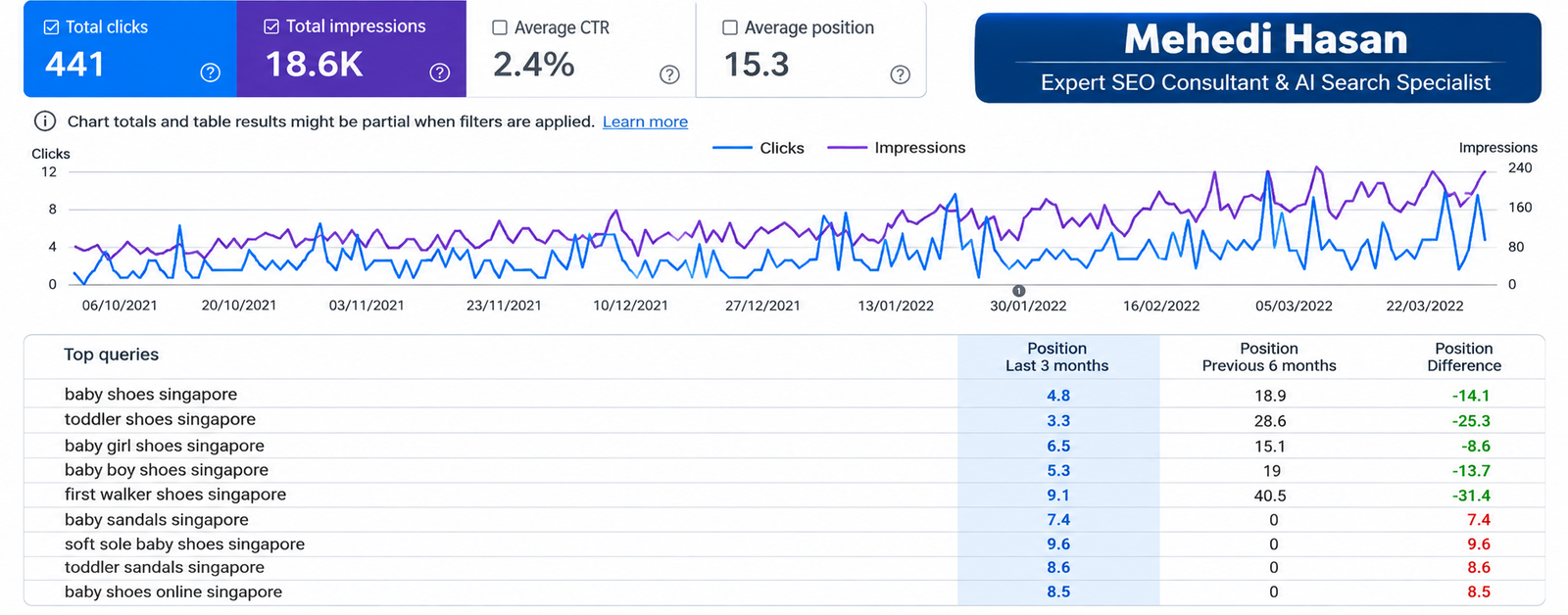
The original case study reported meaningful improvements following implementation of the SEO strategy.
Result 1: Organic Traffic Increased by Over 80%
The website reportedly achieved more than 80% growth in organic traffic.
The most significant improvements were associated with locally relevant, non-branded searches.
This was important because the campaign’s objective was to reach potential customers beyond those already familiar with the business.
Result 2: Improved Google Keyword Rankings
The website began appearing on Google’s first results page for multiple competitive keywords.
These ranking improvements expanded the store’s opportunity to reach customers searching for baby footwear.
Result 3: Stronger Visibility in the Singapore Market
The campaign improved the website’s relevance to its intended geographic audience.
By prioritizing Singapore-focused search terms and content, the strategy sought to attract traffic more closely aligned with the business’s customer base.
Result 4: Improved Competitive Position
The original report also described improvements in domain authority and the website’s competitive position relative to larger industry participants.
These findings suggest that the campaign strengthened the website’s organic search presence, although exact authority scores and competitor comparisons were not provided.
Result 5: More Stable Organic Performance
The source case study reported that the website maintained its search performance during off-peak periods.
This suggests that the improvements were not limited to a short-term increase in traffic.
However, the original report did not provide a detailed timeline or monthly performance data to quantify this stability.
6. Key Insights
Geographic Relevance Matters More Than Traffic Volume Alone
For a market-specific ecommerce business, attracting visitors from the correct country can be more valuable than generating a larger volume of geographically irrelevant traffic.
Non-Branded SEO Supports Customer Acquisition
Branded searches are valuable, but they primarily capture existing awareness.
Improving visibility for non-branded searches allows an ecommerce store to reach customers who have not yet discovered the business.
Technical SEO and Content SEO Work Together
Technical improvements create a stronger foundation for search visibility, while relevant content helps a website compete for customer searches.
Neither should be treated as a complete strategy in isolation.
Internal Linking Supports Discovery and Navigation
Connecting relevant pages helps organize website content, supports search engine discovery, and makes it easier for potential customers to explore products.
Sustainable SEO Requires More Than Keyword Rankings
Keyword positions are useful performance indicators, but the broader objective is to generate relevant traffic that can contribute to business growth.
For ecommerce websites, future performance evaluation should also consider organic conversions, revenue, and customer acquisition.
7. Conclusion
This Singapore baby footwear ecommerce case study demonstrates how a focused SEO strategy can help an emerging online retailer improve its visibility in a competitive market.
By addressing technical limitations, targeting locally relevant keywords, optimizing existing content, strengthening internal linking, and developing useful informational resources, the campaign reportedly delivered more than 80% organic traffic growth.
The most important outcome was the shift toward attracting relevant non-branded search traffic from the business’s intended market.
For ecommerce brands seeking long-term organic growth, the case illustrates the value of aligning SEO activity with customer search behavior, geographic relevance, and commercial objectives.