

Executive Summary
An online home decor retailer approached Mehadi Hasan with a clear business objective: increase its visibility in organic search, attract more qualified shoppers, improve rankings for commercially valuable keywords, and ultimately generate more sales through SEO.
The website had considerable growth potential, but its existing SEO strategy was not fully aligned with customer search behavior or commercial search intent.
A focused ecommerce SEO strategy was developed around keyword research, search intent, on-page optimization, content improvement, internal linking, and topical authority.
Key Result
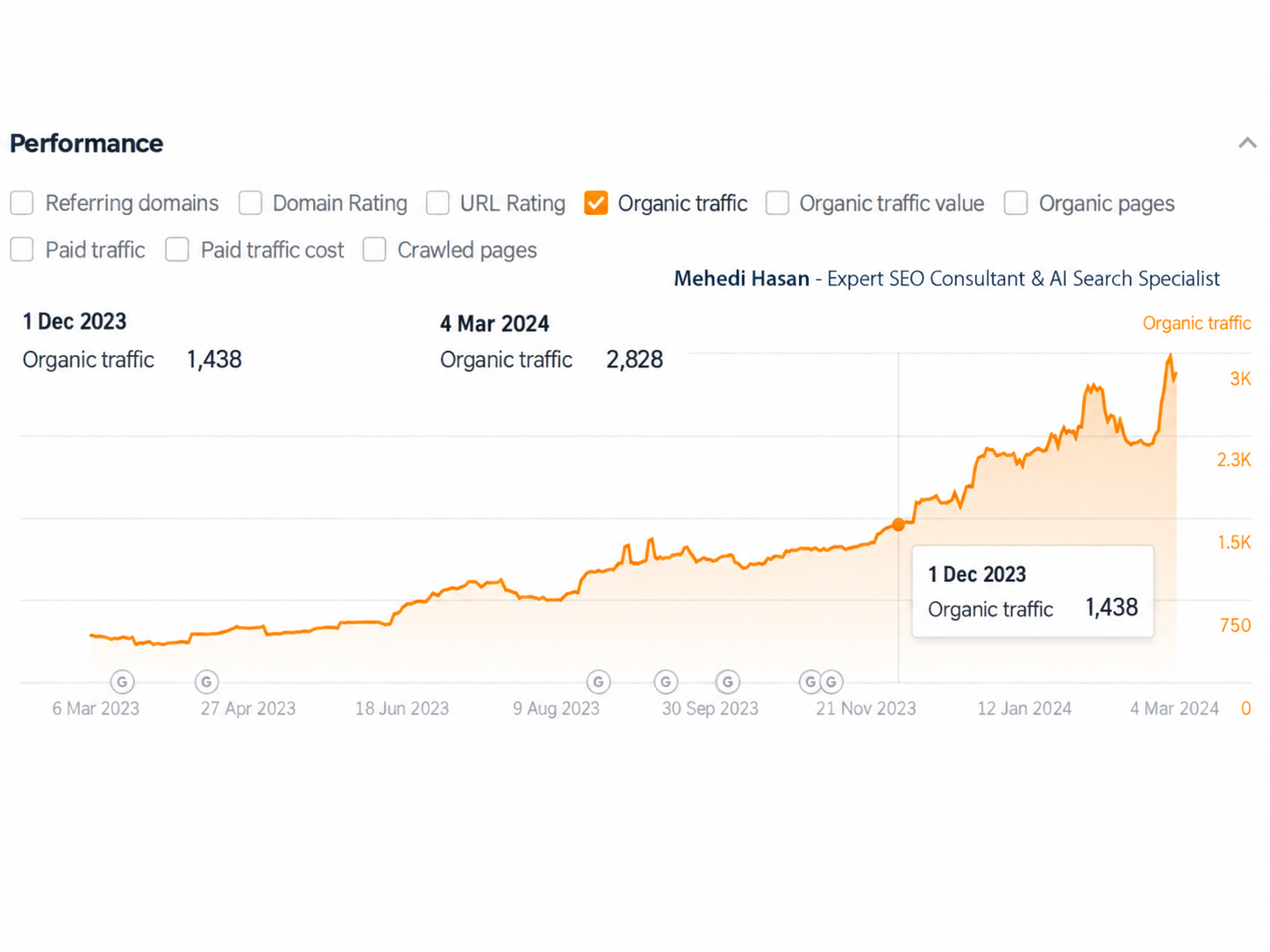
Organic traffic increased by 96.52%.
The campaign also delivered stronger visibility for important commercial keywords and contributed to increased sales and revenue.
The Challenge
The home decor market is highly competitive.
Customers search using thousands of combinations of product names, styles, materials, room types, problems, and buying-related terms.
Simply having attractive products was therefore not enough. The website needed to appear when potential customers were actively searching for relevant products and information.
Several areas presented opportunities for improvement:
- Product and category pages needed stronger search-engine targeting.
- Existing content required closer alignment with search intent.
- Commercially valuable keywords needed greater visibility.
- Long-tail ecommerce opportunities were not being fully utilized.
- Internal linking could be improved to strengthen important pages.
- The site’s informational content needed to establish greater topical authority.
- SEO activity needed to focus more directly on qualified traffic rather than traffic volume alone.
The objective was therefore not merely to attract more visitors.
The real objective was to attract people who were more likely to become customers.
Campaign Objectives
The SEO campaign focused on five primary goals:
- Increase qualified organic traffic.
- Improve rankings for commercially important keywords.
- Strengthen product and category page visibility.
- Build greater topical authority within the home decor niche.
- Turn increased search visibility into additional sales and revenue.
SEO Strategy
Rather than relying on a single SEO technique, the campaign combined several interconnected strategies.
1. Advanced Keyword Research
Keyword research formed the foundation of the campaign.
The strategy considered both high-volume search terms and more specific long-tail searches with stronger purchasing intent.
Instead of targeting keywords based solely on search volume, keyword opportunities were evaluated according to:
- Search intent
- Commercial relevance
- Competition
- Product relevance
- Conversion potential
- Content opportunity
This allowed the campaign to target users at different stages of the customer journey.
For example, broad searches could introduce new customers to the brand, while highly specific product searches could attract visitors much closer to making a purchase.
2. Search Intent Analysis
Ranking for a keyword is valuable only when the page satisfies what the searcher actually wants.
Each important keyword was therefore evaluated according to its likely intent.
Searches could generally fall into categories such as:
- Informational
- Commercial investigation
- Product discovery
- Transactional
Pages were then optimized according to the type of information or product experience users expected to find.
This helped create stronger alignment between:
Keyword → Search Intent → Landing Page → Customer Action
That alignment was particularly important for ecommerce SEO because visitors arriving on the wrong type of page are less likely to convert.
3. On-Page SEO Optimization
Important pages were reviewed and optimized to improve both relevance and search visibility.
Key elements included:
Page Titles
Titles were refined to better communicate the topic of each page while incorporating relevant target keywords naturally.
Meta Descriptions
Meta descriptions were improved to communicate value more clearly and encourage qualified searchers to click through from Google.
Heading Structure
H1, H2, and supporting headings were organized to create clearer page hierarchy and topical relevance.
Content Alignment
Page content was strengthened so that important pages answered the questions and needs associated with their target searches.
Keyword Placement
Primary and supporting keywords were integrated naturally rather than repeated excessively.
The focus was always on relevance and user experience rather than keyword stuffing.
4. Ecommerce Content Optimization
Existing content was reviewed to identify pages that could become stronger organic-search assets.
The content strategy focused on making pages:
- More useful
- More relevant
- Better structured
- More comprehensive
- Better aligned with purchasing intent
Product and category content needed to serve two audiences simultaneously:
Search engines, which require clear topical signals.
Customers, who need enough useful information to make a purchasing decision.
The content strategy was therefore designed to support both rankings and conversions.
5. Building Topical Authority
The campaign expanded beyond product-focused SEO.
Informational resources, guides, and industry-related content were used to strengthen the website’s authority within the home decor niche.
This type of supporting content can help an ecommerce website capture searches earlier in the customer journey while creating opportunities to direct readers toward relevant commercial pages.
Instead of treating blog content as an isolated traffic source, informational content was connected strategically with products and categories.
The resulting structure supported a broader SEO ecosystem:
Informational Content → Internal Links → Commercial Pages → Products → Conversion
6. Internal Linking Strategy
Internal linking played an important role in the campaign.
Relevant pages were connected strategically so that search engines could better understand relationships between content, categories, and commercial landing pages.
The internal linking strategy helped:
- Improve website navigation
- Strengthen important commercial pages
- Distribute internal page authority
- Help search engines discover relevant pages
- Connect informational and transactional content
- Guide users toward relevant products
Instead of adding links randomly, internal links were placed where they were contextually useful.
Results
The combined SEO strategy produced measurable growth.
96.52% Increase in Organic Traffic
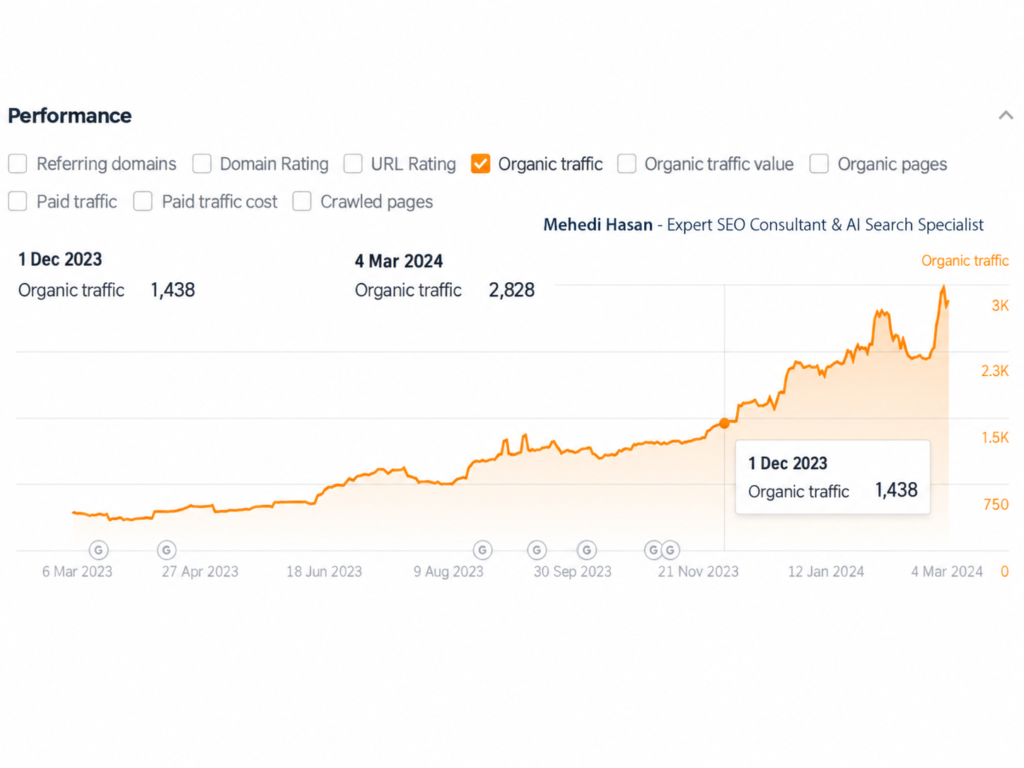
The most significant measurable result was a 96.52% increase in organic traffic.
This represented substantial growth in the number of visitors reaching the ecommerce website through unpaid search results.
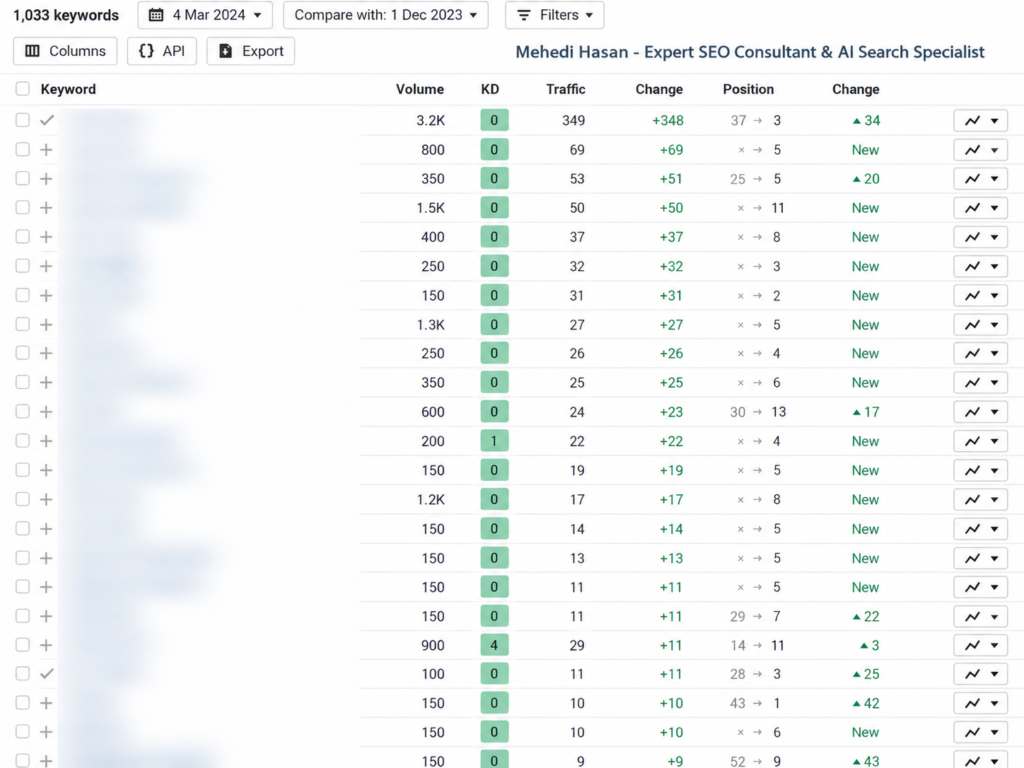
Improved Commercial Keyword Rankings
Important revenue-oriented keywords achieved stronger search visibility.
Improving rankings for these terms was particularly valuable because the searches were closely connected with products and purchasing decisions.
The campaign therefore prioritized commercial relevance rather than pursuing rankings simply for vanity metrics.
Increased Sales and Revenue
The increased organic visibility was accompanied by improved sales and overall revenue.
This was an important measure of campaign success.
The objective of ecommerce SEO is not simply:
More rankings.
Or:
More traffic.
The objective is:
Qualified Organic Traffic → Product Discovery → Purchase → Revenue
By connecting SEO activity to commercial intent, the campaign supported growth beyond search visibility alone.
Why the Strategy Worked
The campaign succeeded because several SEO components supported one another.
Keyword research identified opportunities.
Search-intent analysis determined what users expected.
On-page optimization improved relevance.
Content improvements strengthened individual landing pages.
Authority-building content expanded the website’s topical reach.
Internal linking connected those assets and directed authority toward strategically important pages.
Together, these activities created a stronger organic-search foundation than relying on isolated SEO tactics.
Business Impact
The campaign demonstrated that ecommerce SEO can create meaningful commercial value when traffic growth is connected to customer intent.
The strategy helped the retailer:
- Reach more potential customers through organic search
- Improve visibility for valuable product-related searches
- Strengthen important commercial pages
- Build authority in the home decor niche
- Increase organic traffic
- Support higher sales and revenue
- Create a stronger foundation for continued organic growth
The 96.52% organic traffic increase was the headline result, but the broader impact came from attracting users searching for products and topics closely connected to the client’s business.
Key Takeaways
This project highlights several principles that are important for ecommerce SEO.
Traffic Quality Matters More Than Traffic Alone
A large increase in visitors has limited business value if those visitors have little intention of purchasing.
Keyword selection should therefore consider commercial value and customer intent.
Search Intent Should Determine Page Strategy
Product pages, category pages, guides, and informational articles serve different purposes.
Matching the correct page format to the searcher’s intent improves both SEO relevance and user experience.
Ecommerce SEO Requires More Than Product Optimization
Supporting guides and informational content can strengthen topical authority and help customers discover a brand before they are ready to purchase.
Internal Linking Is a Strategic SEO Tool
Well-planned internal links help search engines understand site structure while directing users and authority toward important commercial pages.
SEO Should Ultimately Support Business Growth
Rankings and traffic are useful performance indicators, but ecommerce SEO should ultimately contribute to customer acquisition and revenue.
Final Outcome
Through a structured ecommerce SEO strategy covering keyword research, search intent, on-page optimization, content development, authority building, and internal linking, the online home decor retailer achieved:
96.52% Growth in Organic Traffic
along with:
Improved Rankings for Important Commercial Keywords
and:
Increased Sales and Overall Revenue
The project demonstrates how an SEO strategy built around customer intent and commercial value can turn organic search into a sustainable acquisition channel for an ecommerce business.