


Project Overview
Mehadi Hasan led an SEO growth project for an established e-commerce business operating in the dietary supplements sector.
Because the website sold products closely connected with health and wellness, it operated within a highly sensitive YMYL (Your Money or Your Life) search environment. Websites in this category face a higher standard for content quality, accuracy, credibility, authority, and trust.
The business had reached a point where organic growth had become stagnant. Despite having an established online presence, the website was struggling to expand its non-branded search visibility and attract new customers through organic search.
The objective was clear: strengthen the website’s organic search performance, improve its credibility within a competitive health-related market, reach new customers, and turn increased visibility into measurable commercial growth.
Key Results
Within six months, the SEO campaign delivered:
- 29% increase in organic sessions
- 35% increase in new organic users
- 1,200 additional organic transactions
- 67% increase in keyword rankings
- $200,000 increase in year-over-year revenue attributed to organic search
These results were achieved while the business was operating in a competitive e-commerce sector and adapting to changing consumer behaviour and economic conditions.
The Challenge
The client was an online retailer specialising in dietary supplements.
Although the business already had products, existing content, and established website authority, organic search performance had stopped growing at the expected rate.
Several problems needed to be addressed.
1. Limited Organic Growth
Organic traffic had become stagnant, restricting the company’s ability to acquire new customers without increasing its reliance on paid channels.
2. YMYL Search Competition
Dietary supplements sit within a health-related search environment where information accuracy and trust are particularly important.
Content could therefore not be treated simply as traditional e-commerce copy. Pages needed to demonstrate stronger expertise, relevance, credibility, and usefulness.
3. Possible Quality and Trust Issues
The website showed signs that suggested its content and authority signals required improvement.
Rather than treating the problem as a simple keyword-ranking exercise, the SEO strategy focused on strengthening the overall quality and credibility of the site’s organic presence.
4. Dependence on Branded Search
A significant opportunity existed outside searches directly connected with the client’s brand.
The website needed to reach consumers earlier in the buying journey through product-related, educational, informational, and category-level searches.
5. Changing Consumer Behaviour
The campaign also had to account for changing purchasing behaviour during the COVID-era economic environment.
This created additional pressure to ensure that organic search could continue generating qualified users and transactions for an online-only business.
SEO Strategy
Mehadi Hasan developed a broader SEO strategy focused on four areas:
- YMYL and trust improvement
- Content development and optimisation
- Non-branded keyword expansion
- Authority building through backlinks
Rather than chasing isolated rankings, the campaign focused on creating an organic search ecosystem capable of generating relevant traffic throughout the customer journey.
1. Strengthening YMYL and E-E-A-T Signals
Health-related websites require a particularly high level of trust.
The SEO strategy therefore placed greater emphasis on improving the quality, relevance, credibility, and usefulness of website content.
The approach focused on creating pages that better answered users’ questions while supporting both commercial and informational search intent.
Content was assessed from the perspective of:
- topical relevance
- information quality
- search intent
- website authority
- content usefulness
- trust
- expertise
- internal consistency
- overall user experience
This was particularly important because dietary supplement searches can directly influence consumer health decisions.
2. Expanding Beyond Branded Keywords
One of the most important strategic changes was reducing the site’s dependence on branded search traffic.
Instead of focusing primarily on users who already knew the company, the campaign targeted broader non-branded search opportunities.
These included searches related to:
- supplement categories
- product types
- consumer questions
- dietary education
- product benefits and use cases
- informational queries
- purchase-intent keywords
This allowed the business to reach users who were actively researching solutions but had not yet chosen a specific brand.
The strategy expanded the website’s addressable organic audience and created opportunities to acquire completely new customers.
Content Strategy
Content became one of the main drivers of the campaign.
Rather than simply publishing more pages, the strategy combined content optimisation with new content development.
Existing Content Improvement
Existing pages were reviewed and strengthened where opportunities were identified.
The objective was to improve:
- topical depth
- relevance to search intent
- keyword targeting
- page structure
- internal linking
- clarity
- usefulness
- conversion potential
Updating existing content also helped the website make better use of pages that already possessed search history and authority.
New Educational Content
New pages were developed around topics connected with dietary education, product knowledge, and consumer awareness.
This expanded the website beyond purely transactional product pages.
Educational content allowed the brand to reach potential customers during the research phase of their buying journey.
A typical organic customer journey could therefore move from:
Informational Search → Educational Content → Product Discovery → Product Page → Transaction
This created additional entry points into the website while supporting broader topical authority.
Authority and Backlink Strategy
Content alone was not sufficient.
The campaign also focused on increasing the website’s external authority through relevant backlinks.
The backlink strategy prioritised quality rather than simply increasing the total number of referring links.
The objective was to acquire links from credible and authoritative websites that could contribute to:
- stronger website authority
- improved search visibility
- greater topical relevance
- referral traffic
- improved trust signals
This supported both new and existing content while helping the website compete for more difficult keywords.
Search Visibility Growth
The combination of content improvement, keyword expansion, and authority development resulted in a significant increase in the number of keywords for which the website ranked.
Keyword rankings increased by 67% during the campaign.
The website also improved its visibility for multiple commercially relevant search terms, creating a larger organic footprint across both informational and transactional searches.
This was particularly important because growth was no longer dependent on a limited group of branded keywords.
Instead, the website could attract customers through a broader range of search queries and stages of the buying journey.
Organic Traffic Growth
The improvements in search visibility translated into measurable traffic growth.
During the six months:
Organic sessions increased by 29%.
More importantly, the website did not simply receive additional visits from existing audiences.
New organic users increased by 35%.
This indicated that the campaign was successfully expanding the company’s reach to potential customers who had not previously interacted with the business.
Conversion and Transaction Growth
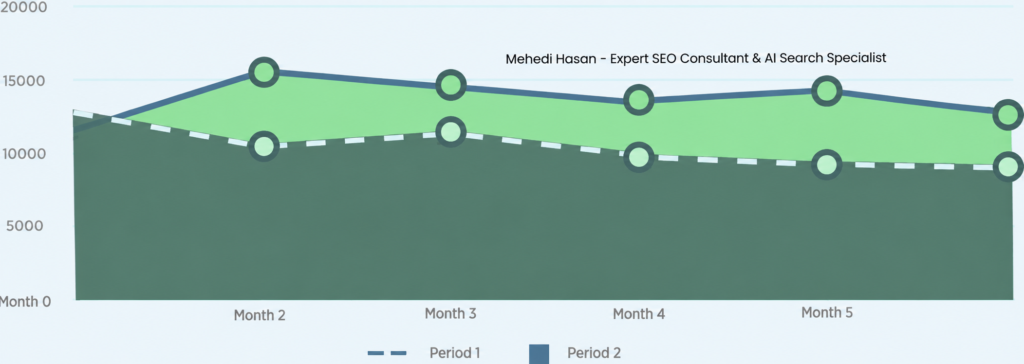
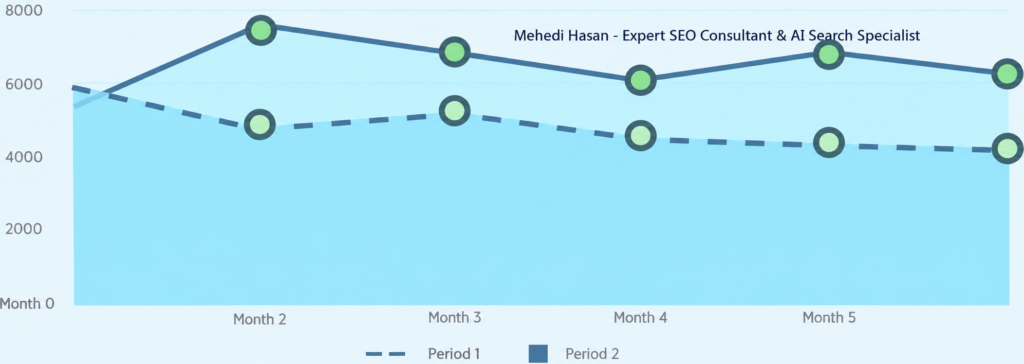
Traffic growth was not treated as the primary measure of success.
For an e-commerce business, the SEO campaign ultimately needed to generate transactions.
During the campaign, organic search produced approximately:
1,200 Additional Organic Transactions
This demonstrated that the increase in search visibility was attracting commercially relevant users rather than generating traffic without purchase intent.
The relationship between the strategy and commercial performance can be summarised as:
Better Content
↓
Broader Keyword Visibility
↓
More Qualified Organic Traffic
↓
More New Customers
↓
More Transactions
↓
Higher Organic Revenue
Revenue Impact
The strongest commercial outcome of the project was the growth in revenue attributable to organic search.
The client recorded approximately:
$200,000 in Additional Year-Over-Year Organic Search Revenue
This demonstrated that SEO was functioning as a revenue acquisition channel rather than simply a traffic-generation activity.
By improving visibility across informational and commercial searches, the campaign created multiple opportunities to introduce potential customers to the business before they reached the final purchasing stage.
Performance Summary
| KPI | Result |
| Organic Sessions | +29% |
| New Organic Users | +35% |
| Additional Organic Transactions | +1,200 |
| Keyword Ranking Growth | +67% |
| YoY Organic Revenue Growth | +$200,000 |
Why the Strategy Worked
Several factors contributed to the campaign’s success.
Search Intent Was Prioritised
The strategy targeted users according to what they were actually searching for rather than attempting to force a limited set of keywords onto existing pages.
Organic Reach Expanded Beyond the Brand
Targeting non-branded keywords opened the website to consumers who had never previously interacted with the company.
Content Supported the Entire Buying Journey
Educational content attracted users during research, while commercial pages captured demand closer to purchase.
Trust Was Treated as an SEO Requirement
Because the website operated in a health-related YMYL environment, credibility and information quality were incorporated into the SEO strategy rather than treated as secondary considerations.
Authority Supported Content Growth
Relevant backlinks strengthened the website’s ability to compete for valuable organic search positions.
Commercial Metrics Defined Success
Traffic and rankings were monitored, but transactions and revenue remained the primary measures of business impact.
Conclusion
This project demonstrates how a structured SEO strategy can create measurable commercial growth for an e-commerce business operating within a competitive YMYL market.
By improving existing content, developing useful educational resources, expanding non-branded keyword coverage, strengthening website authority, and aligning SEO activity with customer search behaviour, Mehadi Hasan helped transform organic search into a stronger customer acquisition channel.
Over six months, the campaign produced:
29% more organic sessions, 35% more new organic users, 1,200 additional organic transactions, 67% keyword ranking growth, and approximately $200,000 in additional year-over-year organic search revenue.
The key lesson from the project is straightforward:
Successful e-commerce SEO is not measured by rankings alone. It should increase qualified visibility, attract new customers, generate transactions, and contribute directly to revenue.