

Executive Summary
Breaking through a competitive consumer market requires more than publishing content and targeting popular keywords. It requires a search strategy that connects audience intent, product positioning, and long-term organic visibility.
This case study examines an SEO growth campaign for a direct-to-consumer alcoholic beverage brand operating in a highly competitive market.
The business initially struggled to attract meaningful organic traffic despite publishing informative content. Its existing approach did not sufficiently address the search behavior of its target audience, particularly consumers interested in health-conscious beverage choices.
The campaign focused on identifying underserved keyword opportunities, improving content relevance, developing an educational content strategy, and gradually strengthening the website’s search authority.
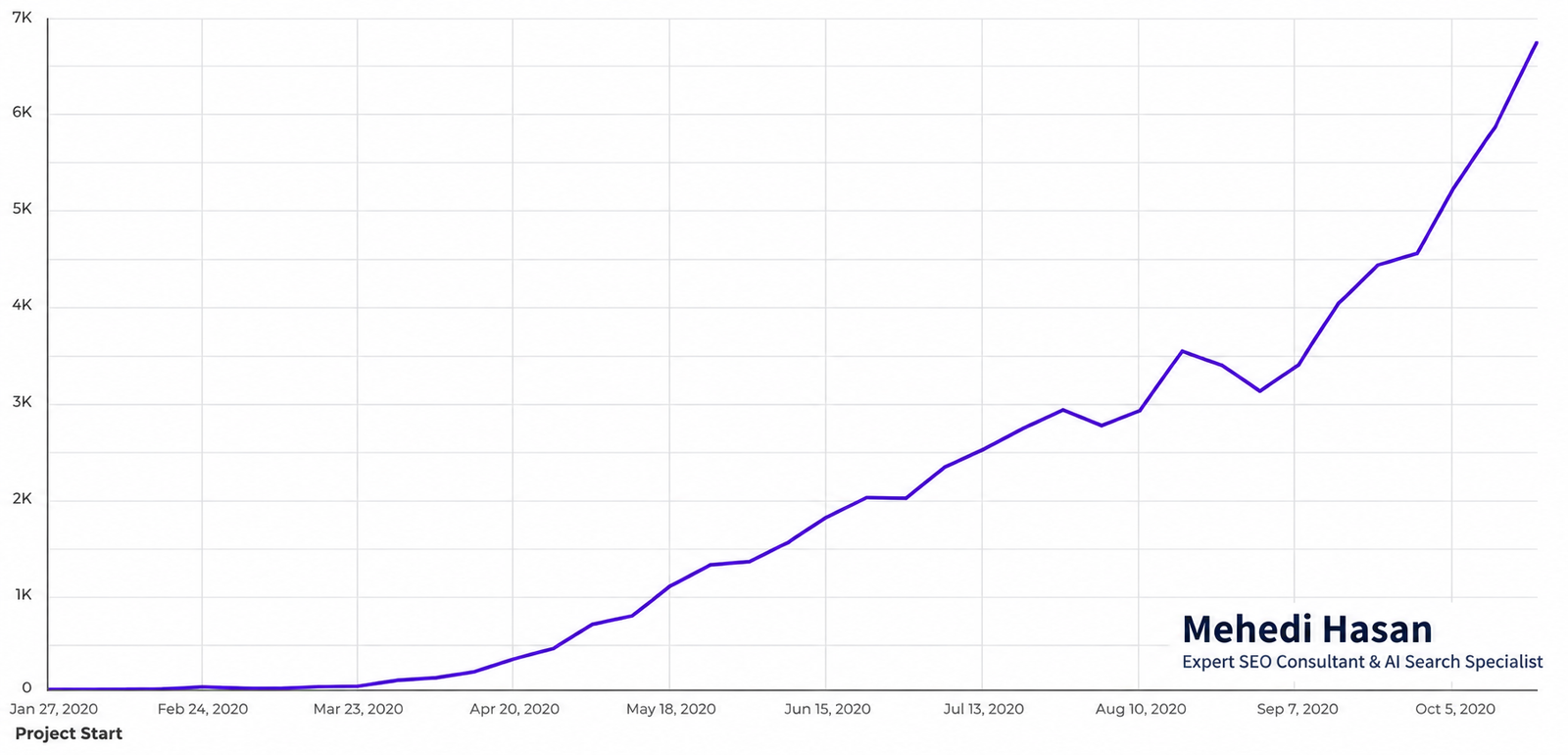
The reported outcome was a fourfold increase in monthly organic sessions within three months, followed by continued growth over the subsequent five months.
1. Campaign Results at a Glance
| Performance Indicator | Reported Result |
| Initial Monthly Organic Sessions | 2,000 |
| Monthly Organic Sessions After 3 Months | 8,000 |
| Initial Traffic Growth | 4x (+300%) |
| Reported Monthly Traffic at Month 6 | 16,000 |
| Reported Monthly Traffic at Month 8 | 22,000 |
| Revenue From One Blog Post | Over $1,000 per month |
The results illustrate how targeted organic search optimization can create sustained growth beyond the initial campaign period.
2. Client Background
The client was a direct-to-consumer beverage business specializing in alcoholic products positioned toward a health-conscious audience.
The brand operated in an established industry where larger competitors and authoritative publishers dominated many informational search queries.
Although the company had an existing website and published educational content, its organic visibility remained limited.
The central opportunity was to connect the brand’s product positioning with relevant consumer questions, especially those underserved by broader beverage industry content.
Primary Business Objective: Build a scalable organic acquisition channel capable of attracting relevant audiences, increasing brand discovery, and supporting revenue growth.
3. The Challenge: Competing in a Saturated Search Market
The campaign faced three interconnected challenges.
Challenge 1: Strong Competition for High-Volume Keywords
The beverage industry contained numerous established websites targeting popular topics and broad search terms.
Competing directly for these keywords offered limited short-term opportunities for a brand with relatively modest organic visibility.
Challenge 2: Insufficient Alignment With Search Intent
The brand’s content was informative, but it did not consistently match the specific questions and interests of its intended audience.
This reduced its ability to attract users searching for relevant information before making purchasing decisions.
Challenge 3: Limited Organic Content Reach
With approximately 2,000 monthly organic sessions at baseline, the business needed a more focused acquisition strategy.
Publishing additional generic content without addressing keyword competition and user intent was unlikely to deliver the desired growth.
The campaign therefore required a more selective approach to content planning and search visibility.
4. SEO Strategy: A Targeted, Content-Led Growth Framework
The strategy combined niche keyword targeting, educational content, progressive keyword expansion, and authority development.
Phase 1: Niche Keyword Research and Opportunity Identification
The priority was to identify keyword opportunities aligned with the brand’s market positioning.
Instead of initially competing for broad, high-difficulty beverage keywords, the strategy prioritized more specific searches with relatively lower competition.
Particular attention was given to queries relevant to health-conscious consumers and practical beverage-related questions.
Strategic Priorities:
- Identify lower-competition search opportunities.
- Target relevant long-tail keywords.
- Match content topics to audience interests.
- Establish topical relevance before pursuing broader competitive terms.
This approach was designed to create early visibility while developing a stronger foundation for future growth.
Phase 2: Content Strategy and Editorial Planning
The next stage involved restructuring the content approach around a more deliberate editorial calendar.
Content topics were selected to balance broader search demand with specific long-tail opportunities.
Rather than treating every article as an isolated publication, the strategy aimed to build a more coherent library of useful, audience-focused resources.
Content Development Priorities:
- Create articles addressing specific consumer questions.
- Balance informational topics with commercially relevant audience interests.
- Use accessible explanations rather than overly technical language.
- Prioritize evergreen topics capable of attracting traffic over time.
This helped shift the website’s content from general information toward more purposeful organic search acquisition.
Phase 3: Educational Content and Topical Relevance
Educational content became an important part of the campaign.
The strategy addressed practical topics that could attract readers beyond a narrow group of beverage enthusiasts.
Examples mentioned in the original campaign included:
Cooking With Alcohol
Content addressing how alcohol is used in food preparation and related practical questions.
Storing Alcohol
Evergreen informational content focused on storage practices and common consumer questions.
These topics offered opportunities to attract searchers with clear informational needs while supporting the brand’s broader topical relevance.
The emphasis was on publishing useful material that remained relevant beyond short-lived trends.
Phase 4: Progressive Keyword Expansion
As the website gained organic visibility, the campaign expanded beyond its initial low-competition keyword targets.
The strategy gradually incorporated more competitive search terms.
This staged approach allowed the brand to pursue broader search opportunities after building an initial base of relevant content and visibility.
The progression followed a straightforward principle:
Start with achievable keyword opportunities, establish search visibility, and expand into more competitive topics as the website develops.
Phase 5: Strategic Link Building
Link building was introduced as another component of the campaign.
The objective was to strengthen the website’s authority and support its ability to compete for more demanding search queries.
The original case study identifies strategic link building as part of the implementation, although it does not specify the number, type, or source of backlinks acquired.
5. Campaign Performance and Measurable Results

First Three Months: Organic Traffic Increased Fourfold
At the beginning of the campaign, the website recorded approximately 2,000 monthly organic sessions.
By the third month, that figure had reached approximately 8,000.
Traffic Growth Calculation:
(8,000 − 2,000) ÷ 2,000 × 100 = 300% growth
This represented a fourfold increase compared with the initial traffic baseline.
The early growth was associated with a more focused keyword strategy and the publication of content aligned with relevant search opportunities.
Month Six: Continued Organic Growth
By the sixth month, the original case study reported approximately 16,000 monthly visitors.
This was equivalent to eight times the original numerical traffic baseline, although the source did not confirm whether the same analytics metric was used.
The result suggested that the campaign’s organic growth continued beyond its initial three-month period.
Month Eight: Reaching 22,000 Monthly Visitors
By month eight, reported monthly traffic had reached approximately 22,000 visitors.
Compared numerically with the initial figure of 2,000, this represented an elevenfold increase.
The progression demonstrated sustained reported growth across the campaign period rather than a single short-term increase.
Revenue Contribution From Organic Content
The original case study also reported that one blog article generated more than $1,000 in monthly revenue.
This result is particularly relevant because it connects the content strategy with a commercial outcome rather than traffic growth alone.
However, the published source does not provide the conversion data, attribution model, or revenue records needed to independently validate this figure.
6. Why the SEO Strategy Was Effective
Several elements of the campaign contributed to its reported success.
Audience-Specific Keyword Targeting
The strategy prioritized topics relevant to the intended customer base instead of pursuing search volume without considering audience fit.
Lower-Competition Entry Points
Beginning with more achievable keyword opportunities provided a practical route toward early organic visibility.
Evergreen Educational Content
Practical informational resources created opportunities for continued search discovery beyond their initial publication dates.
Progressive Search Expansion
The campaign expanded toward more competitive keywords after establishing an initial foundation of organic visibility.
Authority Development
Strategic link building supported the broader objective of improving the website’s ability to compete in organic search.
Together, these activities formed a phased SEO approach focused on both near-term acquisition and longer-term organic growth.
7. Key Business Outcomes
The published campaign results indicate four main business outcomes.
- Increased Organic Discoverability
The brand reached a substantially larger audience through unpaid search results.
- Improved Audience Relevance
The content strategy became more closely aligned with the interests and informational needs of its target customers.
- Greater Organic Acquisition Potential
The website developed a broader library of search-focused content capable of attracting visitors over time.
- Demonstrated Revenue Potential
The reported performance of an individual blog post suggested that organic educational content could contribute directly to commercial results.
8. Key Takeaways for D2C and E-commerce Brands
This case study highlights the importance of focusing on the right search opportunities rather than attempting to rank for every high-volume keyword.
For D2C businesses, effective SEO often begins by understanding the specific problems, interests, and questions of the intended audience.
A focused editorial strategy, supported by keyword research and consistent content development, can help smaller brands compete in established markets.
The campaign also demonstrates the value of measuring organic search performance beyond the first few months. Content can continue contributing to traffic and business outcomes after its initial publication.
9. Final Conclusion
The D2C beverage SEO campaign illustrates how a focused content-led search strategy can support substantial organic traffic growth in a competitive consumer market.
The published results describe an increase from 2,000 to 8,000 monthly organic sessions within three months, followed by reported growth to 22,000 monthly visitors by month eight.
The campaign’s central strengths were its audience-focused keyword selection, practical educational content, phased targeting approach, and investment in search authority.
For brands seeking sustainable organic growth, the case demonstrates the potential value of connecting search demand with meaningful, relevant content.