

Executive Summary
Launching a new website in a competitive industry requires more than publishing content. It demands a clear search engine optimization strategy, a technically sound website, and consistent content development aligned with user search intent.
This case study examines how a newly launched gig economy platform reportedly grew from zero traffic to more than 105,000 monthly visitors within six months.
The growth approach centered on three core areas: establishing an SEO-friendly website structure, identifying valuable search opportunities, and building an extensive library of relevant content.
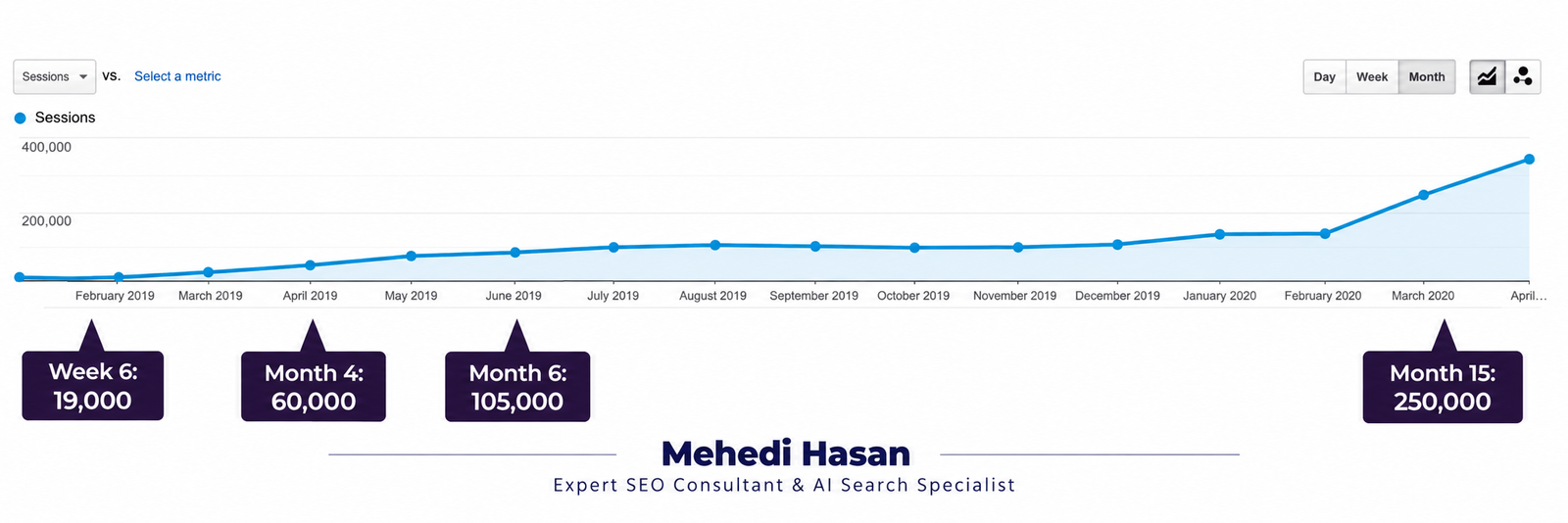
The original published account reports that the platform launched with 75 optimized articles, reached 19,000 sessions within six weeks, and achieved 60,000 visitors by the fourth month. By month six, reported monthly traffic exceeded 105,000 visitors.
The project illustrates how a content-led SEO strategy can support rapid audience acquisition for a new digital platform.
1. Project Background
The client was an emerging online platform operating in the gig economy sector.
Its intended audience included independent contractors, freelancers, gig workers, and individuals seeking information about flexible employment opportunities.
As a new entrant, the platform had to compete with established websites that already possessed substantial content libraries, brand recognition, and search engine visibility.
The business needed to establish a presence in organic search while developing a scalable foundation for long-term growth.
Primary business objective: Reach approximately 100,000 monthly website visitors within six months of launch.
2. The Business Challenge
The platform faced several barriers to attracting an audience through search engines.
Limited existing visibility
As a newly launched website, it had no established traffic history and needed to build visibility for relevant searches.
Competitive search environment
The gig economy market included established publishers and employment-related platforms competing for similar search queries.
Need for extensive topical coverage
A small number of general articles would not adequately address the variety of questions and information needs within the gig economy audience.
Aggressive growth timeline
The six-month target required a coordinated launch and consistent execution rather than relying on gradual, unstructured content publishing.
The central challenge was to create a website capable of attracting search traffic at scale within a relatively short period.
3. SEO Strategy and Planning
The published approach focused on building the website’s search foundation before launch and expanding content coverage systematically.
3.1 SEO-Friendly Website Architecture
The first strategic priority was to establish a website structure that supported both users and search engine discovery.
The original account identifies site structure, navigation, and metadata optimization as important considerations.
The purpose was to reduce foundational SEO issues and support the discovery of new content as the website expanded.
A clear site architecture also made it easier to organize information around the needs of the intended audience.
3.2 Keyword Research and Search Intent
Keyword research was central to the growth strategy.
Rather than targeting only broad, high-volume search terms, the approach included niche queries relevant to gig economy workers.
This created opportunities to address specific user questions alongside more competitive industry topics.
The strategy combined:
- Broad industry-related search topics
- Niche and long-tail keyword opportunities
- Informational queries relevant to gig workers
- Content topics aligned with audience interests
The objective was to develop a sufficiently broad keyword portfolio to attract visitors through multiple relevant search queries.
3.3 Content-Led Growth Strategy
Content production was the main engine of the reported growth.
Before launch, the strategy called for publishing a substantial collection of optimized articles to give the website immediate topical coverage.
The platform reportedly launched with 75 SEO-optimized articles.
The original case study also describes a planned publishing pace of approximately five articles per week.
This approach emphasized consistent publication and comprehensive coverage of relevant topics.
3.4 Broad Topical Coverage
A distinguishing feature of the strategy was its emphasis on covering a wide range of gig economy subjects.
The intention was to create useful content for many different search queries instead of depending on a small number of high-traffic keywords.
This approach increased the number of potential organic entry points to the website.
By combining broad subjects with specialized topics, the platform aimed to reach users at different stages of their information-seeking journey.
4. Implementation Approach
The project can be understood through three broad implementation phases based on the published account.
Phase 1: Pre-Launch Preparation
The initial phase focused on building the website’s SEO foundation.
Activities described in the source included website structure planning, navigation optimization, keyword targeting, and preparation of the initial content library.
The platform launched with 75 optimized articles, providing a substantial starting point for search visibility.
Phase 2: Early Traffic Acquisition
Following launch, the focus shifted toward attracting visitors through the published content.
Within approximately six weeks, the platform reportedly recorded 19,000 sessions.
This early milestone indicated that the website was beginning to attract an audience, although the published account does not provide channel-level analytics to establish the exact proportion attributable to organic search.
Phase 3: Content Expansion and Growth
The later stages emphasized continued content publication and optimization.
By the fourth month, reported traffic reached approximately 60,000 visitors.
By the sixth month, the platform reportedly exceeded 105,000 monthly visitors, surpassing its initial target.
The source describes continued content expansion as an important component of the growth approach.
5. Performance Results
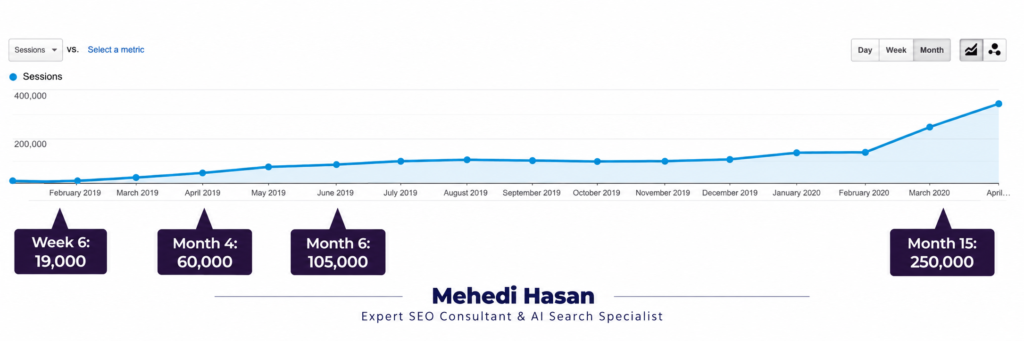
The following figures are drawn from the original published case study.
| Performance Indicator | Reported Result |
| Starting traffic | Zero |
| Initial content library | 75 articles |
| Planned publishing frequency | Five articles per week |
| Traffic after six weeks | 19,000 sessions |
| Traffic by month four | 60,000 visitors |
| Traffic by month six | 105,000+ visitors |
| Initial traffic target | 100,000 monthly visitors |
| Reported target achievement | More than 105% |
Performance Interpretation
The platform reportedly exceeded its six-month visitor target by at least 5,000 monthly visitors.
The progression from 19,000 sessions after six weeks to more than 105,000 reported monthly visitors by month six suggests substantial audience growth.
However, the figures should be interpreted carefully because the original report uses both sessions and visitors, which are not interchangeable measurements.
Without supporting analytics, it is also not possible to calculate verified organic traffic growth, conversion rates, or the contribution of individual SEO activities.
6. Key Strategic Insights
Build the SEO Foundation Before Scaling
Establishing an organized website structure before publishing large volumes of content can reduce avoidable SEO problems and make future expansion easier.
Combine Broad and Niche Keywords
A diversified keyword strategy can create more opportunities for visibility than relying exclusively on highly competitive search terms.
Prepare Content Before Launch
Launching with a substantial library of relevant articles can provide more potential entry points for users than beginning with only a few pages.
Maintain Consistent Content Development
Regular publishing helps expand the range of topics a website addresses and creates additional opportunities to attract relevant visitors.
Measure Growth Against Business Objectives
A clearly defined target provides a useful benchmark for evaluating progress. In this case, the reported six-month traffic result exceeded the initial objective.
7. Business Impact
The principal documented outcome was rapid website audience growth.
The platform reportedly progressed from a new website with no existing traffic to one attracting more than 105,000 monthly visitors within six months.
This represented a significant increase in potential audience reach for a new entrant in the gig economy sector.
The original account does not disclose revenue, lead generation, user registrations, customer acquisition costs, or conversion rates. Consequently, the financial impact of the traffic growth cannot be quantified.
Nevertheless, the reported results demonstrate the potential reach of a structured content and SEO program.
8. Conclusion
This case study illustrates how a newly launched platform can use structured SEO planning, targeted keyword research, and consistent content development to pursue ambitious audience growth objectives.
The reported six-month outcome exceeded the initial traffic target and demonstrated the value of building a substantial content foundation before launch.
The central lesson is that successful SEO growth requires coordinated planning across website architecture, search demand, content production, and ongoing optimization.
For businesses entering competitive digital markets, these principles offer a practical framework for developing a scalable organic search strategy.