

01. Executive Summary
For orthodontic practices, attracting new patients increasingly depends on being visible when people search online for treatments, specialists, and dental care providers in their area.
This case study examines a strategic SEO approach designed to improve an orthodontic clinic’s online presence through technical improvements, service-page optimization, locally relevant content, and better alignment with patient search intent.
The central objective was to create a stronger connection between the clinic’s services and the prospective patients actively searching for orthodontic treatment.
Rather than focusing exclusively on website traffic, the proposed strategy prioritized relevant search visibility, patient engagement, and measurable appointment-related conversions.
02. The Challenge: Competing for Visibility in a Local Healthcare Market
Orthodontics is a competitive area of healthcare marketing. Prospective patients frequently compare multiple providers before choosing where to book an initial consultation.
Search queries such as “orthodontist near me,” “Invisalign treatment,” “braces for adults,” and “children’s orthodontist” represent valuable opportunities to connect with patients who are considering treatment.
The SEO assessment framework focused on five potential barriers:
Limited local search visibility
A clinic may struggle to appear prominently for relevant treatment and location-based searches, reducing its exposure to prospective patients.
Underoptimized treatment pages
Service pages that lack comprehensive, patient-focused information may fail to address important questions about treatment options, suitability, processes, and consultations.
Technical SEO limitations
Indexing problems, inefficient site architecture, mobile usability issues, and slow-loading pages can restrict organic search performance.
Insufficient local authority signals
Incomplete business information, inconsistent directory listings, and weak location relevance can make it harder for search engines to understand the clinic’s local presence.
Weak conversion pathways
Even when visitors reach the website, unclear appointment calls to action or difficult navigation can reduce consultation inquiries.
These areas formed the basis of the proposed SEO improvement strategy. The original project’s specific audit findings require verification.
03. Strategic Objectives
The campaign framework was designed around four business priorities:
- Increase relevant organic visibility: Strengthen rankings for orthodontic treatments and local search queries.
- Improve qualified website traffic: Attract people researching orthodontic services and considering treatment.
- Strengthen local search presence: Improve the clinic’s discoverability through Google Search, Google Maps, and consistent business information.
- Support patient acquisition: Make it easier for prospective patients to find relevant treatment information and request consultations.
04. SEO Strategy and Implementation Framework
Phase 1: Comprehensive SEO Audit
The first stage involved defining a structured assessment of the website’s technical health, search performance, and content quality.
Priority audit areas included:
- Index coverage and crawl accessibility.
- XML sitemap and robots.txt configuration.
- Canonical tags and duplicate content.
- Mobile usability and Core Web Vitals.
- Page titles, meta descriptions, and heading structure.
- Internal linking between treatment and supporting pages.
- Existing organic keyword visibility and landing-page performance.
The purpose was to identify issues with the greatest potential impact on search visibility and prioritize corrective actions.
Phase 2: Patient-Intent Keyword Research
Orthodontic SEO requires understanding the different stages of a patient’s decision-making process.
The keyword strategy organized search terms into three categories.
Treatment-focused keywords
Examples include “Invisalign treatment,” “ceramic braces,” “traditional braces,” and “adult orthodontic treatment.”
Location-focused keywords
Examples include “orthodontist in [city],” “braces specialist near me,” and “Invisalign provider in [location].”
Informational keywords
Examples include “How long does Invisalign take?”, “Braces vs. Invisalign,” and “What age should a child see an orthodontist?”
This approach was intended to connect service pages with commercial and appointment-related searches while using educational content to reach patients earlier in their research.
Phase 3: Treatment Page Optimization
Treatment pages are central to an orthodontic clinic’s organic acquisition strategy.
The recommended optimization framework included:
- Clear, descriptive page titles and headings.
- Unique content for each major orthodontic service.
- Patient-friendly explanations of treatment options.
- Relevant questions and answers.
- Internal links to consultations and related services.
- Clear appointment-booking calls to action.
- Appropriate structured data where supported and applicable.
The emphasis was on creating useful content that helps patients make informed decisions, rather than repeating keywords unnecessarily.
Phase 4: Local SEO and Google Business Profile Optimization
Local visibility was treated as a critical component of the strategy.
Recommended improvements included reviewing the clinic’s Google Business Profile, confirming accurate contact information, selecting relevant business categories, and ensuring consistency across reputable local directories.
Location-specific website content would reinforce the clinic’s geographical relevance.
The strategy also included encouraging authentic patient reviews through appropriate, privacy-conscious processes, without offering incentives or attempting to influence review sentiment.
Phase 5: Healthcare Content Development
Educational content can help an orthodontic clinic address patient questions before an appointment.
The proposed content plan focused on clinically reviewed topics covering orthodontic treatments, patient preparation, treatment expectations, and common concerns.
Each article would be developed around a clear search intent and connected to the relevant treatment page.
Because orthodontic information can influence healthcare decisions, clinical accuracy, professional review, and transparent authorship are essential.
Phase 6: Internal Linking and User Experience
The website structure would be reviewed to help users navigate between educational resources, treatment pages, provider information, and consultation options.
This included improving contextual internal links, reducing unnecessary navigation steps, and ensuring that appointment information was easy to find on mobile devices.
The objective was to support both search engine discovery and a clearer patient journey.
05. Performance Measurement and Results
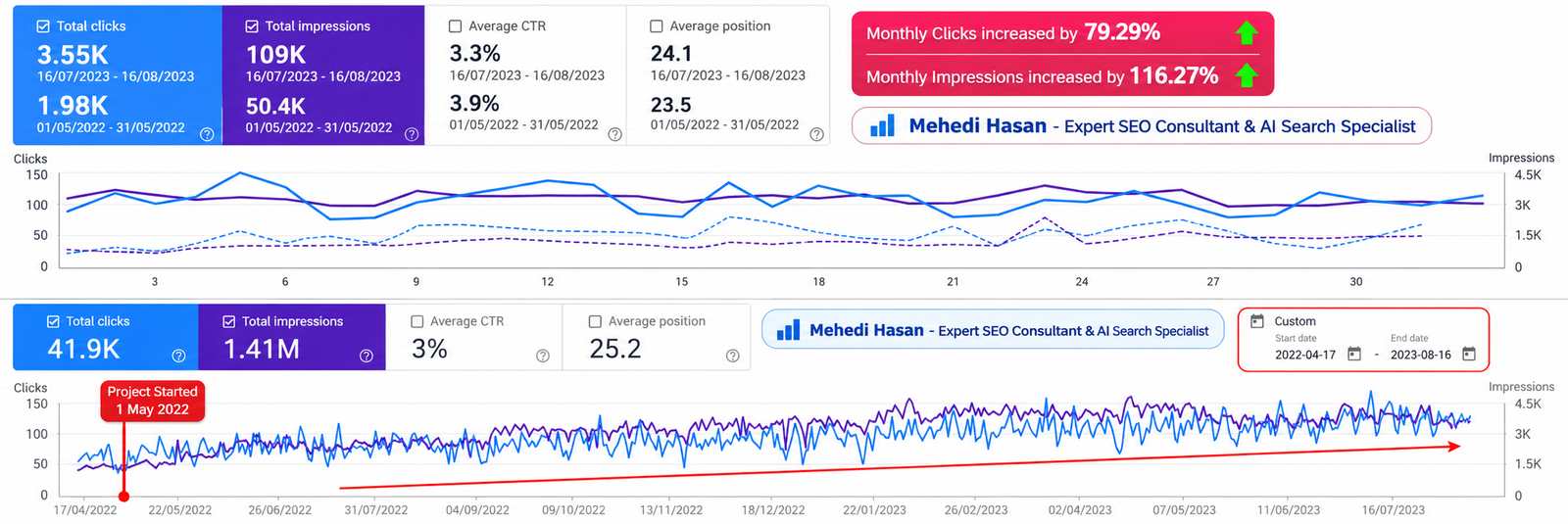
A credible SEO case study should distinguish between work completed, changes observed, and outcomes that can reasonably be attributed to the campaign.
The following metrics should be reported using verified Google Search Console, Google Analytics 4, Google Business Profile, and appointment-tracking data.
06. Business Impact
The commercial value of orthodontic SEO extends beyond higher search rankings.
A well-executed strategy can make a clinic more discoverable when prospective patients search for relevant treatment, provide clearer information during their decision-making process, and create more opportunities for consultation requests.
For this project, the business impact should ultimately be assessed through verified organic inquiries, booked consultations, and, where available, new-patient acquisition data.
These outcomes should not be presented as achieved results until the supporting evidence is confirmed.
07. Key Strategic Insights
Search intent is more valuable than traffic volume alone.
A visitor searching for a specific orthodontic treatment in the clinic’s service area may be more commercially relevant than a visitor researching a broad dental topic.
Treatment pages need both clinical relevance and search clarity.
Clear service descriptions, accurate medical information, and helpful explanations support a better patient experience.
Local SEO requires consistent information.
Website location signals, business profiles, and reputable citations should present accurate and consistent clinic details.
Technical SEO supports content performance.
Search engines must be able to discover, crawl, and index important pages before those pages can compete effectively in organic results.
Patient acquisition requires conversion measurement.
Keyword rankings and traffic are useful indicators, but consultation inquiries and booked appointments provide stronger evidence of business value.
08. Conclusion
An orthodontic clinic’s SEO strategy should connect technical website performance, high-quality treatment information, local search relevance, and a straightforward patient experience.
This case study presents a structured approach to improving those areas through targeted keyword research, treatment-page optimization, technical SEO, local visibility improvements, and performance measurement.
The intended outcome is a more discoverable, informative, and conversion-focused website that supports the clinic’s long-term patient acquisition goals.
Verified campaign results should be added before publishing this document as a completed client success story.