

1. Executive Summary
Expanding an established e-commerce business into international markets requires more than translating product descriptions or launching shopping campaigns. It demands a coordinated strategy that addresses regional search behavior, product visibility, customer trust, and the overall shopping experience.
This case study examines how an integrated Google Shopping and international SEO strategy helped an established e-commerce brand improve its global search presence and organic conversion performance.
Despite having an established domestic presence, the business had limited visibility across international markets. Its existing approach was not fully optimized to reach customers in different geographic regions.
The campaign focused on identifying promising markets, optimizing product data, improving localized search visibility, strengthening customer trust, and enhancing the mobile shopping experience.
Key Performance Results
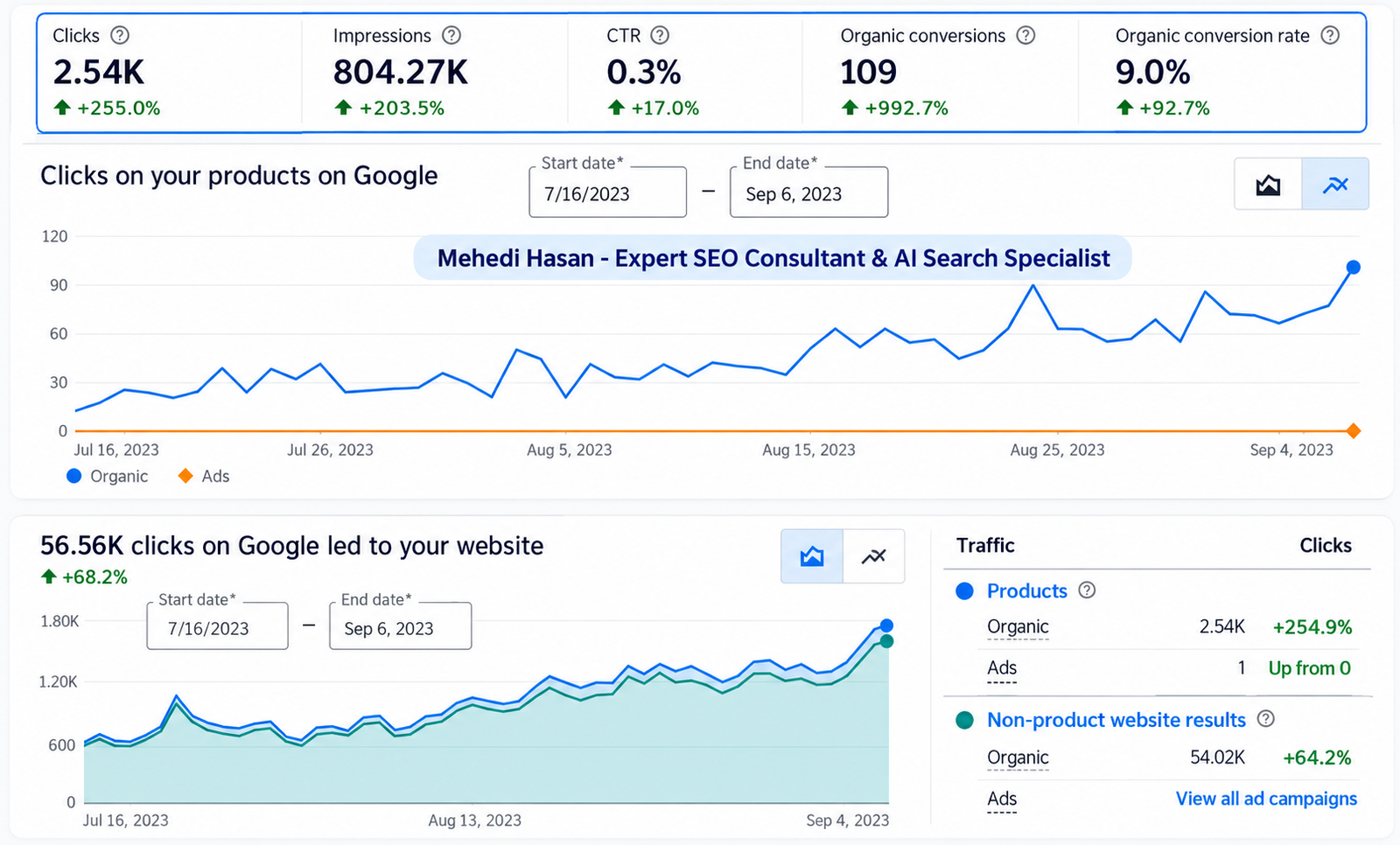
Over a period of just over two months, the campaign reported:
- 992% increase in organic conversions
- 255% increase in clicks
- 203% increase in impressions
These results demonstrate the potential impact of coordinating product feed optimization, international SEO, localized content, and ongoing performance analysis.
2. Client Background
The client was an established e-commerce brand offering a diverse product portfolio.
Although the business had developed a solid presence in its domestic market, it had not achieved comparable visibility or customer acquisition in international markets.
The company recognized an opportunity to expand its reach and attract customers beyond its existing geographic audience.
However, entering new markets introduced several challenges, including regional search preferences, language differences, product discovery, and consumer trust.
The project therefore required a coordinated approach to international product visibility and organic search performance.
3. Business Challenges
The initial assessment identified several areas requiring strategic attention.
Limited International Search Visibility
The brand’s domestic presence was not translating into equivalent visibility across international search markets.
A market-specific optimization strategy was needed to improve product discoverability among overseas customers.
Insufficient Localization
Product listings and website content needed to reflect the language, terminology, and purchasing preferences of different regional audiences.
Without effective localization, the brand risked attracting less relevant traffic and missing opportunities to connect with potential buyers.
Product Feed Optimization Requirements
Google Shopping performance depends heavily on the accuracy, completeness, and relevance of product information.
Product titles, descriptions, attributes, and feed structure required optimization to support stronger product discovery across target markets.
Building Trust in New Markets
Customers encountering an unfamiliar international retailer may hesitate to purchase without adequate trust signals.
Customer reviews and reputation management were therefore important elements of the expansion strategy.
Mobile Shopping Experience
A smooth mobile experience was essential to support customers browsing products and completing purchases on smartphones.
The project needed to address mobile usability alongside visibility and traffic acquisition.
4. Project Objectives
The primary objective was to strengthen the client’s international e-commerce presence while increasing qualified organic traffic and conversions.
Specific goals included:
- Identify international markets with meaningful growth potential.
- Improve product visibility through Google Shopping optimization.
- Strengthen organic rankings for relevant regional search queries.
- Develop localized product and website content.
- Improve product feed quality and consistency.
- Strengthen customer confidence through reviews and trust signals.
- Enhance mobile shopping usability.
- Monitor performance and refine the strategy using campaign data.
5. Strategy and Implementation
The campaign combined technical optimization, international keyword research, localized content, Google Shopping improvements, and ongoing performance monitoring.
Phase 1: International Market Research and Opportunity Analysis
The first stage focused on identifying international markets where the client’s products had potential to attract relevant customers.
The market analysis helped establish priorities for international expansion and informed subsequent SEO and product listing decisions.
The strategic focus was on aligning product offerings with the needs and search behavior of prospective customers in different markets.
Strategic purpose: Prioritize relevant international audiences instead of relying on a broad, undifferentiated global targeting approach.
Phase 2: Google Shopping Account and Product Listing Optimization
Google Shopping was a central component of the international visibility strategy.
The campaign involved establishing and refining Google Shopping accounts and adapting product listings to the requirements of different regional markets.
Optimization activities included:
- Refining product titles to improve clarity and search relevance.
- Improving product descriptions with useful product information.
- Adapting product listing language to regional preferences.
- Aligning product presentation with the expectations of target audiences.
- Improving the overall quality and relevance of shopping listings.
Strategic purpose: Make products easier to discover and more relevant to customers searching across international markets.
Phase 3: Product Feed Structure and Data Optimization
A structured product feed was essential to supporting international Google Shopping visibility.
The optimization process focused on improving the organization and quality of product data in accordance with relevant Google Shopping requirements and best practices.
The work emphasized consistency, relevance, and completeness across product information.
Strategic purpose: Improve the quality of product information supplied to Google, supporting more effective product matching and visibility.
Phase 4: International Keyword Research and On-Page SEO
Alongside Google Shopping improvements, the campaign implemented international SEO initiatives to strengthen organic search visibility.
Keyword research focused on understanding relevant search queries across target markets.
On-page optimization was then used to improve the alignment between website content, product pages, and user search intent.
The approach included:
- Researching relevant keywords for international audiences.
- Improving on-page content relevance.
- Optimizing product-related content for organic discovery.
- Aligning page content with regional search preferences.
- Strengthening the relationship between search queries and landing-page content.
Strategic purpose: Build organic search visibility that could complement shopping campaign activity and support longer-term customer acquisition.
Phase 5: Localized Content Development
The content strategy focused on creating informative and relevant material for customers in different markets.
Rather than treating international audiences as a single customer group, the campaign adapted content to regional expectations and preferences.
This helped improve the relevance of product information and the overall customer experience.
Strategic purpose: Connect product messaging with local customer needs and strengthen the relevance of the website for international searches.
Phase 6: Customer Reviews and Trust Building
Establishing credibility was an important part of entering new markets.
The campaign incorporated a strategy for collecting and managing customer reviews across relevant platforms.
The objective was to make the brand more credible to potential buyers who had limited prior familiarity with the business.
Strategic purpose: Reduce uncertainty among new customers and support purchasing confidence.
Phase 7: Mobile Experience Optimization
Mobile usability was included as a core element of the campaign.
The optimization effort focused on creating a smoother shopping experience for visitors using mobile devices.
The intention was to support easier product discovery, browsing, and purchase completion.
Strategic purpose: Reduce mobile shopping friction and support conversion performance among international visitors.
Phase 8: Performance Monitoring and Continuous Refinement
The campaign used ongoing performance monitoring to evaluate market responses and refine optimization activities.
This approach allowed the strategy to adapt as new performance information became available.
The work emphasized continued adjustments rather than treating SEO and product feed optimization as one-time activities.
Strategic purpose: Use observed performance to guide ongoing improvements in visibility, traffic acquisition, and conversions.
6. Campaign Performance and Results

The campaign reported substantial performance improvements over just over two months.
| Performance Indicator | Reported Growth |
| Organic Conversions | +992% |
| Clicks | +255% |
| Impressions | +203% |
Organic Conversions: 992% Increase
The most significant reported outcome was a 992% increase in organic conversions.
This represents approximately 10.92 times the original conversion volume, assuming comparable measurement periods and attribution definitions.
The increase suggests that the campaign coincided with a substantial improvement in the website’s ability to generate conversion activity from organic visitors.
Clicks: 255% Increase
The campaign also reported a 255% increase in clicks.
This represents approximately 3.55 times the baseline click volume.
The improvement indicates stronger search engagement and increased traffic acquisition during the reporting period.
Impressions: 203% Increase
Search impressions increased by 203%, equivalent to approximately 3.03 times the baseline volume.
This indicates that the website or its listings appeared more frequently across measured search results.
The increase in impressions, alongside higher click volume, suggests that the campaign improved both visibility and user engagement.
Performance Interpretation
The combination of higher impressions, clicks, and organic conversions indicates positive performance across multiple stages of the customer acquisition process.
However, the published figures do not include absolute starting values, detailed channel-level reports, or a controlled attribution analysis.
Therefore, these improvements should be understood as reported campaign outcomes rather than independently established causal effects of any single optimization activity.
7. Business Impact
Expanded International Reach
The campaign strengthened the client’s visibility beyond its established domestic market.
The international SEO and Google Shopping approach created additional opportunities to reach customers in previously underdeveloped geographic markets.
Improved Product Discoverability
Optimized product listings, structured feed data, and localized content helped align the client’s products with relevant customer searches.
This supported the broader objective of improving visibility among prospective international buyers.
Stronger Organic Acquisition
The reported growth in clicks and organic conversions suggests improved customer acquisition performance through search.
The campaign demonstrated how product-level optimization and organic search improvements can work together within an international e-commerce strategy.
New Commercial Opportunities
The expansion strategy was intended to help the business access international demand and create additional revenue opportunities.
Although the original case study describes new revenue streams, it does not disclose verified revenue amounts, sales totals, or profitability figures.
8. Key Strategic Insights
International SEO Requires Market-Specific Execution
A successful international expansion strategy must account for regional search intent, language preferences, and customer expectations.
Market research and localization should guide optimization decisions.
Product Feed Quality Matters
Accurate and relevant product information plays an important role in Google Shopping visibility.
Feed optimization should be treated as an ongoing component of e-commerce search strategy.
Organic SEO and Google Shopping Can Complement Each Other
Google Shopping and organic SEO serve different but potentially complementary roles in customer acquisition.
An integrated strategy can improve product discovery across multiple search experiences, provided each channel is measured separately.
Customer Trust Supports International Expansion
Reviews, localized messaging, and a reliable shopping experience can help reduce hesitation among customers unfamiliar with an international brand.
Continuous Optimization Is Essential
Search performance changes over time.
Regular monitoring and adjustments help ensure that optimization efforts remain aligned with customer behavior and market conditions.
9. Conclusion
This case study illustrates the value of combining international SEO, Google Shopping optimization, localized content, product feed improvements, and customer experience enhancements into a coordinated e-commerce growth strategy.
Over just over two months, the campaign reported a 992% increase in organic conversions, a 255% increase in clicks, and a 203% increase in impressions.
The results highlight the commercial potential of a market-specific approach to international search visibility.
For e-commerce businesses seeking international growth, the central lesson is that product visibility, search relevance, localization, customer trust, and conversion experience should be managed as interconnected parts of the same strategy.