


Executive Summary
Breaking into Google’s first page for competitive commercial keywords is a significant challenge for e-commerce businesses, particularly in the fashion and accessories market.
This case study examines how a targeted SEO campaign helped a U.S.-based sunglasses retailer substantially improve its organic search performance within approximately two months.
Despite having an attractive website and a user-friendly shopping experience, the retailer struggled to achieve strong organic visibility for its primary non-branded keyword.
The campaign addressed this challenge through a coordinated approach involving technical SEO, keyword optimization, content improvements, internal linking, topical authority development, and customer trust signals.
Key Results
- Average Search Position: Improved from 40.9 to 8.6
- Search Impressions: Increased by 185%
- Organic Search Clicks: Increased by 212%
- Long-Tail Keyword Visibility: Additional related keywords reportedly reached first-page positions
- Campaign Duration: Approximately 60 days
These results illustrate how coordinated improvements across multiple SEO disciplines can contribute to meaningful search visibility gains within a relatively short period.
1. Client Background
The client was an established sunglasses e-commerce retailer operating in the United States.
The company offered products within a competitive online retail category where organic search visibility plays an important role in attracting potential customers.
Although the website provided an appealing visual experience and straightforward product navigation, its performance in organic search did not reflect the retailer’s commercial ambitions.
The primary challenge was to improve visibility for an important non-branded search term while building stronger relevance across related product and category pages.
For an e-commerce business, stronger rankings for relevant commercial keywords can increase exposure to potential customers who are actively researching or shopping for products.
2. The Business Challenge
The website faced several interconnected SEO challenges.
Limited visibility for a priority keyword
The primary target keyword had an average Google search position of 40.9 at the beginning of the campaign, placing it well outside the typical first-page range.
Competitive organic search environment
The sunglasses industry includes established retailers, fashion brands, marketplaces, and specialized online stores competing for similar search queries.
Need for stronger content relevance
The campaign identified opportunities to improve existing website content and align it more closely with relevant search intent.
Opportunities for better internal linking
A more deliberate internal linking structure was needed to strengthen relationships between important product, category, and supporting content pages.
Need for stronger customer trust signals
Customer reviews and related trust-building elements offered opportunities to improve the usefulness and credibility of key landing pages.
Project Objectives
The SEO campaign focused on four primary objectives:
- Improve the ranking of the main non-branded commercial keyword.
- Increase organic search impressions and clicks.
- Expand visibility across relevant long-tail search terms.
- Strengthen the website’s technical, content, and internal linking foundations.
3. SEO Strategy and Implementation
The campaign combined eight complementary areas of SEO improvement.
Phase 1: Comprehensive SEO Audit
The project began with a review of the website’s existing SEO performance.
The objective was to identify opportunities that could influence organic visibility and establish priorities for optimization.
The audit informed subsequent decisions involving keyword targeting, page optimization, content relevance, and website structure.
Phase 2: Strategic Keyword Optimization
Keyword optimization focused on the retailer’s primary non-branded search term and related keyword variations.
The strategy aimed to improve alignment between target queries, user search intent, and the content presented on important website pages.
This approach also supported broader visibility for semantically related search terms rather than concentrating exclusively on a single keyword.
Phase 3: On-Page and Technical SEO Improvements
The campaign included optimization of important metadata to better reflect target keywords and search intent.
These improvements helped establish clearer relevance signals for pages competing in organic search.
The original project documentation identifies metadata optimization as a technical SEO activity but does not provide a complete list of implemented technical changes.
Phase 4: Content Enhancement
Existing content was revised to better address user intent and relevant search topics.
The content strategy focused on improving the usefulness, clarity, and topical relevance of important website pages.
Rather than relying exclusively on additional content, the campaign also improved existing assets to support better search performance.
Phase 5: Topical Authority Development
Supporting content clusters were developed around the primary keyword and related topics.
This helped establish a more connected content structure, allowing supporting pages to reinforce the relevance of core commercial pages.
The objective was to build broader topical coverage and improve the website’s ability to appear for related searches.
Phase 6: Strategic Internal Linking
Internal links were improved across relevant product, category, and supporting content pages.
The strategy aimed to make important pages more discoverable, clarify relationships between related topics, and strengthen the website’s internal SEO structure.
For an e-commerce website, effective internal linking also helps users navigate between product discovery, category exploration, and supporting information.
Phase 7: User Behavior Analysis
The campaign incorporated user interaction insights to inform content improvements.
These observations were used to refine the website’s content strategy and better address the needs of search visitors.
The published documentation does not specify which analytics metrics or behavior-analysis tools were used.
Phase 8: Trust and Credibility Improvements
Customer reviews were incorporated more prominently into important product and landing pages.
This approach aimed to improve visitor confidence and provide additional information that could help shoppers evaluate products.
Customer reviews can strengthen the shopping experience and demonstrate authentic customer feedback, although their presence alone does not guarantee higher Google rankings.
4. Campaign Performance and Results
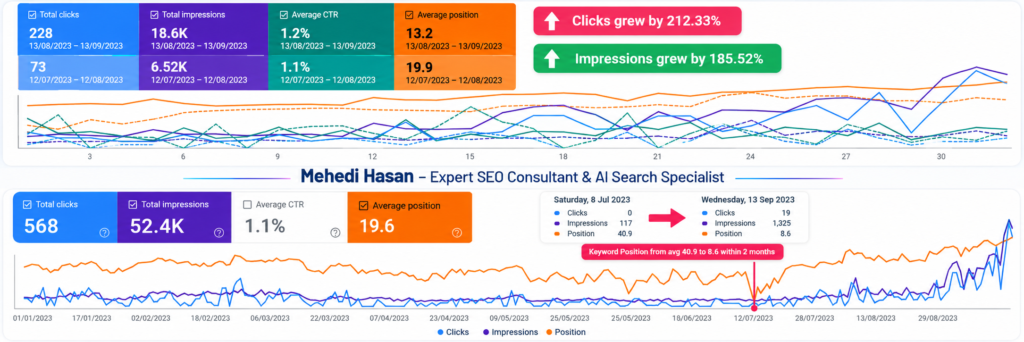
Following approximately two months of SEO activity, the project reported substantial improvements across its principal organic search metrics.
| Performance Metric | Initial Performance | Final Performance |
| Average Search Position | 40.9 | 8.6 |
| Search Impressions | Baseline | +185% |
| Organic Search Clicks | Baseline | +212% |
| Related Long-Tail Rankings | Not specified | Reported first-page visibility |
Ranking Improvement
The target keyword’s reported average search position improved from 40.9 to 8.6.
This represented an improvement of 32.3 average positions and brought the keyword’s average ranking into the numerical range typically associated with Google’s first page.
Search Visibility Growth
Search impressions increased by 185%, indicating that the website appeared substantially more frequently in Google search results during the measured comparison period.
Organic Traffic Growth
Organic search clicks increased by 212%, indicating a significant increase in visits originating from Google search results.
The combined increase in impressions and clicks suggests that the campaign improved both the website’s exposure in search results and the volume of search-driven visits.
Broader Keyword Performance
The campaign also reported improvements in related long-tail keyword rankings, with additional terms reaching first-page positions.
This result suggests that the improvements extended beyond the primary target keyword and supported a wider organic search presence.
5. Why the Strategy Was Effective
The campaign’s central strength was its coordinated approach.
Rather than treating keyword optimization, content quality, internal linking, and technical SEO as isolated tasks, the project addressed them as interconnected elements of search performance.
Three aspects of the strategy were particularly important:
Search intent alignment: Improving the relationship between target queries and page content helped make important pages more relevant to their intended audience.
Connected content architecture: Supporting content clusters and internal links established clearer relationships between informational and commercial pages.
Customer-focused improvements: Content refinement and visible customer reviews helped improve the quality of the website experience for prospective buyers.
Although the published results are consistent with an effective SEO campaign, the available evidence does not isolate the contribution of each activity.
6. Business Impact
The most clearly documented impact was improved organic search visibility.
Higher impressions increased the website’s exposure to potential customers, while additional organic clicks brought more search visitors to the retailer’s website.
The improved rankings also created opportunities to attract users searching for relevant products without relying entirely on paid advertising.
However, the published case study does not provide conversion, revenue, transaction, or customer acquisition cost data. Therefore, the commercial return on investment cannot be quantified from the available information.
7. Key Lessons
This project highlights several practical lessons for e-commerce SEO.
First, improving existing content and website structure can be an important component of an effective SEO strategy.
Second, targeting a priority keyword should be supported by related search terms and content that addresses the broader subject.
Third, internal linking deserves deliberate attention, particularly on websites with multiple product and category pages.
Finally, SEO performance should be evaluated through a combination of ranking, impression, traffic, and business outcome metrics rather than ranking positions alone.
Conclusion
This sunglasses e-commerce SEO campaign demonstrates how a focused, coordinated optimization strategy can produce substantial improvements in organic search performance over a relatively short period.
Within approximately 60 days, the project reported an improvement in average search position from 40.9 to 8.6, a 185% increase in search impressions, and a 212% increase in organic clicks.
The case illustrates the value of combining keyword targeting, content enhancement, technical optimization, internal linking, and customer trust signals within a unified SEO strategy.