

01. Executive Summary
Establishing a competitive online presence in the technology sector requires more than publishing content and targeting popular keywords. It demands a structured SEO strategy built around technical performance, search intent, content relevance, and website authority.
This case study examines how a consumer electronics company addressed its limited organic visibility through a coordinated nine-month SEO campaign.
The strategy focused on identifying high-potential keyword opportunities, improving existing content, developing new informational resources, strengthening the website’s backlink profile, and continuously evaluating search performance.
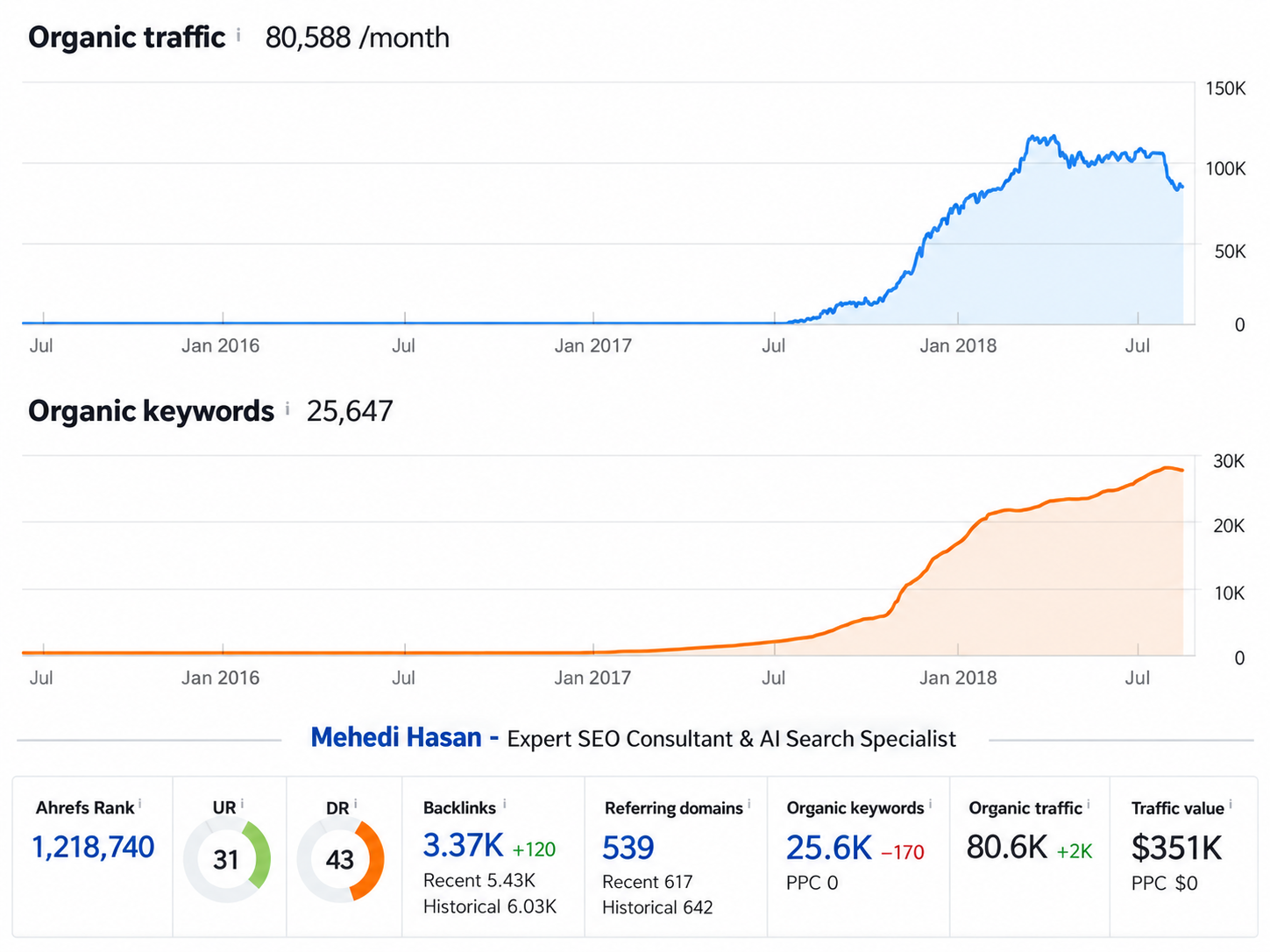
According to the published project results, the campaign achieved:
- 25,000 ranking keywords in organic search.
- 80,000+ monthly organic visits at the reported performance milestone.
- $350,000+ estimated monthly organic traffic value.
- 200+ new content pieces developed to improve topical coverage.
- 230 priority keyword opportunities identified for targeted optimization.
These results illustrate the potential impact of combining technical SEO, keyword research, content development, and authority building within a unified growth strategy.
02. Client Background
The client was an emerging technology company operating in the competitive consumer electronics market.
Established in July 2017, the company had developed a comprehensive website to showcase its products and reach potential customers.
However, its digital presence was not delivering the expected level of organic search visibility.
By October 2017, the website was attracting approximately 13,000 monthly visitors, according to the original account. Despite this existing traffic, the company had substantial opportunities to improve its search rankings and attract a larger audience.
The primary objective was to turn the website into a stronger organic acquisition channel by improving its visibility for commercially relevant and informational search queries.
03. The Business Challenge
The company faced several interconnected SEO challenges.
Limited visibility for valuable search terms
Although the website contained relevant product and informational pages, many commercially important keywords were not performing strongly in organic search.
Insufficient topical coverage
The website lacked enough targeted content to address the full range of questions, interests, and purchasing considerations of potential customers.
Weak authority signals
The initial assessment identified opportunities to strengthen the website’s backlink profile and improve its competitiveness against established technology publishers and retailers.
Underperforming existing rankings
Several potentially valuable keywords were positioned on the second or third pages of search results.
These keywords represented an opportunity to increase visibility by improving existing rankings rather than relying exclusively on newly created pages.
Competitive industry conditions
Consumer electronics is a demanding search category, with established brands, retailers, review websites, and technology publications competing for attention.
A successful strategy therefore required consistent execution, prioritization, and performance measurement.
04. SEO Objectives
The campaign was designed around five core objectives:
- Improve the website’s organic visibility across relevant consumer electronics topics.
- Increase rankings for high-value commercial and informational keywords.
- Expand content coverage to address customer search intent.
- Strengthen website authority through relevant link acquisition.
- Build a scalable organic search acquisition channel capable of supporting long-term business growth.
The broader goal was to improve search visibility while attracting more relevant potential customers.
05. Strategic Approach and Implementation
Phase 1: SEO Audit and Opportunity Assessment
The campaign began with an assessment of the website’s existing organic search performance.
The audit evaluated potential barriers to visibility and identified areas where optimization could produce measurable improvements.
The reported assessment found no existing search engine penalties.
However, it identified two important opportunities: underutilized high-value keywords and an insufficient authoritative backlink profile.
These findings helped establish the campaign’s initial priorities.
Phase 2: Keyword Research and Prioritization
Keyword research formed a central component of the growth strategy.
The campaign identified 230 priority keywords described as easy-win opportunities.
These were search queries for which the website already had some visibility, particularly rankings on the second and third search results pages.
The strategy prioritized keywords using factors such as:
- Existing search ranking positions.
- Relevance to the company’s products and audience.
- Commercial intent and potential customer value.
- Cost-per-click indicators.
- Opportunities for meaningful ranking improvements.
Rather than treating every keyword equally, the campaign focused on opportunities where optimization could potentially generate faster visibility gains.
Phase 3: Content Expansion and Optimization
Content development was another major component of the campaign.
More than 200 new content pieces were produced to improve the website’s coverage of relevant consumer electronics topics.
The content strategy aimed to align individual pages with user search intent while expanding the site’s relevance across related subjects.
The campaign also emphasized semantic relevance through the use of related terminology and contextual keywords.
This approach supported a broader objective: developing a more comprehensive content resource capable of answering customer questions at different stages of their purchasing journey.
Phase 4: Authority Development and Link Building
The initial SEO assessment highlighted the need for a stronger backlink profile.
A link-building strategy was therefore introduced to improve the website’s authority and competitive positioning.
The reported work focused on diversifying the backlink profile and strengthening external authority signals.
The original case study does not disclose the number of links acquired, referring domains gained, or specific outreach methods. Accordingly, these figures are not presented as verified campaign outcomes.
Phase 5: Performance Monitoring and Continuous Optimization
SEO performance was monitored throughout the campaign to identify progress and adjust priorities.
The strategy included regular reviews of keyword rankings, search visibility, and organic performance.
This iterative process enabled the campaign to respond to performance trends rather than relying on a fixed optimization plan.
Continuous evaluation was particularly important because the campaign combined improvements to existing pages with the development of new content.
06. Campaign Performance and Results

The original case study reports substantial improvements in the company’s organic search performance over the nine-month engagement.
Key Performance Indicators
| Performance Metric | Reported Outcome |
| Campaign duration | 9 months |
| Initial monthly website traffic | Approximately 13,000 visitors |
| Monthly organic traffic at reported milestone | 80,000+ visits |
| Organic ranking keywords | 25,000 |
| Estimated monthly organic traffic value | $350,000+ |
| Priority keyword opportunities | 230 |
| New content pieces | 200+ |
| Initial monthly campaign budget | $3,000 |
| Reported budget scaling | Up to $40,000 per month |
Organic Search Visibility
One of the campaign’s most significant reported achievements was reaching 25,000 ranking keywords.
This indicates that the website gained visibility across a substantially wider range of relevant search queries.
Broader keyword coverage can create more opportunities for users to discover a business through informational, comparative, and commercial searches.
Organic Traffic Growth
The campaign reported more than 80,000 monthly organic visits at its performance milestone.
This represented a substantial organic acquisition result for a company seeking to strengthen its presence in the technology sector.
The source also mentions approximately 13,000 monthly website visitors at an earlier stage. However, it does not establish whether this figure exclusively represented organic traffic.
Therefore, a precise percentage increase in organic traffic cannot be independently calculated from the published figures.
Estimated Organic Traffic Value
The case study reports an estimated monthly organic traffic value exceeding $350,000.
This metric generally represents an estimate of what comparable search traffic might cost through paid advertising.
It should not be interpreted as actual revenue, realized advertising savings, or return on investment.
Nevertheless, the reported figure suggests that the website achieved visibility for keywords with meaningful commercial value.
User Engagement
The original account also describes improvements in user engagement, including lower bounce rates and longer average session duration.
These are qualitative reported outcomes because the underlying engagement figures were not disclosed.
07. Strategic Business Impact
The campaign demonstrates several ways in which a structured SEO program can support a technology company’s digital growth.
Expanded market visibility
Broader keyword rankings increased the website’s potential exposure across relevant consumer electronics searches.
Greater organic acquisition capacity
The reported traffic performance suggests that organic search became a more substantial source of website visits.
Improved content coverage
The addition of more than 200 content pieces expanded the website’s ability to address customer questions and relevant topics.
Stronger competitive positioning
Keyword optimization and authority-building activities were designed to help the website compete more effectively in search results.
Long-term search assets
Unlike campaigns that depend entirely on paid media, well-maintained organic content can continue attracting visitors after its initial publication.
However, the original study does not provide verified lead generation, sales, conversion, or profitability data. Its demonstrated impact is therefore best described in terms of search visibility, estimated traffic value, and organic acquisition performance.
08. Key Lessons from the Campaign
Prioritize Existing Keyword Opportunities
Keywords already ranking on pages two or three can offer valuable optimization opportunities.
Identifying these terms can help SEO teams prioritize pages with an existing foundation of search relevance.
Align Content with Search Intent
Publishing more content alone does not guarantee stronger performance.
Content needs to address relevant questions, satisfy search intent, and provide useful information to its intended audience.
Combine Content and Authority Development
Content optimization and backlink development address different aspects of organic search competitiveness.
A coordinated approach can be more effective than treating these activities as disconnected tasks.
Measure Progress Consistently
SEO is an iterative process.
Regular performance reviews help identify which activities are producing results and where additional optimization may be necessary.
Evaluate Commercial Impact Carefully
Ranking keywords and organic traffic are valuable performance indicators, but they are not equivalent to business revenue.
A complete SEO measurement framework should also examine conversions, qualified leads, sales, and customer acquisition costs wherever data is available.
09. Conclusion
This nine-month consumer electronics SEO campaign illustrates how a structured organic growth strategy can improve search visibility in a competitive market.
Through targeted keyword research, content expansion, authority development, and ongoing optimization, the website reportedly reached 25,000 ranking keywords and generated more than 80,000 monthly organic visits.
The reported results highlight the importance of combining strategic planning with consistent execution and measurable performance monitoring.
For technology businesses seeking to build sustainable search visibility, the central lesson is clear: effective SEO depends on identifying the right opportunities, developing relevant content, strengthening authority, and continuously improving performance.