

Executive Summary
Achieving sustainable organic growth requires more than securing initial keyword rankings. Search engine algorithm changes, evolving customer behavior and increasing competition can significantly affect a website’s ability to maintain momentum.
This case study examines the SEO recovery of a Singapore-based e-commerce business specializing in baby footwear.
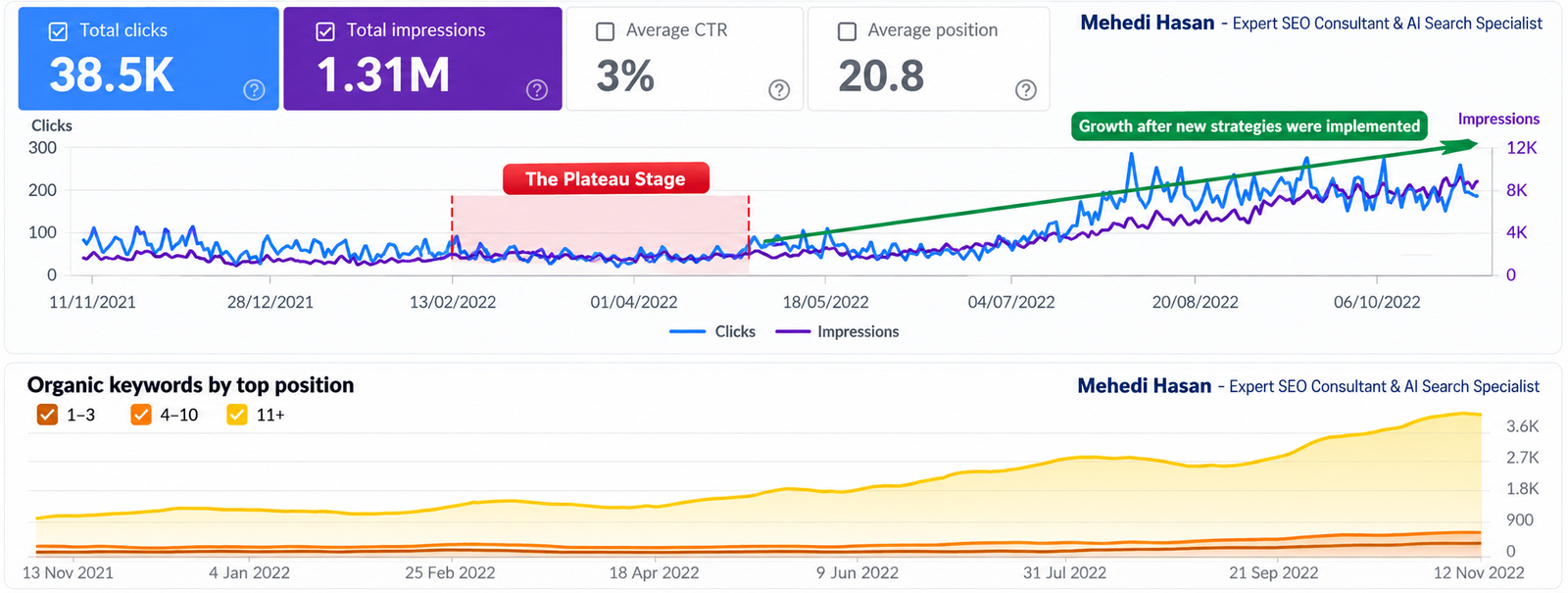
The website initially experienced an 80% increase in organic traffic within three months. However, following changes in Google’s search algorithms in early 2022, organic growth began to stagnate.
To address this challenge, the SEO strategy shifted toward improving product and category page relevance, identifying high-potential ranking opportunities, expanding informational content and strengthening the connection between search intent and transactional landing pages.
Between March and October 2022, the website recorded substantial improvements in organic search visibility and engagement.
Performance Highlights
| Performance Indicator | Initial | Final | Reported Growth |
| Search Impressions | 18,600 | 1,310,000 | +6,943.0% |
| Organic Search Clicks | 441 | 38,500 | +8,630.2% |
| Initial Organic Traffic Growth | Baseline | +80% | Within 3 months |
| Non-Branded Keyword Visibility | Limited | Expanded | Qualitative improvement |
The results above are taken from the original published case study. The reporting period and measurement intervals require confirmation against the underlying Google Search Console data.
1. Business Background
The business operated in Singapore’s competitive online baby footwear market, where customers search for products based on age, comfort, functionality, design and purchasing intent.
Organic search represented an important opportunity to attract potential customers who were actively researching or shopping for baby shoes.
The website had already demonstrated growth potential through its initial SEO performance. Nevertheless, maintaining that trajectory required a more comprehensive approach to content relevance, page optimization and search visibility.
The central business challenge was to restore organic growth without relying exclusively on existing product rankings.
2. The Challenge: Organic Traffic Stagnation
Despite strong early performance, the website encountered a growth plateau following Google’s search algorithm changes.
The original case study associates the slowdown with Google’s Product Reviews Update and discusses the subsequent May 2022 Core Update.
The situation required a reassessment of the existing SEO approach.
Key Challenges
Stagnating Organic Performance
Initial traffic improvements were no longer translating into consistent growth, suggesting that the existing optimization strategy needed refinement.
Underdeveloped Search Opportunities
The website needed to identify additional relevant keywords and landing pages capable of attracting new organic search demand.
Product and Category Page Relevance
Commercial pages required stronger alignment with user search intent and better integration of supporting information.
Limited Informational Search Coverage
The existing content strategy needed to reach customers earlier in their purchasing journey, particularly through non-branded informational queries.
Search Algorithm Volatility
The website needed a more adaptable content and optimization approach to respond to changes in Google’s ranking systems.
3. SEO Objectives
The recovery strategy focused on five objectives:
- Restore positive organic search growth after the traffic plateau.
- Increase impressions and clicks from relevant Google searches.
- Improve the search performance of product and category pages.
- Expand visibility for informational and non-branded keywords.
- Build a more sustainable content structure capable of supporting long-term organic discovery.
These objectives informed the subsequent on-page and content optimization activities.
4. SEO Strategy and Implementation
The recovery initiative involved six interconnected optimization activities.
4.1 Product and Category Page Optimization
The priority was improving the relevance and SEO performance of the website’s existing commercial landing pages.
Product and category pages were revised to better support search visibility and user intent.
The strategy emphasized presenting useful product information, improving the organization of page content and ensuring that important commercial pages could compete for relevant search queries.
Strategic purpose: Improve the ability of high-value commercial pages to attract relevant organic search traffic.
4.2 High-Potential Page Identification
The next activity involved identifying existing pages with opportunities for improved search performance.
This approach, described in the original project as Sweet Spot Analysis, focused on selecting promising pages for further optimization.
Rather than treating every page as an equal priority, the strategy concentrated resources on pages with stronger potential to improve their visibility in search results.
Strategic purpose: Direct SEO efforts toward pages with meaningful ranking opportunities.
4.3 Search Intent-Based Content Enhancement
The content on product pages was expanded to address users’ informational needs alongside their purchasing intentions.
Enhancements included content designed to support:
- Relevant product-related search queries.
- Frequently asked customer questions.
- Featured snippet opportunities.
- Review-related search result features.
- Better alignment between page content and search intent.
This helped broaden the informational value of commercial pages.
Strategic purpose: Improve topical relevance and help product pages satisfy a wider range of customer search needs.
4.4 Product Image Optimization
Product imagery was updated to better reflect user expectations and search intent.
The strategy also connected relevant visual content to transactional landing pages, creating clearer pathways between product discovery and purchasing destinations.
This was particularly relevant to a visually driven e-commerce category such as baby footwear.
Strategic purpose: Support product discovery and strengthen the connection between visual content and commercial landing pages.
4.5 Existing Content Refresh
Previously published content was updated with more current and relevant information.
The objective was to preserve the usefulness of existing pages while improving their ability to respond to evolving customer questions and market interests.
This approach helped extend the value of the website’s existing content assets rather than depending entirely on new content creation.
Strategic purpose: Maintain content relevance and strengthen existing organic search opportunities.
4.6 Informational Blog Expansion
The content strategy expanded beyond product and category pages through additional SEO-structured blog articles.
These articles targeted informational, non-branded searches relevant to the business and its potential customers.
By addressing topics beyond immediate product purchases, the website could reach users during the research and consideration stages of their buying journey.
Strategic purpose: Expand organic visibility, attract new audiences and create additional pathways toward relevant commercial pages.
5. Performance Results
The original case study reports a significant improvement in Google search performance between March and October 2022.
5.1 Search Impressions
Search impressions increased from approximately 18,600 to 1.31 million.
This represents a calculated increase of approximately 6,943%, equivalent to 70.4 times the initial figure.
The improvement indicates that the website appeared substantially more frequently in Google search results during the reported comparison.
5.2 Organic Search Clicks
Search clicks increased from 441 to approximately 38,500.
This represents a calculated increase of approximately 8,630%, equivalent to 87.3 times the initial figure.
The increase suggests that the website generated substantially more visits from Google search results during the comparison period.
5.3 Expanded Non-Branded Keyword Visibility
The original case study also reports improved rankings across a wider range of informational, non-branded keywords.
This development was strategically important because it reduced reliance on a narrow set of existing search terms and created additional opportunities to reach potential customers.
The source does not disclose the exact number of newly ranking keywords or their individual ranking positions.
5.4 Performance Through Algorithm Changes
The project also reports that the website continued its growth trajectory through the May 2022 Core Update.
Although this is a positive observation, the available evidence does not isolate the effect of that algorithm update or establish how much of the growth was directly caused by each SEO intervention.
6. Business Impact
The strongest documented outcome was a substantial increase in organic search exposure and search-generated clicks.
From a business perspective, the reported results suggest several potential benefits.
Greater Brand Discovery
More search impressions created additional opportunities for potential customers to encounter the brand.
Expanded Customer Acquisition Opportunities
The increase in search clicks brought substantially more users to the website from Google search results.
Broader Search Market Coverage
Improved non-branded keyword visibility enabled the website to reach customers searching for information beyond its existing branded and product-specific terms.
Improved Content Coverage
The combination of optimized commercial pages and informational content supported a broader range of customer search intentions.
While these developments demonstrate improved organic search performance, the source does not provide conversion rates, transaction counts, revenue or return-on-investment data. Therefore, direct financial impact cannot be quantified from the published information.
7. Key Strategic Insights
Search Growth Requires Continuous Optimization
Early SEO success does not guarantee sustained growth. Existing pages and content strategies require periodic reassessment as search conditions change.
Existing Pages Can Offer Valuable Growth Opportunities
Optimizing promising commercial and informational pages can form an important part of a recovery strategy, alongside creating new content.
Search Intent Should Guide Content Decisions
Pages are more useful when their content addresses the actual questions, expectations and purchasing intentions of the intended audience.
Informational and Commercial SEO Should Work Together
Product pages support transactional searches, while informational articles create opportunities to attract customers earlier in the buying process.
A coordinated approach allows both content types to contribute to broader organic visibility.
Performance Measurement Must Remain Central
Impressions, clicks and keyword visibility provide important evidence of SEO progress. Conversion and revenue data are also needed to establish the full commercial value of an SEO initiative.
8. Conclusion
This Singapore e-commerce SEO case study illustrates how a website can recover from stagnant organic growth through a coordinated optimization strategy.
The combination of improved product and category pages, high-potential page targeting, search intent-based content, image optimization, content refreshes and informational blog expansion coincided with substantial growth in Google search visibility.
Over the reported March–October 2022 period, impressions increased from 18,600 to 1.31 million, while clicks increased from 441 to 38,500.
The central lesson is that sustainable SEO performance depends on continually identifying search opportunities, improving content relevance and adapting to changes in the search environment.