

Executive Summary
A cosmetics brand operating in Malaysia faced significant challenges in expanding its organic search visibility and connecting with potential customers in a competitive beauty market.
Despite offering an established range of cosmetic products, the brand needed a more structured approach to content development, keyword targeting, and website optimization.
The SEO campaign addressed these challenges through a topical authority strategy designed to strengthen the website’s relevance across interconnected beauty and cosmetics search topics.
Over two months, the original case study reported:
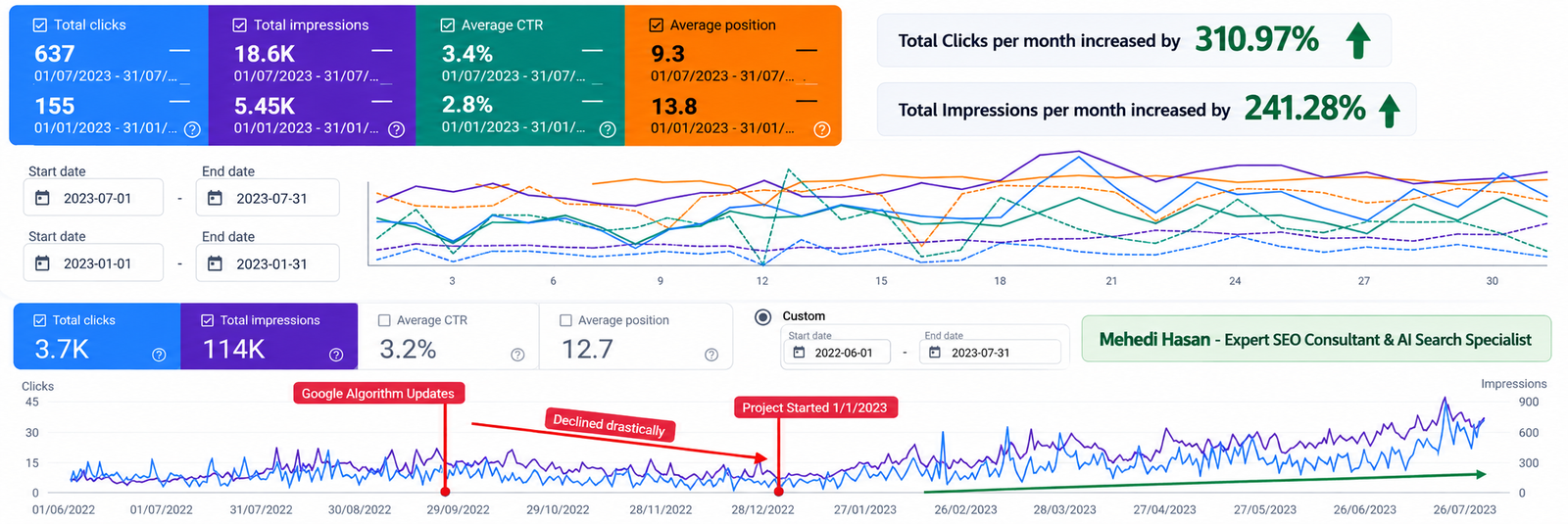
- 21,000% increase in organic search impressions
- 6,000% increase in organic search clicks
- First-page visibility for multiple targeted keywords
- Improved rankings across targeted keyword variations
These reported outcomes demonstrate the potential impact of combining search intent research, structured content planning, on-page SEO, and internal linking.
1. Client Background
The client was a cosmetics brand based in Malaysia, operating in the competitive beauty and personal care sector.
The brand offered a range of cosmetic products but faced challenges in attracting relevant organic traffic from search engines.
With established competitors competing for similar search queries, improving search visibility required a structured content strategy rather than relying exclusively on individual product pages or isolated keyword optimization.
The campaign focused on building a more comprehensive and search-friendly website content structure.
2. The Business Challenge
The central challenge was improving the brand’s visibility among potential customers searching for cosmetics, skincare information, and related beauty products.
The campaign sought to address several interconnected SEO priorities.
Limited Organic Search Visibility
The website needed stronger visibility across relevant search queries to reach a wider audience.
Competitive Keyword Landscape
Beauty-related search results featured competition from established brands, ecommerce retailers, and informational publishers.
Insufficient Topical Coverage
The website required a more comprehensive content structure to cover relevant topics and their associated search intents.
Content Organization and Relevance
Existing content needed better alignment with targeted keywords, related subjects, and user expectations.
Internal Linking Opportunities
A stronger internal linking structure was necessary to improve navigation and connect related content.
3. Campaign Objectives
The campaign focused on five primary objectives:
- Increase organic impressions and clicks from relevant Google searches.
- Improve rankings for targeted cosmetics and beauty-related keywords.
- Establish broader topical coverage across important product and informational subjects.
- Strengthen the website’s content organization and internal linking.
- Create a scalable SEO foundation to support continued organic visibility.
The broader commercial goal was to attract more relevant visitors who could potentially become customers.
4. SEO Strategy and Implementation
Phase 1: Keyword Research and Search Intent Analysis
The first stage involved identifying primary and secondary keywords relevant to the cosmetics market.
Keyword research was paired with search intent analysis to better understand the information and products users were looking for.
The strategy considered different types of searches, including informational queries and product-oriented queries.
This helped guide content selection and ensure that pages addressed relevant customer needs.
Phase 2: Topical Authority Mapping
A topical content map was developed to organize related subjects into a connected content strategy.
Rather than approaching every keyword independently, the strategy grouped related queries into broader topics.
This approach was intended to improve topical coverage and establish clearer relationships between relevant pages.
The content map also provided a framework for identifying gaps and prioritizing new content.
Phase 3: SEO-Focused Content Development
New content was developed to address relevant beauty and cosmetics topics.
Content production emphasized:
- Alignment with user search intent
- Clear and informative explanations
- Relevant primary and secondary keyword coverage
- Logical heading structures
- Connections to related website content
- Useful information for the intended audience
The objective was to improve content relevance while expanding the number of search queries the website could potentially serve.
Phase 4: On-Page SEO Optimization
Existing and newly developed pages received on-page optimization.
Key activities included improving title tags, meta descriptions, URL structures, and the organization of page content.
These changes aimed to communicate each page’s subject more clearly to both users and search engines.
Phase 5: Internal Linking Optimization
The website’s internal linking structure was improved to connect relevant pages.
Contextual internal links helped establish relationships between related content and supported navigation across the website.
This also created clearer pathways between informational content and other relevant pages.
Phase 6: Structured Data Implementation
Relevant structured data markup was implemented to provide additional context about website content.
Structured data can help eligible search engines interpret page information more consistently.
However, implementing schema markup does not guarantee enhanced search appearances or higher rankings.
Phase 7: Content Consolidation and Optimization
Existing content was reviewed to identify overlapping topics and opportunities for improvement.
Where appropriate, related content was refined or consolidated to reduce unnecessary duplication and competing keyword targets.
This process aimed to improve content clarity, strengthen topical relevance, and create a more organized website structure.
5. Campaign Results

The original published case study reported significant improvements over the two-month campaign.
| Performance Indicator | Reported Outcome |
| Organic Search Impressions | +21,000% |
| Organic Search Clicks | +6,000% |
| Keyword Rankings | Top rankings reported for targeted variations |
| First-Page Visibility | Multiple keywords reached the first page |
| Campaign Duration | 2 Months |
Organic Impression Growth
Organic search impressions reportedly increased by 21,000%.
This indicates that the website appeared in Google search results substantially more frequently during the comparison period.
The increase suggests expanded search visibility, although the original article does not provide the exact impression counts or comparison dates.
Organic Click Growth
Organic search clicks reportedly increased by 6,000%.
This indicates a substantial increase in visits originating from Google search results.
The original report does not provide absolute click totals, conversion data, or sales attribution, so the commercial impact cannot be quantified.
Keyword Ranking Improvements
The campaign also reported improvements across targeted keyword variations, including first-page visibility for multiple queries.
These outcomes are consistent with the campaign’s emphasis on topical content coverage, keyword relevance, and website organization.
However, a detailed keyword ranking report would be required to independently validate the full extent of these improvements.
6. Why the Strategy Was Effective
The campaign combined several complementary SEO practices rather than depending on a single optimization technique.
Topical Coverage
Organizing related subjects into a connected content plan helped create broader coverage of the cosmetics niche.
Search Intent Alignment
Researching customer queries supported content that addressed specific information needs.
Content Quality and Relevance
Developing and improving relevant content expanded the website’s potential to appear for related searches.
Website Organization
Internal linking and content consolidation improved relationships between pages and supported a clearer website structure.
Technical Content Context
On-page improvements and structured data helped communicate page information more consistently.
Together, these activities provided a coherent approach to improving organic search visibility.
7. Key Takeaways
This campaign highlights several important lessons for cosmetics and ecommerce businesses.
First, topical authority strategies can provide a useful framework for organizing content in competitive markets.
Second, keyword research should consider the intent behind each search rather than focusing solely on search volume.
Third, content development works best when supported by effective on-page optimization and internal linking.
Finally, SEO performance should be assessed through a combination of search visibility, organic clicks, keyword performance, and, where available, business conversion data.
8. Conclusion
The Malaysian cosmetics campaign demonstrates how a coordinated topical authority SEO strategy can support substantial organic search growth within a relatively short period.
According to the original published results, the website achieved a 21,000% increase in impressions and a 6,000% increase in clicks over two months, alongside improvements in targeted keyword rankings.
The campaign illustrates the value of aligning keyword research, content planning, on-page optimization, internal linking, and content consolidation around a coherent search strategy.