

Executive Summary
A Singapore-based packaged food company sought to expand beyond its established physical retail and distribution network by entering the competitive e-commerce market.
Despite having an existing customer base and a recognizable offline presence, the company lacked a dedicated online sales platform and sufficient organic search visibility to reach digital consumers.
The project focused on developing an e-commerce website, optimizing its commercial pages for purchase-intent search queries, and creating search-friendly content designed to attract potential customers.
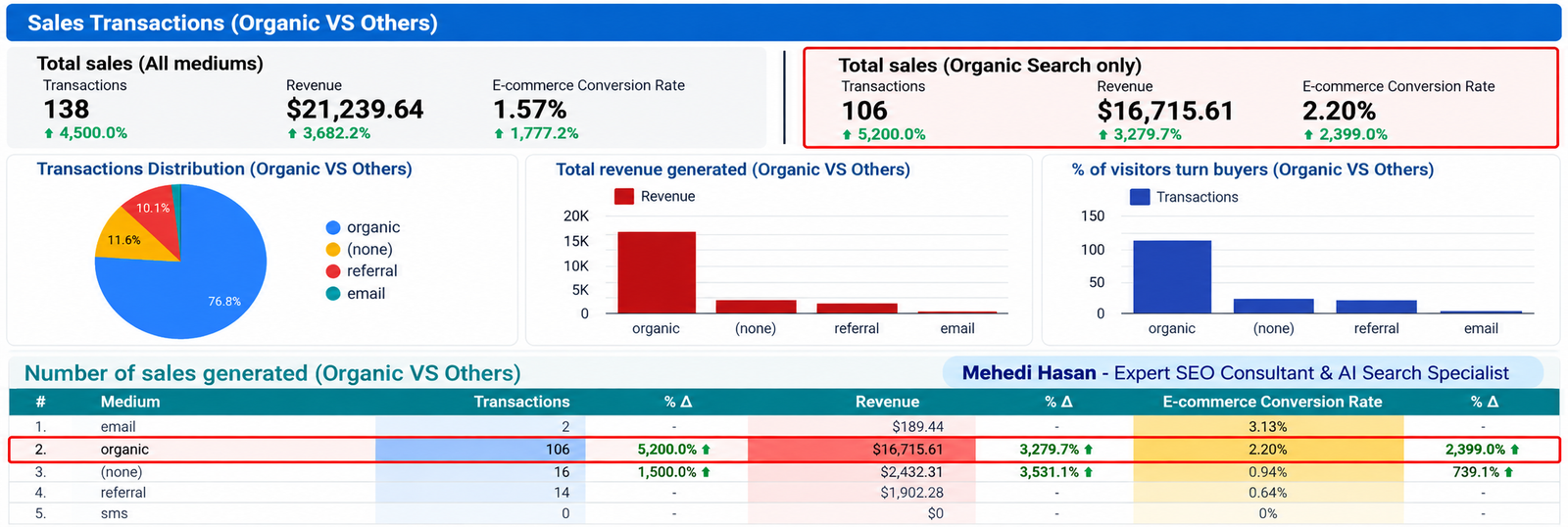
The original case study reported a 3,000% increase in revenue within 28 days, with organic search identified as the leading revenue-generating marketing channel.
This case demonstrates how combining an accessible online storefront with commercially focused SEO can support rapid digital expansion.
1. The Business Challenge
The client had built its business through physical stores and established product distribution channels. However, its limited e-commerce capabilities restricted opportunities to acquire customers searching online.
Three main challenges shaped the project.
Limited Online Sales Infrastructure
The company needed an e-commerce platform that would allow customers to discover products, explore available options, and complete purchases online.
Insufficient Organic Search Visibility
Although the brand was established offline, its products had limited visibility in organic search results. This reduced its ability to reach consumers actively searching for relevant packaged food products.
Dependence on Traditional Sales Channels
The business needed to diversify beyond physical retail and distribution by creating a measurable, scalable online revenue channel.
Primary business objective: Establish an e-commerce presence capable of attracting qualified organic traffic and converting that traffic into sales.
2. Strategic Approach
The project combined e-commerce development with commercially focused search engine optimization.
Phase 1: E-commerce Platform Development
The priority was establishing a functional online storefront aligned with the client’s product portfolio.
The platform was developed to support product discovery and online purchasing, creating a foundation for digital customer acquisition.
This addressed the fundamental barrier preventing the company from generating direct online sales.
Phase 2: Purchase-Intent Keyword Targeting
The SEO strategy prioritized keywords associated with customers actively considering a purchase.
Rather than concentrating exclusively on broad informational searches, the approach focused on commercial relevance.
This allowed the website to target users further along the purchasing journey, where search visibility could translate into meaningful revenue opportunities.
Phase 3: SEO-Focused Content Development
Product-related content was developed and optimized to improve search relevance and help potential customers understand the available offerings.
The strategy emphasized aligning page content with relevant search queries while supporting product discovery and user engagement.
Phase 4: Performance Evaluation
The original case study assessed the campaign over its first 28 days and compared organic search performance against other marketing channels, including email, SMS, and paid advertising.
The central performance measure was revenue growth, rather than search visibility alone.
3. Results and Business Impact
The campaign produced substantial reported growth during the initial 28-day implementation period.
| Performance Indicator | Reported Outcome |
| Revenue growth | +3,000% |
| Campaign duration | 28 days |
| Leading revenue channel | Organic Search |
| Conversion performance | Organic search reportedly outperformed other evaluated channels |
| Online sales capability | E-commerce storefront established |
Revenue Growth
The original case study reports a 3,000% increase in revenue during the first 28 days.
A 3,000% increase represents revenue reaching 31 times the baseline amount, assuming the percentage is calculated conventionally.
However, the original publication does not disclose the starting revenue, ending revenue, or precise comparison period. The percentage should therefore be treated as a reported result rather than an independently validated financial measurement.
Organic Search Performance
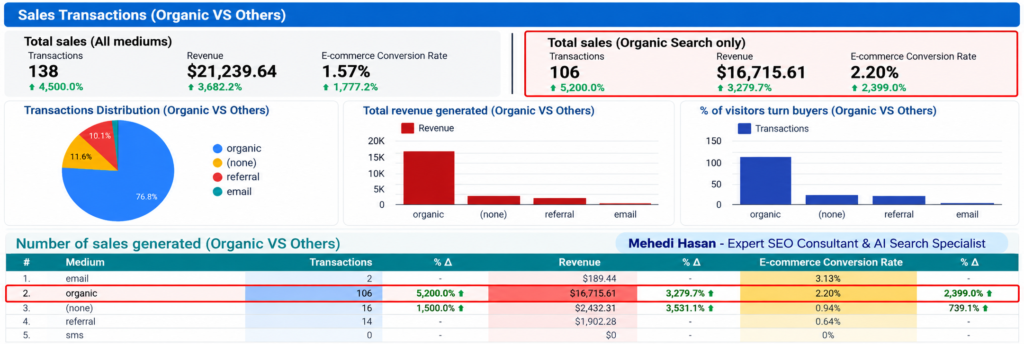
Organic search was reported as the strongest marketing channel for both revenue generation and conversion performance compared with the other channels evaluated.
This suggests that attracting visitors with clear purchasing intent was an important part of the campaign’s commercial performance.
Digital Sales Expansion
Beyond the reported revenue increase, the project established an online purchasing channel for a company previously focused on physical retail and distribution.
This created an additional route for customer acquisition and sales beyond the company’s traditional business model.
4. Why the Strategy Was Effective
The campaign combined three complementary elements.
A functional e-commerce platform enabled customers to purchase products online.
Commercially relevant keyword targeting helped connect the website with people actively searching for products.
Optimized product content supported search relevance and helped customers evaluate available offerings.
Together, these activities addressed both discoverability and the ability to complete purchases.
The results suggest that SEO was an important contributor to the company’s early online revenue performance. However, because the project involved launching an e-commerce platform and optimizing it simultaneously, the precise contribution of SEO cannot be isolated from the available data.
5. Key Business Takeaways
Search visibility should support commercial objectives. Increasing organic traffic is valuable when that traffic contributes to customer acquisition and revenue.
Purchase intent matters. Commercially relevant search queries can connect businesses with customers closer to making purchasing decisions.
E-commerce infrastructure and SEO work together. Search visibility creates opportunities for discovery, while a functioning storefront enables transactions.
Channel-level measurement is essential. Comparing organic search with paid advertising, email, and other channels helps businesses understand where their revenue originates.
Performance claims require clear measurement. Reliable case studies should document baseline metrics, comparison dates, analytics sources, and attribution methods.
6. Conclusion
This 28-day e-commerce growth project illustrates the commercial potential of integrating online store development with purchase-intent SEO and optimized product content.
For the Singapore-based packaged food company, the original publication reports a 3,000% revenue increase, with organic search emerging as its leading revenue channel.
The broader lesson is that successful e-commerce SEO should be evaluated through measurable business outcomes, including qualified traffic, conversions, and revenue.