

1. Executive Summary
An online travel agency offering travel services and holiday packages faced a significant digital marketing challenge. Despite having an attractive website and a diverse range of travel offerings, the business struggled to attract sufficient visitors through organic search.
The website’s existing content was not effectively aligned with how potential customers searched for destinations, travel packages, and related services.
The SEO campaign focused on identifying content gaps, understanding search intent, improving existing landing pages, developing topical relevance, and strengthening internal linking.
Reported results within three months:
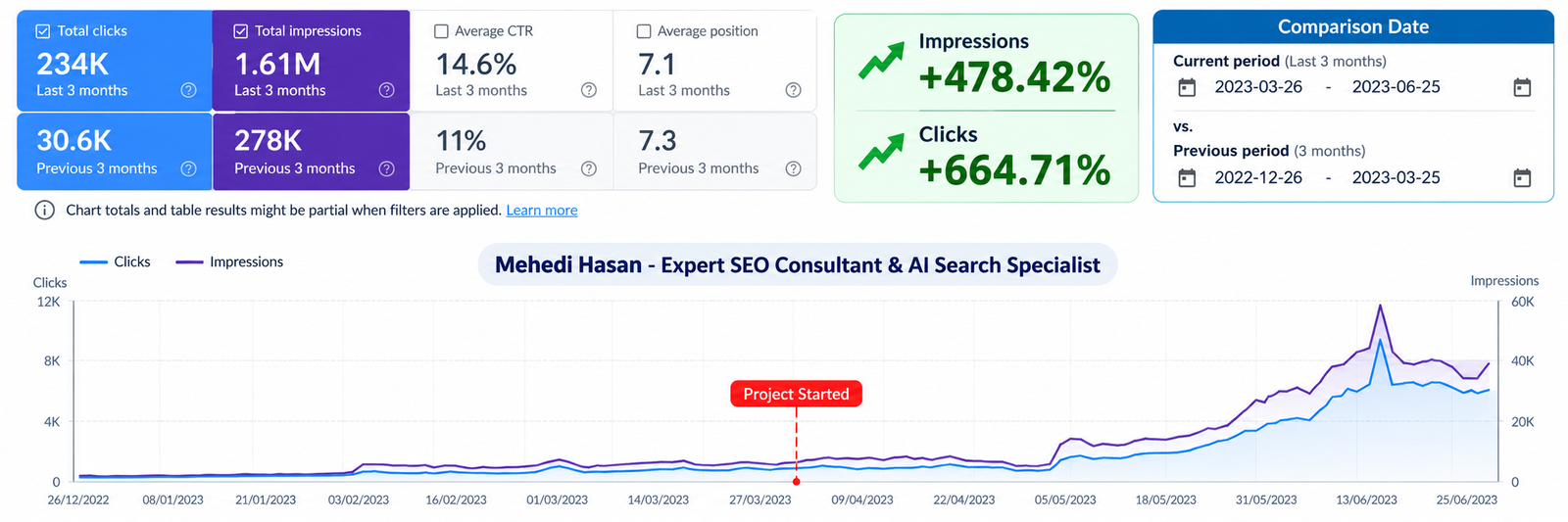
- 478% increase in Google Search impressions
- 664% increase in organic search clicks
- First-page Google rankings for numerous competitive keywords
- Improved visibility across relevant travel-related search queries
- Stronger topical coverage within the travel sector
These outcomes demonstrate the potential of a structured, search-intent-driven SEO strategy to improve organic visibility in a competitive market.
2. Client Background
The client operated an online travel agency offering a variety of travel services and holiday packages.
The business had invested in an appealing website designed to present its services professionally. However, the site’s organic search performance did not reflect the breadth of its offerings.
The central challenge was attracting potential travelers during their online research and purchasing journeys.
In a competitive travel market, customers search using different combinations of destinations, package types, travel preferences, and booking-related questions. The website needed a content structure capable of addressing these different search intentions.
3. The Business Challenge
Limited Organic Search Visibility
Although the website contained information about its travel services, it was not receiving the expected exposure in Google’s organic search results.
Content Misalignment with Search Intent
Existing content did not consistently address the questions, requirements, and expectations behind relevant search queries.
Competitive Search Landscape
Travel and tourism search results are highly competitive, with established agencies, booking platforms, and travel publishers targeting overlapping keywords.
Underdeveloped Topical Coverage
The website needed broader, better-organized coverage of relevant travel topics to improve its ability to compete for related search queries.
Internal Linking Opportunities
The relationship between informational content and commercial landing pages required improvement to help users and search engines navigate relevant sections of the website.
4. Campaign Objectives
The campaign was designed around five primary objectives:
- Increase organic visibility for commercially relevant travel-related keywords.
- Improve rankings for competitive search terms.
- Increase organic clicks from Google Search.
- Improve content relevance through stronger alignment with user intent.
- Establish a more comprehensive and interconnected content structure to support future organic growth.
5. SEO Strategy and Implementation
Phase 1: Comprehensive Content Audit
The first stage involved reviewing the website’s existing content to identify weaknesses and opportunities.
The audit focused on identifying pages that could benefit from improved relevance, content depth, keyword targeting, and structural organization.
This process provided the foundation for prioritizing SEO improvements.
Phase 2: Quick-Win Opportunity Analysis
A targeted opportunity assessment was conducted to identify areas where optimization could potentially generate faster improvements.
The objective was to prioritize existing pages and keyword opportunities with promising potential rather than relying exclusively on newly published content.
This allowed the campaign to balance immediate optimization opportunities with longer-term content development.
Phase 3: Search Intent and User Behavior Analysis
Search query patterns and user behavior were examined to understand what potential travelers expected when searching online.
The strategy considered different stages of the customer journey, including:
- Researching destinations and travel options
- Comparing travel packages and services
- Evaluating relevant travel information
- Exploring booking-related options
These search intentions informed how existing content was revised and how new content opportunities were selected.
Phase 4: Strategic Keyword Research
Keyword research focused on identifying relevant primary keywords and related search variations.
The goal was to create a more complete understanding of the subjects and search queries associated with the agency’s travel offerings.
Rather than treating each keyword as an isolated target, the campaign considered the relationship between primary topics, supporting queries, and relevant content pages.
Phase 5: Search-Intent-Based Landing Page Optimization
Existing travel and package pages were revised to better reflect relevant search intent.
Content improvements focused on making the pages more informative, useful, and closely aligned with the requirements of potential customers.
This approach aimed to improve the relevance of important commercial pages while maintaining a clear connection to the agency’s services.
Phase 6: Topical Content Strategy
A topical content map was developed to organize relevant subjects and their associated keyword variations.
This helped guide the expansion of the website’s content coverage.
The strategy was designed to build stronger relationships between relevant topics and improve the website’s ability to appear for a wider range of travel-related searches.
Phase 7: New Content Development
New content was created to address additional search queries and information needs that were not sufficiently covered by the existing website.
The emphasis was on producing useful, search-focused content that complemented the agency’s primary services.
This expanded the website’s potential reach across relevant informational and commercial search queries.
Phase 8: Strategic Internal Linking
The website’s internal linking structure was improved to establish clearer connections between related pages.
The strategy aimed to:
- Connect supporting informational content with relevant commercial pages
- Improve navigation between related topics
- Help search engines discover relevant content
- Strengthen contextual relationships throughout the website
- Support the visibility of important landing pages
6. SEO Performance and Results
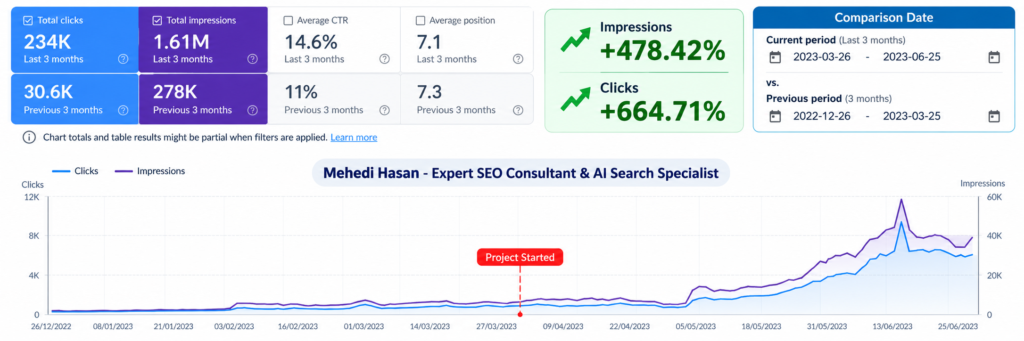
The original case study reports substantial organic search growth during the three-month campaign.
| Performance Metric | Reported Outcome |
| Google Search Impressions | +478% |
| Organic Search Clicks | +664% |
| Campaign Duration | 3 months |
| Competitive Keyword Rankings | Numerous first-page positions |
| Topical Visibility | Reported improvement across major keyword variations |
478% Increase in Search Impressions
The increase in impressions indicates that the website appeared substantially more frequently in Google Search results.
This suggests that the campaign expanded the site’s organic search visibility across relevant queries.
664% Increase in Organic Clicks
Organic search clicks increased at a faster rate than impressions.
This is consistent with improved search performance, potentially reflecting changes in ranking positions, keyword coverage, or search result relevance.
However, the published data does not provide enough information to isolate the contribution of each factor.
Improved Competitive Keyword Rankings
The original report states that numerous competitive keywords reached Google’s first page.
These ranking improvements helped establish a stronger organic presence for the website within relevant travel-related search results.
Expanded Topical Visibility
The combination of optimized existing content, new content development, and internal linking contributed to the reported improvement in topical search coverage.
The campaign illustrates how coordinated content optimization can support broader visibility rather than focusing on a small group of isolated keywords.
7. Strategic Insights
Search Intent Should Guide Content Development
Keyword targeting is most effective when content directly addresses the needs behind the search.
Understanding why someone searches for a travel-related topic is essential when developing useful landing pages.
Existing Content Can Offer Significant Opportunities
A content audit and targeted optimization process can identify valuable improvements without requiring a complete website rebuild.
Topical Coverage Supports Broader Organic Visibility
Organizing content around related subjects allows a website to address more relevant search queries while maintaining a coherent content structure.
Internal Linking Connects Content with Business Priorities
Effective internal linking helps connect informational content with important service and package pages.
SEO Performance Requires Measurable Evaluation
Tracking impressions, clicks, and keyword rankings helps evaluate whether an optimization strategy is producing meaningful search visibility improvements.
Additional conversion and revenue data would be needed to assess the campaign’s complete commercial impact.
8. Conclusion
This online travel agency case study demonstrates how a structured SEO campaign can improve organic search performance in a competitive industry.
By combining content auditing, keyword research, search-intent analysis, landing page optimization, topical content development, and strategic internal linking, the campaign reportedly achieved a 478% increase in impressions and a 664% increase in organic clicks within three months.
The case highlights the importance of building an SEO strategy around relevant user needs, connected content, and measurable organic search outcomes.