

Executive Summary
Building organic visibility in the competitive healthcare industry requires more than targeting high-volume keywords. Healthcare websites must demonstrate subject-matter expertise, provide accurate information, satisfy patient search intent, and establish credibility with both users and search engines.
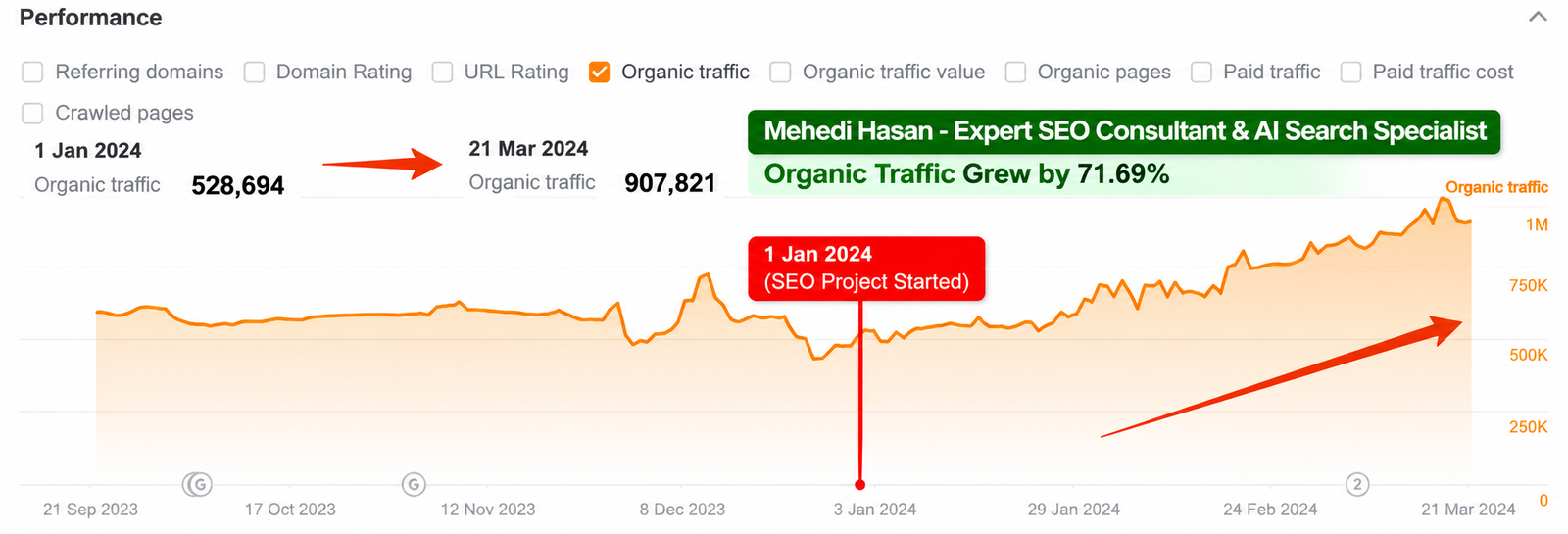
This case study examines an SEO campaign for an orthopedic clinic that achieved a 71.69% increase in organic traffic through a structured, content-focused search engine optimization strategy.
Beginning in January 2024, the campaign concentrated on understanding patient search behavior, developing comprehensive keyword clusters, improving content quality, strengthening topical relevance, and implementing strategic internal linking.
The campaign also emphasized Google’s Experience, Expertise, Authoritativeness, and Trustworthiness (E-E-A-T) principles, particularly important for websites publishing medical information.
The reported traffic growth occurred during a period that included Google’s March 2024 core algorithm update, demonstrating the potential value of a quality-focused SEO approach in a competitive healthcare market.
1. Project Background
Understanding the Client’s Industry
The client operated an orthopedic clinic offering specialized medical services related to musculoskeletal health.
Potential patients frequently use Google to research orthopedic conditions, understand symptoms, explore treatment options, and identify qualified healthcare providers.
For an orthopedic clinic, organic search visibility creates opportunities to reach prospective patients throughout their healthcare decision-making journey.
However, competing for these searches presents several challenges.
Established hospitals, medical publishers, specialist clinics, and authoritative healthcare websites frequently dominate search engine results pages.
A successful SEO strategy therefore needs to address both search visibility and the reliability of the information presented.
Primary Campaign Objective
The campaign focused on increasing qualified organic traffic by improving the website’s relevance, content quality, and search engine visibility.
The strategic priorities included:
- Increasing organic traffic from relevant healthcare searches.
- Improving visibility for competitive orthopedic-related keywords.
- Creating informative content aligned with patient search intent.
- Building topical authority around orthopedic conditions and treatments.
- Strengthening content credibility through expertise and trust signals.
- Improving internal linking and content discoverability.
- Establishing a foundation for sustainable organic growth.
2. The SEO Challenges
Challenge 1: Competing in a Highly Competitive Healthcare Market
Orthopedic healthcare searches frequently return results from well-established medical institutions and authoritative health information platforms.
Competing with these websites requires comprehensive, relevant, and trustworthy content rather than isolated keyword optimization.
Challenge 2: Understanding Different Patient Search Intentions
Not every healthcare search represents an immediate intention to book an appointment.
Some users search for symptoms, others research treatment options, and some actively compare orthopedic specialists.
The SEO strategy needed to account for these different stages of the patient journey.
Challenge 3: Establishing Medical Content Credibility
Healthcare information can influence decisions affecting patients’ health and well-being.
Consequently, medical content requires careful attention to accuracy, transparency, expertise, and supporting information.
Challenge 4: Creating a Cohesive Content Structure
Publishing individual articles without a clear relationship between topics can make it difficult to establish comprehensive subject coverage.
A structured topical framework was needed to connect related subjects and improve the overall content experience.
3. SEO Strategy and Implementation
The campaign followed a content-led SEO approach built around user intent, keyword research, topical organization, and content credibility.
Phase 1: Search Intent Analysis and Performance Research
The priority was understanding how potential patients searched for orthopedic information.
Search behavior and available performance data were analyzed to identify relevant informational needs and opportunities for improved content alignment.
The analysis considered several types of search intent:
Informational Intent: Users researching orthopedic symptoms, conditions, and available treatments.
Commercial Investigation: Users comparing treatment options, specialists, or healthcare providers.
Service-Oriented Intent: Users looking for orthopedic consultations, treatment services, or specialist appointments.
This intent-based approach helped shape the website’s content strategy around the needs of its target audience.
Phase 2: Comprehensive Keyword Research and Topical Mapping
A detailed keyword research process was used to identify relevant primary search terms and supporting keywords.
Rather than focusing exclusively on individual high-volume phrases, the campaign organized related search topics into a comprehensive topical map.
This framework helped establish relationships between primary healthcare subjects and supporting informational content.
For example, a typical orthopedic topical structure could include:
Primary Topic: Knee Pain and Orthopedic Treatment
Supporting subjects:
- Common causes of knee pain
- Knee pain symptoms and diagnosis
- Non-surgical knee pain treatments
- Orthopedic consultation for knee problems
- Recovery and rehabilitation information
These are illustrative examples of a topical structure, not a verified list of keywords used in the original campaign.
Phase 3: High-Value Healthcare Content Development
Content quality was a central part of the campaign.
The strategy prioritized useful, comprehensive information designed to answer patient questions and provide meaningful value.
The content approach emphasized:
- Clear alignment with search intent.
- Comprehensive coverage of relevant subjects.
- Logical organization and readability.
- Useful explanations rather than superficial keyword-focused writing.
- Consistency across related healthcare topics.
The goal was to create content that could satisfy users’ information needs while strengthening the website’s relevance for orthopedic searches.
Phase 4: Building Topical Authority Through Content Clusters
Related content was organized into connected topical clusters.
This structure helped establish clearer relationships between broad orthopedic subjects and more specific supporting topics.
A well-organized content cluster can improve navigation, help search engines discover related pages, and allow users to explore a subject in greater depth.
By strengthening the relationships between content assets, the campaign aimed to improve the website’s overall topical relevance.
Phase 5: Strengthening E-E-A-T Signals
Medical SEO requires particular attention to trust and credibility.
The campaign incorporated E-E-A-T-focused improvements, including more detailed author information and the use of expert insights.
These measures were intended to make content authorship and expertise more transparent.
For healthcare websites, an effective trust-building framework may also include qualified medical review, reliable references, transparent editorial practices, and accurate provider information.
These additional practices are recommended considerations rather than independently confirmed activities in this campaign.
Phase 6: Strategic Internal Linking
Internal linking formed another important part of the SEO strategy.
Relevant pages were connected to help users discover related information and improve the overall website structure.
The internal linking approach supported three main objectives:
- Improving navigation between related orthopedic topics.
- Helping search engines discover and understand content relationships.
- Supporting the visibility of relevant pages through contextual connections.
The strategy focused on creating useful relationships between pages rather than adding links without a clear purpose.
Phase 7: Improving Content Relevance and User Engagement
The campaign also emphasized making content useful and engaging for its intended audience.
Content was structured to answer relevant questions, support the user’s research journey, and provide accessible information.
The underlying principle was straightforward: organic growth should come from satisfying genuine user needs, not simply increasing the number of indexed pages.
4. Campaign Results and Performance
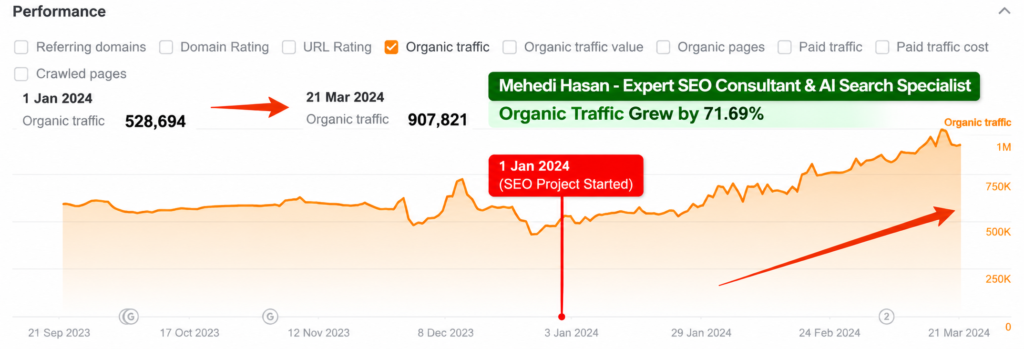
The original campaign report identified substantial growth in organic traffic and improvements in keyword visibility.
Reported SEO Performance
| Performance Indicator | Reported Outcome |
| Organic Traffic Growth | +71.69% |
| Competitive Keyword Visibility | Improved |
| Keyword Rankings | Top rankings reported for multiple competitive terms |
| Content Strategy | Intent-focused topical clusters implemented |
| Website Authority Signals | E-E-A-T improvements incorporated |
| Internal Linking | Strategically strengthened |
71.69% Growth in Organic Traffic
The headline result was a 71.69% increase in organic traffic.
This represents a substantial improvement in organic search visibility during the reported campaign period.
The original account also noted positive traffic movement during the first month of implementation.
However, the published article does not provide exact baseline traffic, final traffic totals, the comparison dates used for the percentage calculation, or independently verifiable analytics exports.
Therefore, the 71.69% figure should be presented as a reported campaign result rather than an independently audited measurement.
Keyword Ranking Improvements
The campaign also reported achieving strong positions for several competitive search terms.
These ranking improvements were presented as evidence of stronger organic visibility for the orthopedic website.
A detailed ranking comparison, including keyword names, starting positions, final positions, and ranking dates, was not provided in the original report.
5. Performance During Google’s March 2024 Core Update
An important aspect of this campaign was its timing.
The SEO work began in January 2024, before Google’s March 2024 core update.
The original case study reported that the website continued to perform positively during the period surrounding this update.
The campaign’s emphasis on useful content, topical relevance, and credibility was consistent with Google’s broader focus on rewarding helpful, reliable information.
Nevertheless, the available evidence does not establish that the algorithm update directly caused the reported traffic increase.
The result is better understood as reported organic growth during a period of significant changes to Google’s search systems.
6. Why the Strategy Was Effective
The campaign illustrates several important principles of healthcare SEO.
Search Intent Alignment
Content was developed around the information users were actively searching for, helping improve relevance to the intended audience.
Comprehensive Topical Coverage
Related topics were organized into a connected content structure rather than treated as unrelated pages.
Content Quality and Credibility
The campaign prioritized useful information and stronger expertise signals, both particularly important for healthcare content.
Internal Content Relationships
Strategic internal links supported website navigation, content discovery, and clearer topical relationships.
Long-Term SEO Foundations
The overall approach emphasized relevance, information quality, and website organization rather than dependence on isolated optimization tactics.
These strategic elements provide a plausible explanation for the reported improvements, although the source does not isolate the contribution of each activity.
7. Key Lessons From the Campaign
Quality Matters More Than Content Volume Alone
Publishing more pages does not automatically improve search visibility.
For medical websites, relevant, accurate, and comprehensive content is especially important.
Topical Organization Supports Discoverability
A connected content structure makes it easier for visitors to navigate related subjects and helps search engines understand the website’s subject coverage.
Healthcare SEO Requires Strong Trust Signals
Transparent authorship, relevant expertise, and reliable medical information are important elements of a credible healthcare website.
Organic Performance Should Be Measured Over Time
Search rankings and traffic can fluctuate because of competition, seasonality, algorithm changes, and other factors.
A reliable evaluation requires consistent reporting periods and supporting analytics data.
8. Conclusion
This orthopedic clinic SEO campaign demonstrates how a structured, content-focused strategy can support meaningful improvements in organic search visibility.
By combining search intent analysis, comprehensive keyword research, topical content organization, E-E-A-T improvements, and strategic internal linking, the campaign established a stronger foundation for organic search performance.
The reported outcome was a 71.69% increase in organic traffic, alongside improvements in competitive keyword visibility.
The broader lesson is that effective healthcare SEO depends on creating trustworthy, useful, and well-organized content that addresses real patient needs.