

1. Executive Summary
A well-established used car dealership in Singapore faced a significant digital marketing challenge. Although the company had an online presence, its website struggled to attract qualified organic traffic and convert visitors into potential customers.
The dealership operated in a competitive automotive market where buyers frequently searched online for specific car brands, models, manufacturing years, and affordable second-hand vehicles.
The SEO campaign focused on strengthening the website’s technical foundation, improving its relevance for commercial search queries, and creating content aligned with the purchasing behavior of Singaporean car buyers.
Reported results after three months:
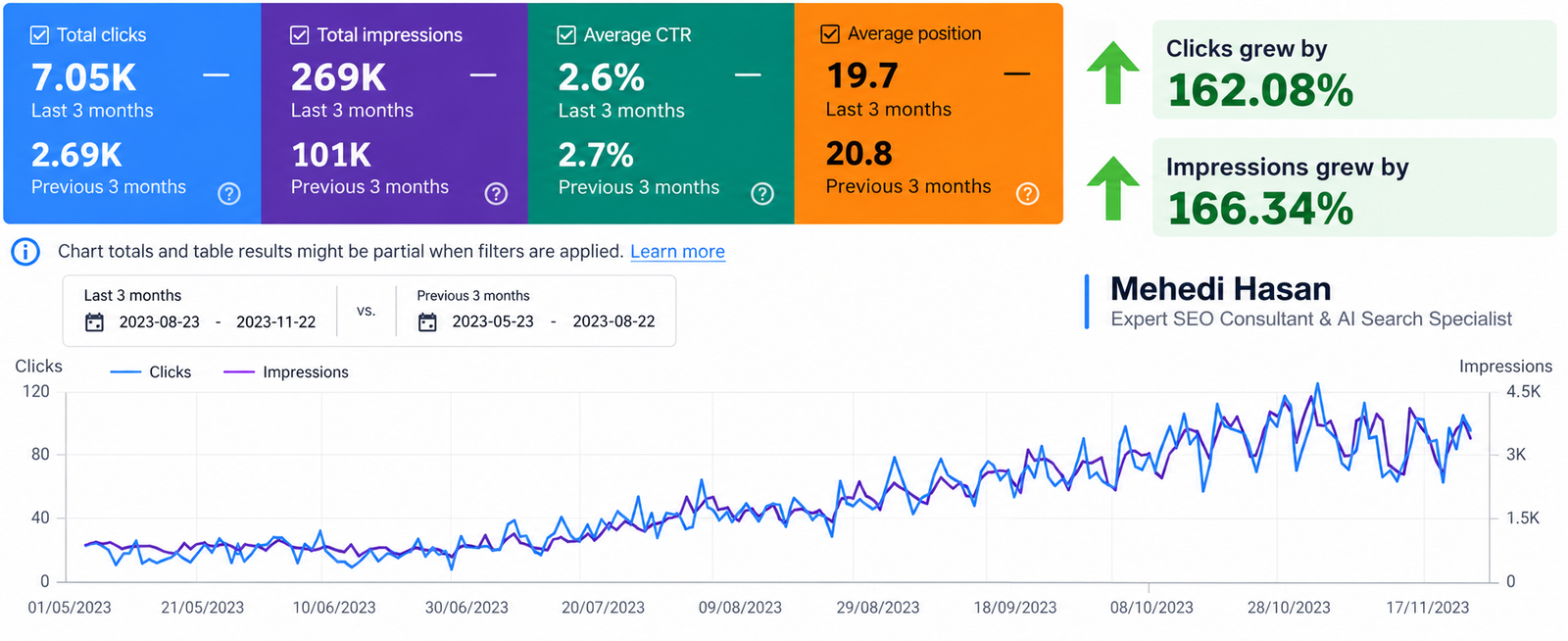
- 166% increase in organic search impressions
- 162% increase in organic search clicks
- Improved rankings for important car brands and model-specific keywords
- Increased customer engagement and reported sales inquiries
- Stronger organic visibility within Singapore’s used car market
These results demonstrate how targeted technical improvements, localized keyword strategies, and structured content optimization can substantially improve organic search performance.
2. Client Background
The client was an established automotive dealership specializing in pre-owned vehicles in Singapore.
Its website served as a digital showroom where prospective buyers could explore available vehicles, compare models, and inquire about purchasing options.
However, maintaining an online inventory was not sufficient to attract customers through search engines.
The dealership needed to appear more prominently when prospective buyers searched for specific used vehicles, compared car models, or researched purchasing options.
Business Objectives
The campaign was designed around four objectives:
- Increase organic search visibility for commercially relevant automotive keywords.
- Attract potential buyers searching for used cars in Singapore.
- Improve search rankings for individual vehicle brands, models, and manufacturing years.
- Increase customer inquiries and support online sales through more qualified website traffic.
3. Initial SEO Challenges
Challenge 1: Limited Organic Search Visibility
The dealership’s website was not achieving its desired visibility for important automotive searches.
Potential customers searching for used vehicles could discover competing dealerships before reaching the client’s website.
This created a missed opportunity to attract buyers actively researching their next vehicle.
Challenge 2: Insufficient Keyword Targeting
Used car buyers often search using highly specific terms.
Examples include:
- Used Toyota cars in Singapore
- Second-hand Honda Civic Singapore
- Used Mercedes-Benz Singapore
- Toyota Corolla used car price
- Affordable used cars in Singapore
These examples illustrate relevant search intent rather than verified campaign keywords.
The website needed a more focused keyword strategy connecting individual vehicle pages and supporting content with relevant customer searches.
Challenge 3: Technical and On-Page SEO Limitations
The campaign identified opportunities to improve the website’s technical structure, navigation, metadata, and on-page relevance.
These limitations could reduce search engines’ ability to understand the relationship between vehicle listings, category pages, and supporting content.
Challenge 4: Competitive Local Search Market
Singapore’s automotive market contains multiple dealerships and vehicle-listing platforms competing for the same search audience.
The dealership needed content and landing pages that reflected local buying behavior rather than relying exclusively on broad automotive keywords.
Challenge 5: Limited Conversion Efficiency
The business needed more than increased website visits.
Its priority was attracting people with genuine purchasing intent and guiding them toward vehicle inquiries and sales conversations.
This required closer alignment between keyword targeting, page content, and customer needs.
4. SEO Strategy and Implementation
The campaign combined technical SEO, localized content development, keyword targeting, and internal linking.
Phase 1: Technical SEO Audit and Website Optimization
The first stage focused on assessing the website’s technical foundation.
The objective was to identify weaknesses affecting search engine accessibility, website structure, and user navigation.
The technical SEO work focused on:
- Reviewing website architecture and page hierarchy.
- Improving navigation between relevant vehicle and category pages.
- Identifying opportunities to strengthen search engine accessibility.
- Reviewing technical factors affecting user experience.
- Establishing a clearer structure for important automotive landing pages.
A stronger technical foundation supported the effectiveness of subsequent content and on-page improvements.
Phase 2: Localized Keyword Research
The next priority was understanding how Singaporean customers searched for second-hand vehicles.
Rather than concentrating exclusively on broad keywords such as “used cars,” the strategy emphasized commercially relevant search terms.
Keyword categories included:
Location-based keywords: Searches connecting used car purchases with Singapore.
Brand-specific keywords: Searches focused on manufacturers such as Toyota, Honda, BMW, and Mercedes-Benz.
Model-specific keywords: Queries involving particular vehicle models.
Year-specific keywords: Searches combining vehicle models with manufacturing or registration years.
Informational keywords: Queries from prospective buyers researching used vehicle ownership and purchasing decisions.
This approach aimed to connect the website with users at different stages of the car-buying journey.
Phase 3: Topical Content Cluster Development
The campaign developed topical clusters around the Singapore used car market.
The purpose was to create a more organized content structure and strengthen the website’s relevance to related automotive searches.
The content strategy connected broader used car topics with specific vehicle-related subjects.
For example, a main used car category could be supported by pages covering individual manufacturers, vehicle models, and relevant buying considerations.
This structure helped users navigate related information while making the website’s topical relationships clearer to search engines.
Phase 4: On-Page SEO Improvements
Existing pages were refined to better align with their target keywords and search intent.
The optimization work included:
- Improving SEO title tags.
- Refining meta descriptions.
- Restructuring page headings.
- Updating page copy to reflect relevant automotive search terms.
- Improving the relationship between content and user search intent.
- Strengthening the relevance of important vehicle landing pages.
Special attention was given to pages targeting vehicle brands, individual models, and model years.
These pages were particularly valuable because they could attract customers already interested in specific vehicles.
Phase 5: Strategic Internal Linking
Internal linking was improved to establish clearer connections between related pages.
The strategy focused on connecting relevant automotive content with important vehicle and category pages.
This supported three objectives:
- Help visitors discover relevant vehicles and supporting information.
- Improve search engine discovery of related website pages.
- Strengthen the site’s overall content organization.
The result was a more connected website structure designed to support both SEO performance and user navigation.
Phase 6: Commercial Landing Page Optimization
The campaign also focused on improving the relevance of pages associated with specific vehicle searches.
The objective was to match pages more closely with the information prospective buyers expected to find.
By prioritizing brand, model, and year-specific searches, the strategy aimed to attract visitors with stronger purchase intent.
This helped connect organic search activity with the dealership’s lead-generation objectives.
5. Campaign Results and Performance
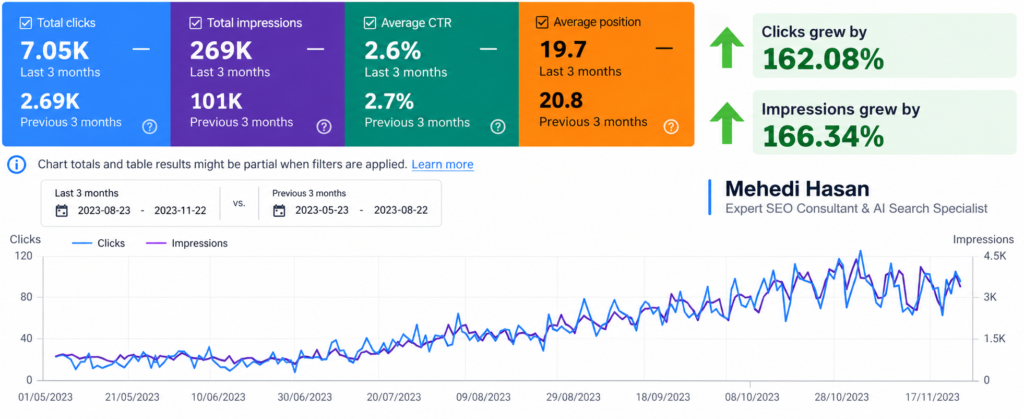
After three months of SEO implementation, the dealership reported substantial improvements in Google search visibility.
Key Performance Indicators
| Performance Metric | Reported Result |
| Organic Search Impressions | +166% |
| Organic Search Clicks | +162% |
| Brand and Model Keyword Rankings | Improved |
| Customer Engagement | Improved |
| Sales Inquiries | Increased, not quantified |
| Sales Conversions | Improvement reported, not quantified |
| Campaign Duration | 3 Months |
Organic Search Impressions: +166%
The website experienced a 166% increase in search impressions.
This means its pages appeared substantially more frequently in Google search results during the measured comparison period.
The increase indicates broader search visibility for automotive-related queries.
Organic Search Clicks: +162%
Organic search clicks increased by 162%.
This was a significant outcome because the campaign aimed to attract more visitors through unpaid search results.
The improvement suggests that the website was reaching a larger search audience and generating more visits from Google.
Keyword Ranking Improvements
The campaign also reported improved rankings for important keywords associated with popular vehicle manufacturers and models.
These ranking gains supported the dealership’s ability to compete for searches related to its inventory.
Customer Engagement and Lead Generation
The original case study reported improved customer engagement, increased inquiries, and stronger sales conversion activity.
However, exact inquiry volumes, conversion rates, and sales revenue were not disclosed.
Accordingly, the commercial impact should be described as a reported improvement rather than a quantified financial return.
6. Business Impact
The SEO campaign produced benefits beyond search engine visibility.
Stronger Market Presence
Improved rankings and search impressions increased the dealership’s exposure to prospective buyers searching for used vehicles in Singapore.
More Relevant Organic Traffic
Targeting vehicle-specific and localized keywords helped align search traffic with the dealership’s commercial offering.
Improved Customer Discovery
Better website structure and internal linking made it easier for visitors to explore relevant vehicle pages.
Greater Lead-Generation Potential
The reported increase in inquiries indicated that improvements in organic search performance were supporting the dealership’s broader customer acquisition objectives.
A Stronger Foundation for Continued SEO
The combination of technical improvements, content clusters, and optimized landing pages created a structure that could support future organic growth.
7. Key Takeaways
This campaign highlights several important principles for automotive SEO.
Search intent matters more than keyword volume alone. Vehicle-specific searches can be commercially valuable because they reflect clearly defined customer interests.
Local relevance is essential. Content aligned with Singapore’s automotive market can better address the needs of local buyers.
Technical SEO and content optimization work together. A clear website structure helps search engines discover relevant pages while supporting a better browsing experience.
Internal linking supports both navigation and SEO. Connecting related vehicle and category pages helps visitors find information and improves content discoverability.
Search visibility and sales are different performance measures. Growth in impressions and clicks should be evaluated alongside verified inquiry, conversion, and revenue data.
8. Conclusion
The three-month SEO campaign demonstrated how a targeted approach to technical SEO, localized content, topical clustering, and vehicle-specific page optimization can improve the search performance of an automotive dealership.
With reported increases of 166% in organic search impressions and 162% in organic search clicks, the dealership achieved substantially greater visibility in Google’s search results.
The campaign also reported stronger keyword rankings, improved engagement, and increased customer inquiries.
The central lesson is that effective automotive SEO requires more than attracting traffic. It requires connecting relevant search demand with useful vehicle information and clear opportunities for prospective buyers to contact the dealership.