

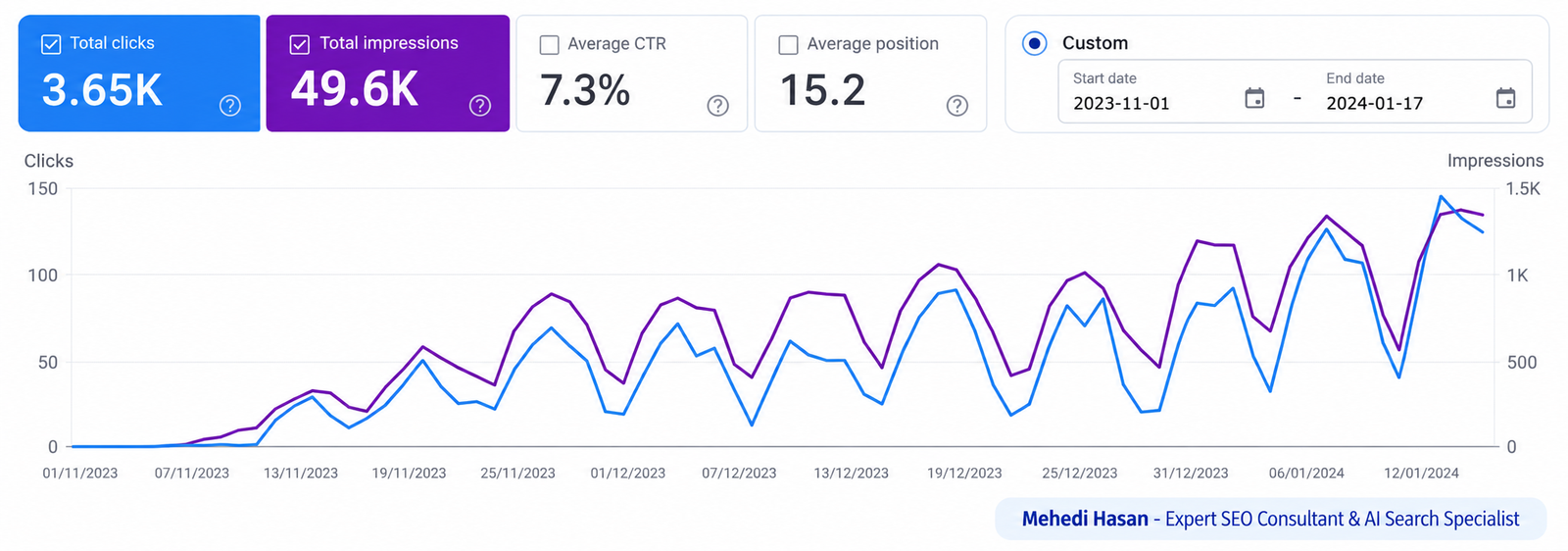
Executive Summary
Launching a new website is only the beginning. The real challenge is making it discoverable to potential customers in an increasingly competitive search environment.
This case study examines a newly launched website that reportedly achieved 50,000 Google Search impressions within its first three months.
The central objective was to establish organic search visibility from a limited starting position and create a foundation for sustainable growth.
The reported outcome demonstrates how quickly a new website can begin gaining exposure in Google Search. However, impressions represent search visibility rather than website visits, leads, or revenue.
1. Project Overview
Website Type: Newly Launched Website
Industry: Not Disclosed
Starting Position: Limited Established Search Visibility
Primary Goal: Build Organic Search Presence
Reporting Period: First 90 Days
A new website typically faces several obstacles, including limited search history, minimal existing keyword coverage, and competition from established domains.
The project therefore required an SEO approach focused on helping search engines discover, understand, and appropriately rank relevant website content.
2. The SEO Challenge
The main challenge was building search visibility within a relatively short period.
Four areas were particularly important to evaluate:
Limited Search Presence: A newly launched domain may initially have few indexed pages and little visibility for relevant queries.
Competitive Search Results: Established websites often have more extensive content, stronger backlink profiles, and longer performance histories.
Content and Keyword Coverage: New websites need pages that address the questions, needs, and search intent of their target audience.
Technical Readiness: Search engines must be able to crawl, render, and index important pages before those pages can compete effectively.
3. SEO Strategy and Implementation Framework
The following framework outlines the activities that could support a campaign of this type. The precise actions undertaken in the original project require confirmation.
Phase 1: Technical SEO and Website Foundation
The priority in a new-site SEO campaign is establishing a technically accessible website.
Key workstreams include:
- Reviewing crawlability and indexability.
- Validating XML sitemaps and robots.txt directives.
- Checking canonical URLs and redirect behavior.
- Reviewing mobile usability and page performance.
- Identifying technical errors that prevent important pages from appearing in search.
Strategic purpose: Ensure that search engines can efficiently discover and process the website’s most valuable pages.
Phase 2: Keyword Research and Search Intent Mapping
A new website needs a clear understanding of the queries its target audience uses.
The recommended process involves identifying relevant primary keywords, long-tail opportunities, informational searches, and commercially valuable terms.
Keywords should then be mapped to appropriate landing pages to avoid unnecessary overlap and establish clear content priorities.
Strategic purpose: Build topical relevance while targeting achievable search opportunities.
Phase 3: Content Development and On-Page SEO
Once the website’s technical foundation and keyword strategy are established, the focus shifts to useful, search-aligned content.
Core activities include:
- Creating pages around distinct search intents.
- Writing clear page titles and meta descriptions.
- Organizing content with meaningful headings.
- Adding relevant explanations, examples, and FAQs.
- Strengthening internal links between related pages.
- Reviewing content quality, accuracy, and originality.
Strategic purpose: Give search engines and visitors useful pages that directly address relevant queries.
Phase 4: Performance Monitoring and Refinement
Google Search Console provides visibility into how a website performs in Google’s organic search results.
The primary metrics to review are:
- Total search impressions.
- Organic search clicks.
- Average click-through rate.
- Average search position.
- Search queries generating visibility.
- Pages contributing to search growth.
Performance data can then guide updates to existing pages, identify new content opportunities, and reveal technical issues requiring attention.
Strategic purpose: Use actual search performance to prioritize further improvements.
4. Reported Campaign Results
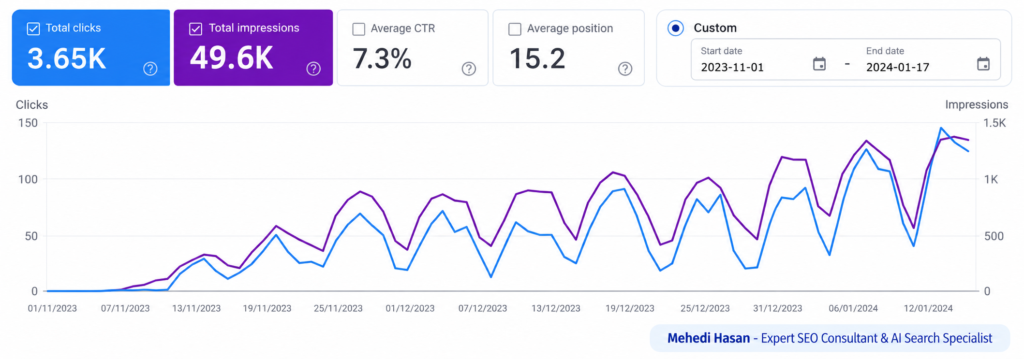
The headline result from the referenced case study was:
50,000 Google Search Impressions in Three Months
| Performance Indicator | Reported Outcome |
| Campaign duration | 3 months |
| Google Search impressions | 50,000 |
| Organic search clicks | Not verified |
| Organic traffic growth | Not verified |
| Keyword ranking improvements | Not verified |
| Leads or conversions | Not verified |
What Does This Result Mean?
A Google Search impression generally occurs when a link to the website appears in a Google Search result, subject to Google’s reporting rules.
Achieving 50,000 impressions suggests that the website gained measurable exposure across search results during the reporting period.
This is an encouraging early visibility milestone, particularly for a new website. However, it does not establish how many people visited the website or became customers.
5. Strategic Insights
A strong technical foundation matters. Content cannot reach its full organic potential if important pages are inaccessible or incorrectly indexed.
Search intent should guide content decisions. Relevant pages built around specific user needs are more useful than content created solely to include keywords.
Long-tail searches can support early visibility. Specific queries may provide opportunities for newer websites to compete while building broader topical coverage.
Performance data should guide optimization. Search Console can reveal which topics, pages, and queries deserve additional investment.
Visibility is an early-stage metric. Impressions are valuable for evaluating discoverability, but clicks, engagement, leads, and revenue are necessary for assessing business impact.
6. Conclusion
The reported achievement of 50,000 Google Search impressions in 90 days illustrates the potential for a newly launched website to establish meaningful search visibility within a short period.
The case also highlights an important distinction: gaining visibility is a starting point, not the final measure of SEO success.
A complete assessment would examine whether that visibility translated into qualified organic traffic, stronger keyword positions, and measurable business outcomes.