

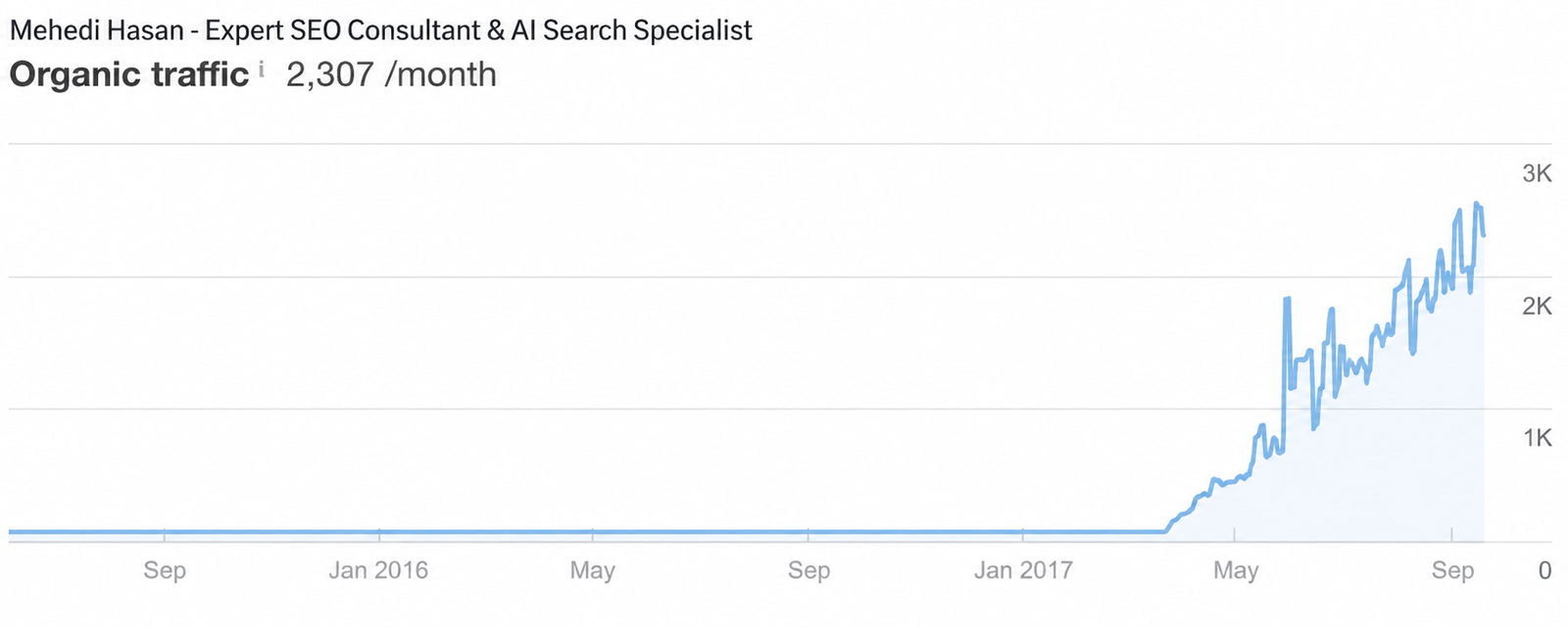
An e-commerce business was struggling to generate meaningful traffic from organic search and relied heavily on paid acquisition.
At the beginning of the campaign, the website attracted approximately 100 organic visitors per month and had limited search visibility.
A structured 12-month SEO campaign was developed to improve technical performance, identify achievable keyword opportunities, expand relevant content, strengthen authority, and increase the website’s overall presence in Google search results.
By the end of the campaign, monthly organic traffic had increased to approximately 2,300 visitors, while the website ranked for 3,591 organic keywords.
Campaign at a Glance
| Metric | Result |
| Campaign Duration | 12 Months |
| Monthly SEO Budget | $950 |
| Starting Organic Traffic | Approx. 100/month |
| Final Organic Traffic | Approx. 2,300/month |
| Traffic Growth | Approx. 2,200% |
| Overall Traffic Increase | Approx. 23× |
| Organic Keywords Achieved | 3,591 |
The Challenge
The e-commerce website had products with organic search potential, but its existing SEO activity lacked a coordinated strategy.
The main challenges included:
- Very low organic search traffic
- Heavy dependence on paid traffic
- Limited keyword visibility
- Missed opportunities across product and category pages
- Content gaps compared with competing websites
- Underoptimized pages already ranking within reach of stronger Google positions
- Insufficient authority supporting commercially important pages
- No clear long-term content and link-building framework
Instead of continuing with isolated SEO activities, the website needed a structured strategy connecting technical SEO, keyword research, content development, internal optimization, and authority building.
The SEO Strategy
1. Comprehensive SEO Audit
The campaign began with a detailed review of the website to identify issues that could prevent search engines from properly crawling, understanding, and ranking important pages.
The audit focused particularly on:
- Website structure
- Search visibility
- Content accessibility
- Page-level optimization
- Internal linking opportunities
- Technical barriers affecting rankings
- Existing keyword performance
This created the foundation for the rest of the campaign.
Rather than immediately creating large amounts of new content, priority was given to understanding where the website already had SEO potential and where improvements could produce the highest return.
2. Easy-Win Keyword Analysis
One of the most important parts of the strategy was identifying keywords for which the website was already showing some visibility.
The analysis identified 76 potential keyword opportunities appearing across approximately pages one to three of search results.
These keywords were associated with:
- Product pages
- Category pages
- Existing blog content
Because Google was already recognizing these pages as relevant, improving them offered a potentially faster route to increased visibility than starting exclusively with completely new keywords.
The optimization process focused on strengthening relevance, content quality, internal linking, and authority around these existing opportunities.
3. Competitor Keyword Gap Analysis
Competitor research was then conducted to understand where competing e-commerce websites were gaining organic visibility that the client was missing.
This analysis uncovered 31 important search terms for which competitors were ranking while the client’s website had little or no visibility.
These gaps helped identify new content opportunities and allowed the SEO campaign to prioritize subjects with demonstrated search demand.
Instead of publishing content without clear search intent, new content could therefore be developed around identifiable gaps in the market.
4. Strategic Content Development
Content became a central component of the growth strategy.
During the initial months of the campaign, SEO-focused long-form content was developed consistently around priority keywords.
Each piece was intended to serve a specific purpose within the site’s broader search strategy.
Content development focused on:
- Search intent
- Relevant keyword targeting
- Topical depth
- Useful information for potential customers
- Natural opportunities for internal links
- Connections between informational content and commercial pages
The objective was not simply to increase the number of indexed pages.
The broader goal was to expand the range of relevant searches for which the website could compete while strengthening the site’s topical coverage.
5. Link Building and Authority Development
Content optimization alone was not treated as sufficient.
A supporting link-building campaign was implemented to strengthen the authority of priority pages and keywords.
During the first three months, content creation and link acquisition were carried out in parallel.
The original campaign used a HOTH Foundations Medium link-building package, with links directed toward selected easy-win keyword opportunities and diversified anchor text.
The purpose of this stage was to reinforce pages that had already demonstrated ranking potential and give them stronger signals to compete for higher search positions.
6. Internal Linking Improvements
As more detailed content became available, internal linking opportunities increased.
Relevant blog content could be connected with:
- Product pages
- Category pages
- Related educational content
- Priority commercial pages
This helped create clearer relationships between pages and allowed SEO value to circulate more effectively throughout the website.
Internal linking also supported users by providing logical routes from informational content toward relevant products and categories.
Results
After 12 months of sustained SEO work, the website experienced substantial growth in organic search visibility.
Organic Traffic

Before the campaign: approximately 100 organic visitors per month
After the campaign: approximately 2,300 organic visitors per month
That represents approximately:
2,200% Organic Traffic Growth
or roughly:
23× the Original Monthly Organic Traffic
Organic Keyword Visibility

The website expanded its search presence to approximately:
3,591 Organic Keywords
This increased keyword footprint gave the business significantly broader exposure across relevant search queries and reduced its dependence on a small number of traffic sources.
Before vs. After
| SEO Metric | Before | After 12 Months |
| Monthly Organic Visitors | Approx. 100 | Approx. 2,300 |
| Organic Keyword Visibility | Very Limited | 3,591 Keywords |
| SEO Approach | Fragmented | Structured Campaign |
| Content Strategy | Limited | Consistent Long-Form SEO Content |
| Keyword Targeting | Unstructured | Opportunity & Competitor Driven |
| Internal Linking | Limited | Strategically Expanded |
| Authority Building | Inconsistent | Ongoing Link Acquisition |
What Drove the Growth?
The campaign did not depend on a single SEO tactic.
Growth came from combining several complementary activities:
Technical foundation
Potential barriers to ranking were identified before aggressive expansion.
Existing ranking opportunities
76 easy-win keywords were prioritized instead of focusing entirely on difficult new terms.
Competitor intelligence
31 keyword gaps helped guide new content development.
Consistent content production
Long-form SEO content increased topical coverage and keyword reach.
Authority development
Link building supported strategically important pages and search terms.
Internal linking
New and existing content was connected to strengthen relevant sections of the website.
The important factor was coordination. Each activity supported the others as part of one SEO system.
Key Takeaways
This project demonstrates how an e-commerce website with relatively little organic visibility can achieve significant search growth through a structured SEO strategy.
Three lessons stand out.
1. Existing rankings can contain valuable opportunities
Keywords already appearing within reach of page-one positions can often provide faster growth opportunities than targeting only highly competitive new terms.
2. Content should be built around evidence
Competitor gaps, existing rankings, search intent, and commercial relevance provided a clearer basis for deciding what content to create.
3. Content and authority work together
Detailed content can expand keyword coverage, while internal linking and external links can help strategically important pages compete more effectively.
Next Phase of the SEO Strategy
With a substantial content base established, the next phase should focus increasingly on strengthening pages that already demonstrate ranking potential.
Priority areas include:
- Building high-quality links to commercially valuable pages
- Updating content that is approaching top-ranking positions
- Expanding internal links between related topics
- Consolidating overlapping content where necessary
- Improving product and category page optimization
- Monitoring ranking changes and reallocating effort toward the strongest opportunities
- Expanding topical coverage based on additional competitor and search-gap research
The objective is to convert the broader keyword footprint into stronger positions for the search terms most relevant to commercial growth.
Conclusion
Over a 12-month period, the e-commerce website reportedly grew from approximately 100 to 2,300 monthly organic visitors and expanded its search visibility to 3,591 organic keywords.
The campaign showed that substantial organic growth can come from systematically combining technical SEO, opportunity-based keyword research, competitor analysis, long-form content, internal linking, and authority building.
Rather than relying on isolated SEO tactics, the project used a coordinated strategy designed around measurable search opportunities.