

A successful e-commerce SEO campaign requires more than publishing content or building backlinks. Sustainable organic growth comes from identifying technical barriers, understanding search demand, prioritizing realistic ranking opportunities, and consistently executing against a structured strategy.
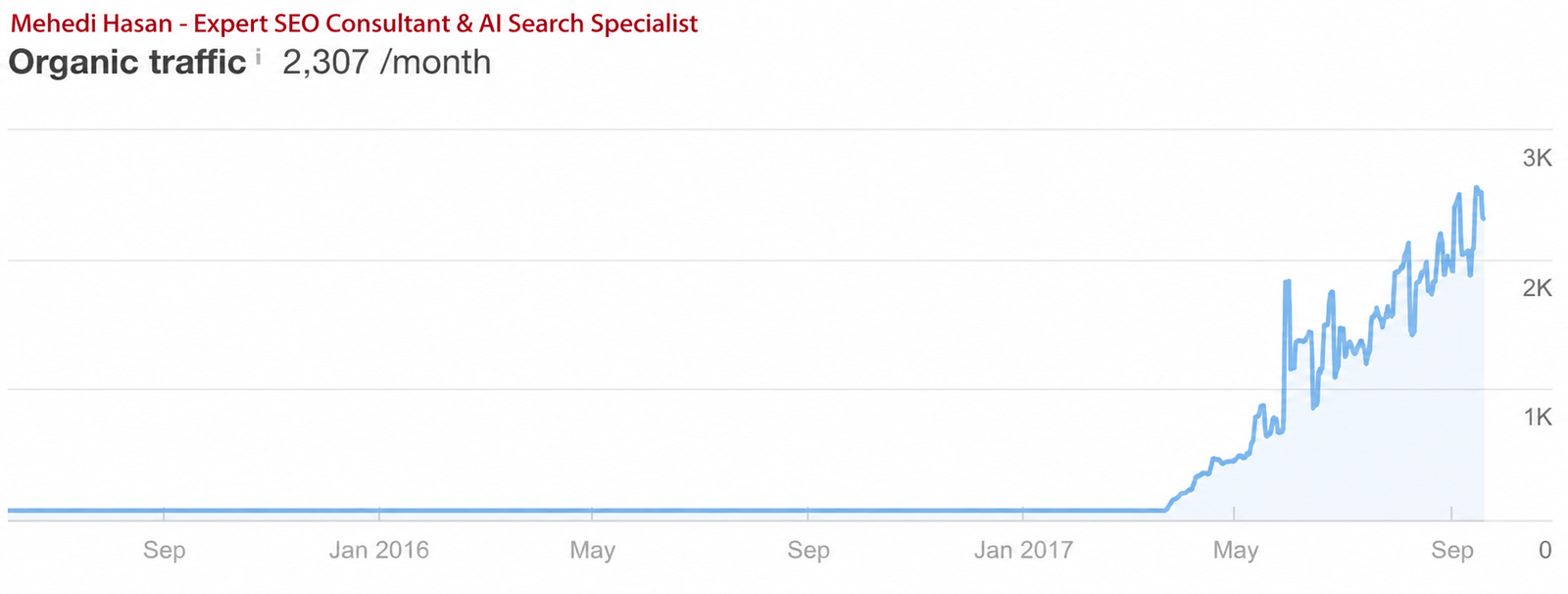
This case study examines how a focused 12-month SEO campaign helped an e-commerce website grow from approximately 100 monthly organic visitors to more than 2,300, while expanding its organic keyword footprint to 3,591 ranking keywords.
Campaign Overview
| Metric | Result |
| Campaign Duration | 12 Months |
| Monthly SEO Budget | $1,000 |
| Starting Organic Traffic | Approximately 100 visitors/month |
| Final Organic Traffic | 2,307 visitors/month |
| Organic Keywords | 3,591 |
| Primary Focus | Technical SEO, Keyword Research, Content & Link Building |
The objective was clear: reduce the website’s dependence on paid acquisition and establish a sustainable organic search channel capable of attracting relevant potential customers.
The Challenge
When the campaign began, the e-commerce website had very limited organic visibility.
Although the business was already generating traffic through paid channels, its presence in Google’s organic search results was weak. Previous SEO activities had been carried out inconsistently, without a unified strategy connecting technical optimization, keyword targeting, content creation, and authority building.
Several issues limited organic growth:
- Very low organic search traffic
- Limited keyword visibility
- Underoptimized product and category pages
- Missed ranking opportunities
- Content gaps compared with competitors
- Insufficient supporting informational content
- Lack of a structured link-building strategy
Instead of pursuing isolated SEO tactics, the campaign required a complete strategy built around opportunities that could generate measurable ranking improvements.
The SEO Strategy
1. Comprehensive SEO Audit
The campaign started with an in-depth review of the website.
The purpose of the audit was to identify issues that could prevent search engines from properly discovering, understanding, indexing, or ranking important pages.
Key areas reviewed included:
- Website architecture
- Search engine accessibility
- Indexation
- Internal linking
- Page-level optimization
- Content visibility
- Product and category page structure
- Keyword targeting
- Existing organic rankings
The audit created the foundation for the entire campaign.
Rather than immediately producing more content, priority was given to understanding what was already working, where ranking potential existed, and what obstacles needed to be addressed first.
2. Finding High-Potential “Easy Win” Keywords
One of the most important opportunities came from keywords for which the website was already ranking, but not yet in strong positions.
The research identified 76 potential keywords appearing between the lower positions of page one and approximately page three of the search results.
These keywords were especially valuable because Google had already associated the website with the relevant search topics.
Instead of starting entirely from zero, existing rankings could be strengthened through better optimization.
The opportunities covered several page types, including:
- Product pages
- Category pages
- Blog articles
- Commercial search terms
- Informational search queries
These keywords became an early priority because improving an existing position can often produce results faster than attempting to rank a completely new page for a highly competitive term.
3. Competitor Keyword Gap Analysis
Ranking opportunities were not limited to keywords already associated with the website.
A competitive analysis was conducted to identify search queries generating visibility for competing businesses but not for the client.
The analysis uncovered 31 important competitor keywords that represented content and ranking gaps.
These opportunities provided direction for:
- New content creation
- Category optimization
- Supporting articles
- Internal linking
- Future landing pages
Instead of selecting topics based solely on search volume, the campaign focused on keywords that were relevant to the client’s products and demonstrated existing search demand within the competitive landscape.
4. Building a Content Strategy Around Search Intent
Content became a central part of the growth strategy.
During the initial months of the campaign, long-form SEO content was created consistently around high-priority topics identified during keyword research.
Each article was designed to satisfy a specific search intent rather than simply increasing the number of pages on the website.
Content development focused on:
- High-value informational queries
- Topics related to commercial products
- Supporting category and product pages
- Long-tail search opportunities
- Competitor content gaps
- Internal linking opportunities
Detailed informational content also strengthened the site’s topical coverage.
For an e-commerce website, this is particularly useful because product pages alone often cannot address every question customers search for during the buying journey.
Informational content can attract visitors earlier in that journey and guide them toward relevant commercial pages through internal links.
5. Strategic Link Building
Content optimization was supported by an ongoing link-building campaign.
The strategy focused particularly on pages and keywords that already demonstrated ranking potential.
Instead of concentrating links around a single exact-match keyword, diversified anchor text was used to develop a more natural backlink profile.
Link-building efforts were designed to strengthen:
- Priority landing pages
- Existing easy-win keywords
- Relevant informational content
- Overall website authority
The campaign combined content development and authority building rather than treating them as separate activities.
Results
After 12 months of consistent SEO execution, the website recorded substantial growth in organic search visibility.
Organic Traffic

Starting point: Approximately 100 monthly organic visitors
After 12 months: 2,307 monthly organic visitors
This represents approximately 23 times the original monthly organic traffic level.
More importantly, the growth came from organic search rather than requiring the business to purchase every visit through paid advertising.
Keyword Growth
The website also expanded its presence across Google’s search results to:
3,591 Organic Keywords

This wider keyword footprint indicated that the website was becoming visible across a much broader range of commercially and informationally relevant searches.
Rather than depending on a handful of high-volume terms, the site developed visibility across hundreds and eventually thousands of search queries.
What Drove the Growth?
The performance was not the result of one isolated SEO technique.
Several parts of the strategy worked together.
Technical Foundation
SEO auditing helped identify barriers that could restrict search visibility.
Opportunity-Based Keyword Research
The campaign prioritized terms where ranking improvements were realistically achievable.
Competitor Analysis
Keyword gaps exposed opportunities the existing website had overlooked.
Long-Form Content
New content increased topical coverage and gave the website additional opportunities to rank.
Internal Linking
Informational content created more pathways to important category and commercial pages.
Authority Building
Relevant backlinks supported pages already demonstrating organic potential.
Consistent Execution
SEO activities were maintained over the full 12-month campaign instead of relying on short-term interventions.
Why the Strategy Worked
One of the campaign’s strongest characteristics was prioritization.
Instead of immediately competing for only the most difficult keywords in the market, the strategy first identified opportunities where the website was already close to stronger positions.
Improving a keyword from page two to page one can potentially have a much greater impact than producing another article for a keyword where the website has no existing authority.
At the same time, competitor gap analysis created a pipeline of additional topics for longer-term expansion.
This combination provided both:
Shorter-term ranking opportunities through existing keywords
and
Longer-term organic growth through new content and increased topical coverage.
Building a Sustainable SEO Asset
The campaign did more than increase traffic.
By the end of the project, the website had built a significantly larger content and keyword foundation.
That foundation created additional opportunities for:
- Internal linking
- Category-page optimization
- Product discovery
- Backlink acquisition
- Long-tail keyword rankings
- Content updates
- Conversion optimization
As a website’s content library and authority improve, future SEO campaigns can build on those existing assets instead of starting from zero.
Next Phase of Growth
With a stronger content foundation established, the next stage should focus on strengthening the pages showing the highest commercial and ranking potential.
Priority activities include:
- Building authoritative links to priority pages
- Strengthening internal links between informational and commercial content
- Updating existing articles based on ranking performance
- Improving category and product-page optimization
- Expanding content around proven keyword clusters
- Monitoring rankings and identifying new easy-win opportunities
- Improving organic traffic conversion rates
At this stage, the objective shifts from simply expanding visibility toward maximizing the commercial value of the organic traffic already being generated.
Key Takeaways
This campaign demonstrates several important principles of e-commerce SEO.
SEO growth starts with research.
Understanding current rankings, competitors, technical limitations, and search demand should come before execution.
Existing rankings can contain some of the best opportunities.
Keywords already appearing within striking distance of page one deserve close attention.
Content should support commercial pages.
Informational articles are most valuable when they strengthen the wider customer journey and connect users to relevant products or categories.
SEO compounds over time.
Content, rankings, internal links, and backlinks create assets that can continue supporting future organic growth.
Consistency matters.
The results were achieved over a 12-month campaign rather than through a one-time optimization project.