


Executive Summary
Breaking into a competitive e-commerce market requires more than an attractive website and a strong product offering. For a newly established premium beverage retailer in Malaysia, the challenge was building search visibility in a market already dominated by established competitors.
The website initially relied heavily on branded search traffic, limiting its ability to reach customers searching for products, categories, and relevant information without knowing the company’s name.
The SEO campaign addressed these limitations through technical improvements, targeted keyword optimization, content development, category restructuring, and strategic improvements to high-potential pages.
Key Results
- 593.3% increase in reported monthly organic traffic between September 2020 and the 2022 reporting point.
- 16,111 to approximately 111,700 monthly organic visits.
- 250.4% growth during the first 12 months.
- 191% increase in the reported organic keyword-ranking metric, from 7,954 to approximately 23,150.
The results demonstrate the potential of combining technical SEO, search-intent alignment, and content optimization into a coordinated long-term growth strategy.
1. Client Background
The client was a newly launched Malaysian e-commerce business specializing in premium alcoholic beverages.
Although the company operated in an established consumer market, its website faced significant barriers to organic discovery.
Established competitors already occupied valuable positions in Google’s search results. These businesses benefited from stronger website histories, established content libraries, and greater visibility for commercially relevant search queries.
For the client, competing effectively required a strategy that could gradually build search relevance and capture customers beyond its existing brand audience.
The objective was to develop organic search into a more effective acquisition channel.
2. The Core SEO Challenges
Limited Non-Branded Visibility
The website’s initial SEO focus was concentrated on branded keywords. This restricted its ability to reach potential customers searching for product types, categories, and related information.
Expanding non-branded visibility became a central campaign priority.
Technical SEO Limitations
The website had technical issues affecting its search performance, including duplicate content and broken pages.
These problems required attention to improve site quality, indexing efficiency, and the accessibility of important pages.
Insufficient Content Depth
The website lacked the content depth needed to compete consistently across informational and commercial search queries.
Developing relevant, optimized content was necessary to strengthen the site’s topical coverage.
Competitive Search Environment
As a relatively new website, the business faced established competitors with stronger search visibility.
Rather than pursuing every competitive keyword simultaneously, the campaign required a prioritized approach focused on achievable ranking opportunities.
3. SEO Strategy and Implementation
The campaign followed seven interconnected areas of optimization.
Phase 1: Comprehensive SEO Audit
The initial stage involved assessing the website’s technical and on-page SEO condition.
The purpose was to identify problems restricting organic performance and establish priorities for corrective action.
The audit informed the technical fixes, page optimization work, and structural improvements implemented during the campaign.
Phase 2: Technical SEO Optimization
Technical improvements focused on resolving duplicate content and broken-page issues.
These changes were intended to improve website accessibility for search engines, reduce unnecessary technical barriers, and establish a stronger foundation for subsequent optimization.
Phase 3: Search-Intent-Based On-Page SEO
Product pages were optimized to better align with high-intent search queries.
The strategy focused on increasing the relevance of important commercial pages to searches associated with the client’s product offering.
This was especially important for expanding visibility beyond branded searches.
Phase 4: SEO Content Development
The content strategy targeted informational search opportunities relevant to the client’s niche.
SEO-focused blog content was developed to broaden keyword coverage, answer relevant user questions, and support the website’s authority within its market.
The objective was to build a more comprehensive organic presence rather than rely exclusively on product and category pages.
Phase 5: SERP Feature Optimization
Content was refined to improve its suitability for enhanced search-result features, including rich results and FAQ-related search appearances.
This work aimed to increase visibility within search results and create additional opportunities to attract relevant clicks.
Eligibility for search features does not guarantee that Google will display them.
Phase 6: High-Potential Page Prioritization
A sweet-spot analysis was used to identify pages with promising ranking potential.
Instead of distributing optimization resources evenly across the website, attention was directed toward pages where targeted improvements could create meaningful search-performance gains.
This approach supported more focused SEO execution.
Phase 7: Product and Category Page Restructuring
The campaign also included restructuring product and category pages to improve their SEO organization and user experience.
The goal was to make important commercial pages easier to navigate, more relevant to search queries, and better positioned to compete in organic results.
4. Campaign Performance and Results
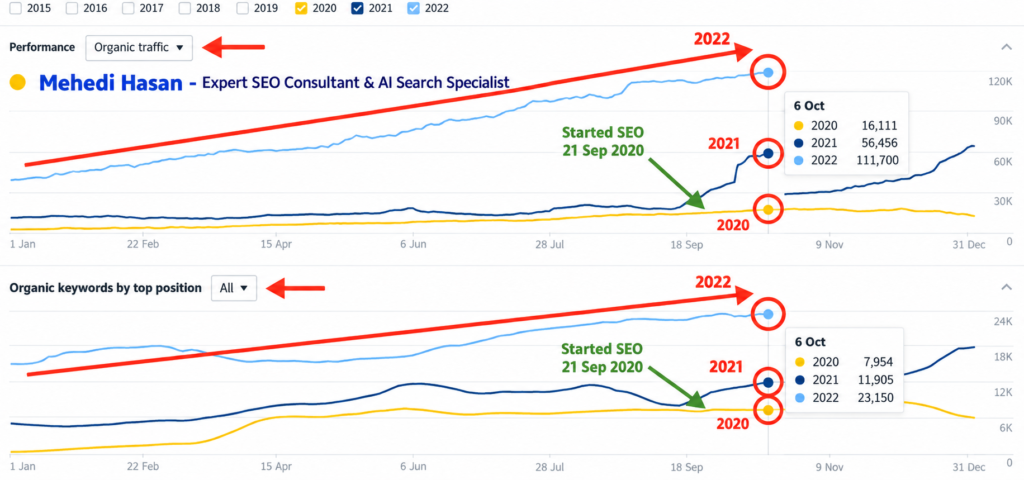
Organic Traffic Growth
At the beginning of the campaign in September 2020, the website recorded 16,111 monthly organic visits.
By September 2021, reported monthly organic traffic had increased to 56,456 visits.
This represented a 250.4% increase over the initial 12-month period.
The upward trajectory continued into 2022, when the website reportedly reached approximately 111,700 monthly organic visits.
Compared with the September 2020 baseline, this represented an overall increase of approximately 593.3%.
Organic Keyword Visibility
The original case study also reported an increase in its organic keyword-ranking metric from 7,954 in 2020 to approximately 23,150 in 2022.
This represents an increase of approximately 191%.
The improvement suggests broader search visibility across relevant queries, although the source does not define whether these figures represent total ranking keywords or keywords within specific ranking positions.
Performance Summary
| Performance Indicator | Initial | Reported Outcome |
| Monthly organic visits | 16,111 | ~111,700 |
| Organic traffic growth | Baseline | +593.3% |
| Organic ranking metric | 7,954 | ~23,150 |
| Ranking metric growth | Baseline | +191.0% |
Measurement note: These figures are based on the published case study. They have not been independently validated against Google Search Console, Google Analytics, or third-party SEO reporting exports.
5. Strategic Insights
Several important lessons emerge from this campaign.
Technical SEO creates the foundation. Resolving structural and technical issues helps ensure that subsequent content and page optimization efforts are not undermined by avoidable website problems.
Non-branded keywords expand acquisition opportunities. Targeting relevant searches beyond a company’s name can expose a business to customers who have not previously encountered its brand.
Content and commercial SEO work together. Informational content supports broader discovery, while optimized product and category pages target users with more direct commercial intent.
Prioritization improves execution. Identifying pages with strong ranking potential allows SEO resources to be directed toward opportunities with clearer potential value.
SEO growth is cumulative. The reported results developed over an extended period, illustrating the importance of sustained optimization rather than expecting immediate outcomes.
6. Business Impact
The most clearly documented outcome was a substantial increase in organic search visibility.
By reaching approximately 111,700 monthly organic visits, the website developed a significantly larger search audience than it had at the campaign’s outset.
The reported expansion in keyword visibility also suggests that the site became discoverable across a broader range of relevant searches.
These outcomes could support customer acquisition and commercial growth. However, the published source does not provide verified revenue, transaction, conversion-rate, or customer-acquisition figures.
Accordingly, the business impact should be evaluated primarily through the documented improvements in organic traffic and search visibility.
7. Conclusion
This case study illustrates how a coordinated SEO campaign can help a relatively new e-commerce website compete in a crowded search environment.
By addressing technical weaknesses, improving commercial pages, developing relevant content, and prioritizing promising ranking opportunities, the campaign was associated with substantial growth in organic search performance.
Monthly organic visits increased from 16,111 to approximately 111,700, while the reported keyword-ranking metric grew by approximately 191%.
The central lesson is that sustainable SEO performance depends on aligning technical website quality, content relevance, and strategic execution with the way customers search.