

Executive Summary
Growing an eCommerce business in the competitive health supplements industry requires more than targeting high-volume keywords. Success depends on building a technically sound website, publishing trustworthy content, improving product visibility, and attracting qualified organic visitors who are ready to purchase.
This case study examines an SEO campaign for an online health supplements retailer facing declining search visibility, content quality issues, and intense competition from established brands.
The campaign combined technical SEO improvements, content restructuring, keyword optimization, and relevant link acquisition to strengthen the website’s organic search performance.
Campaign Results

| Key Performance Indicator | Reported Improvement |
| Organic Website Traffic | +240.33% |
| Organic Revenue | +438.02% |
| Primary Marketing Channel | Google Organic Search |
| Industry | Health Supplements |
| Core Strategy | Technical SEO, Content & Authority Building |
1. Project Background
The client operated an eCommerce website specializing in health supplements and wellness products.
Despite offering products in a market with significant consumer demand, the website struggled to compete organically against established retailers, recognized supplement brands, and authoritative health information websites.
Several SEO weaknesses were limiting its ability to attract relevant visitors and convert organic search demand into sales.
The website required a structured SEO improvement strategy that could address existing performance problems while establishing a stronger foundation for long-term organic growth.
Primary Business Objectives
The campaign focused on four business objectives:
- Improve the website’s visibility across commercially relevant Google searches.
- Increase qualified organic traffic to important product, category, and informational pages.
- Strengthen content quality and website credibility in the health supplements market.
- Generate more organic revenue through improved search visibility and user experience.
2. Initial SEO Challenges
Challenge 1: Strong Competition in the Health Supplements Market
The health supplements industry is highly competitive, with established businesses occupying prominent search positions for valuable commercial keywords.
The website faced difficulty gaining visibility against competitors with stronger content libraries, more established domain authority, and broader search coverage.
Strategic priority: Identify achievable keyword opportunities and improve the relevance of pages targeting specific customer needs.
Challenge 2: Thin and Underperforming Content
Several website pages contained insufficient or weakly optimized content.
This limited their ability to provide meaningful information to users and compete effectively in organic search.
For health-related products, content quality is particularly important because customers expect reliable information about product ingredients, intended uses, and relevant precautions.
Strategic priority: Improve content depth, relevance, readability, and credibility.
Challenge 3: Keyword Cannibalization
Multiple pages were targeting overlapping keywords and similar search intent.
This created uncertainty about which pages should rank for particular queries and weakened the website’s overall content structure.
Strategic priority: Clarify keyword targeting and strengthen page-level search intent alignment.
Challenge 4: Poorly Optimized Landing Pages
Important landing pages were not fully optimized for their target keywords or user expectations.
Weaknesses included page titles, heading structures, content organization, and on-page relevance.
Strategic priority: Improve critical category and landing pages to attract more relevant organic visitors.
Challenge 5: Search Performance Decline Following Google Updates
The website had experienced search performance problems associated with Google algorithm updates.
This highlighted the need to reassess content quality, technical accessibility, and the overall usefulness of the website.
Strategic priority: Address identifiable SEO weaknesses and improve compliance with Google’s quality-oriented search guidance.
3. SEO Strategy and Implementation
A coordinated SEO strategy was developed around three core areas: technical improvements, content quality, and website authority.
Phase 1: Technical SEO Improvements
Technical SEO formed the foundation of the campaign.
The objective was to reduce technical barriers that could prevent search engines from discovering, interpreting, and ranking important website pages.
The campaign included technical SEO enhancements as part of its wider optimization effort.
Key areas relevant to this work included:
- Search engine crawling and indexing accessibility.
- Website architecture and page organization.
- Internal linking between relevant content and commercial pages.
- Identification of duplicate or competing page targets.
- Optimization of important landing page elements.
The technical work supported the broader goal of making the website easier for search engines to understand and more useful for visitors.
Phase 2: On-Page SEO Optimization
The next priority was improving the relevance and presentation of important website pages.
Metadata optimization
Page titles and meta descriptions were revised to better represent page topics and align with relevant search queries.
Heading structure improvements
Heading hierarchies were updated to improve content organization and make the main purpose of each page clearer.
Keyword cannibalization resolution
Overlapping keyword targets were reviewed to reduce competition between pages serving similar search intent.
Content layout improvements
Page content was reorganized to make important information easier to locate and understand.
Together, these changes aimed to improve search relevance and provide a more effective experience for potential customers.
Phase 3: Content Strategy and Quality Improvements
Content optimization was a central component of the campaign.
Existing blog content was reviewed and improved to better serve users searching for information about supplements, wellness topics, and related products.
The strategy emphasized three priorities.
- Improving existing content
Underperforming articles were updated to improve their relevance, usefulness, and overall quality.
- Targeting long-tail keywords
The campaign focused on more specific search queries that aligned with customer interests and niche product categories.
These keywords provided opportunities to reach relevant audiences without relying exclusively on highly competitive broad search terms.
- Strengthening content credibility
Content improvements emphasized expertise, authoritativeness, and trustworthiness.
For a health supplements website, credible information and transparent product descriptions are important to both user confidence and search quality.
Phase 4: Strategic Link Building
A targeted link-building strategy supported the website’s content and technical improvements.
The campaign focused on obtaining backlinks from relevant, quality websites rather than relying solely on link volume.
The objectives were to strengthen the website’s authority signals, improve the visibility of important pages, and support long-term search competitiveness.
Link relevance and quality were central considerations throughout the process.
4. Campaign Performance and Results
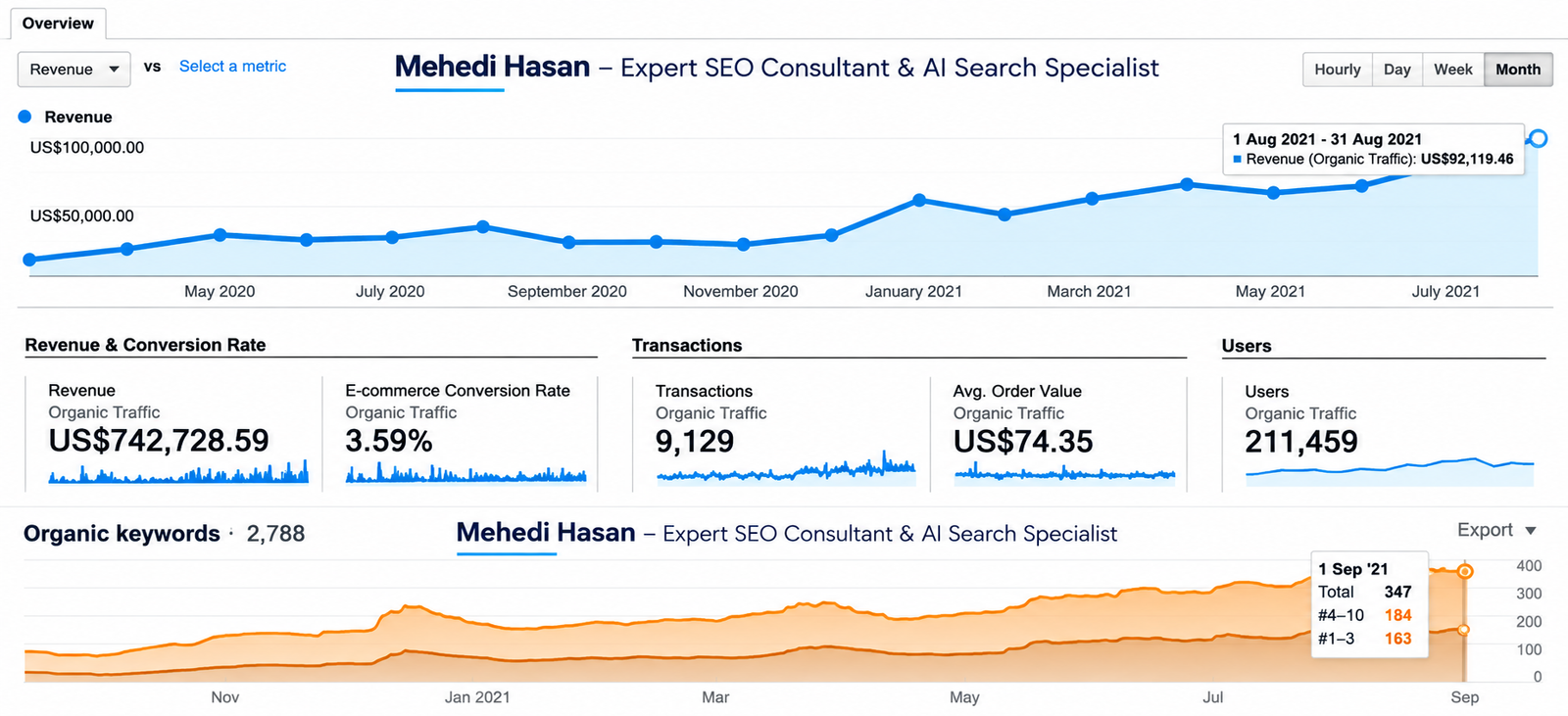
The reported campaign outcomes showed substantial improvements in both organic traffic and revenue.
Result 1: Organic Traffic Increased by 240.33%
The website recorded a 240.33% increase in organic traffic over the campaign’s reported comparison period.
This means organic traffic reached approximately 3.40 times its original level.
The growth was reported following a combination of technical improvements, on-page optimization, content updates, and link building.
Result 2: Organic Revenue Increased by 438.02%
The campaign also reported a 438.02% increase in organic revenue.
This represents approximately 5.38 times the original organic revenue level.
Revenue growth exceeding traffic growth is a particularly important outcome because it indicates that the commercial results improved faster than the volume of organic visits.
However, the published figures alone do not establish whether this difference resulted from conversion rate improvements, higher order values, changes in product mix, or other factors.
Performance Summary
| Metric | Before Campaign | After Campaign |
| Organic Traffic Index | 100 | 340.33 |
| Organic Revenue Index | 100 | 538.02 |
| Organic Traffic Growth | Baseline | +240.33% |
| Organic Revenue Growth | Baseline | +438.02% |
Note: Index values illustrate the published percentage changes using a baseline of 100. They are not actual traffic counts or revenue amounts.
5. Why the SEO Strategy Was Effective
The campaign’s approach addressed multiple weaknesses rather than focusing on a single SEO tactic.
A coordinated optimization strategy
Technical SEO, content improvements, and link building supported the same business objectives.
Improved keyword relevance
Resolving overlapping keyword targets and refining on-page content helped establish clearer targeting across the website.
Higher-quality content
Improved informational content supported the needs of users researching products in a competitive and trust-sensitive industry.
Stronger website authority
Relevant link acquisition complemented the website’s content improvements and broader organic visibility strategy.
Commercial performance focus
The campaign measured success through both traffic growth and revenue improvement, providing a stronger business perspective than rankings alone.
6. Key Takeaways
This case study highlights several important lessons for eCommerce businesses.
Content quality matters in competitive industries. Thin or poorly structured content can limit organic performance, particularly in health-related markets.
Keyword targeting must be clearly organized. Multiple pages competing for similar queries can weaken a website’s search strategy.
Technical and content improvements work together. Strong content is more effective when search engines can discover, interpret, and access it properly.
Authority building should prioritize relevance. Quality backlinks from relevant websites can complement a well-structured SEO campaign.
Revenue is a critical SEO performance metric. Increased traffic is valuable, but its commercial contribution must also be evaluated.
7. Conclusion
This health supplements eCommerce campaign illustrates how a coordinated SEO improvement strategy can support substantial organic growth.
By addressing technical weaknesses, improving content quality, refining keyword targeting, and building relevant backlinks, the campaign reported:
- 240.33% growth in organic traffic
- 438.02% growth in organic revenue
The results reinforce the importance of connecting SEO improvements with measurable business outcomes.
For eCommerce businesses operating in competitive markets, sustained organic growth requires ongoing attention to technical quality, relevant content, search intent, and website credibility.