

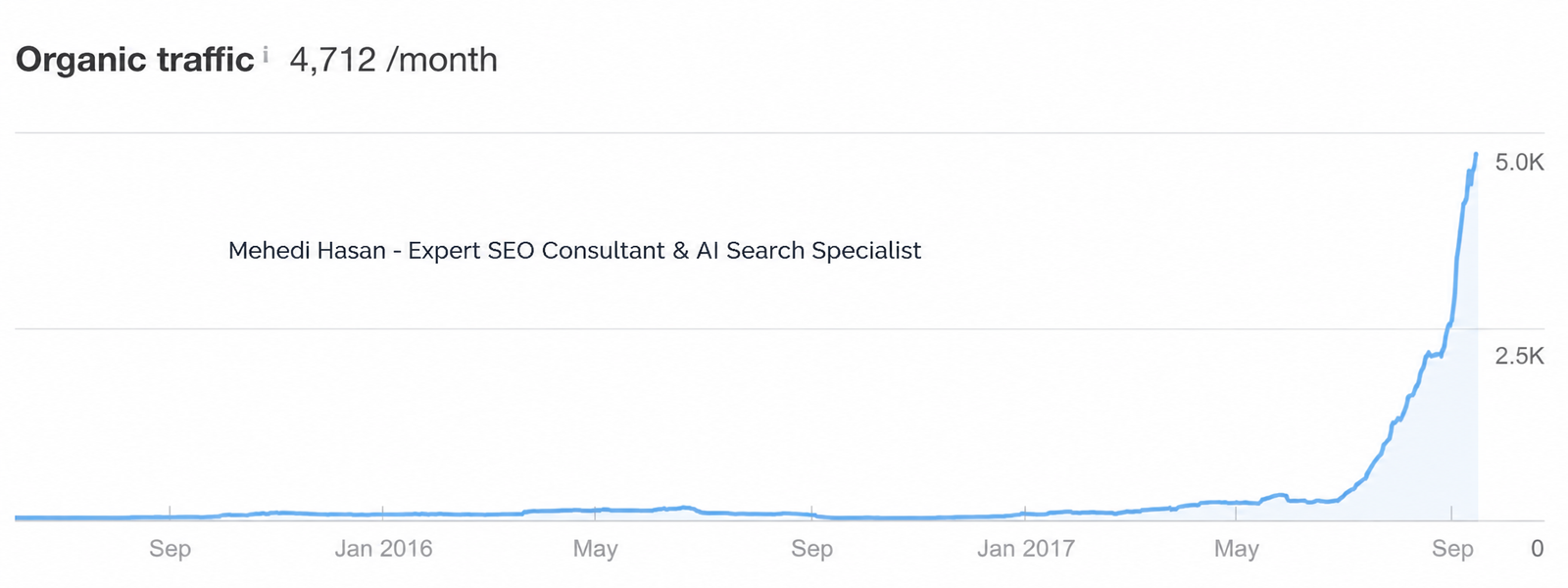
For ecommerce businesses, having hundreds of pages and years of published content does not automatically translate into organic traffic.
In this project, an established online store had been operating for years and had accumulated a substantial amount of content. Despite this, its organic search performance remained significantly below its potential.
The opportunity was clear: instead of rebuilding the website from scratch, the existing authority, content, and keyword footprint could be turned into measurable organic growth through a focused SEO strategy.
The campaign concentrated on identifying achievable keyword opportunities, strengthening commercially important pages, improving content relevance, and building authority around priority search terms.
Campaign Overview
| Campaign Detail | Information |
| Industry | Ecommerce / Online Retail |
| Primary Goal | Increase qualified organic traffic and keyword visibility |
| Reported Campaign Budget | $1,200 per month |
| SEO Approach | Technical review, keyword research, content optimization, content creation and authority building |
| Organic Traffic Result | 4,712 monthly organic visitors |
| Initial Focus Period | First 3 months |
| Long-Term Campaign Framework | 12 months |
The objective was not simply to increase traffic. The strategy was designed to improve rankings for keywords capable of attracting potential customers while simultaneously expanding the site’s overall organic search presence.
The Challenge
The ecommerce website had been established in late 2013 and had accumulated a considerable amount of content over time.
However, having an established domain and a large content library had not resulted in meaningful organic visibility.
Several problems were limiting performance:
- Important commercial keywords were not ranking on Google’s first page.
- Many target keywords were positioned outside the most valuable search results.
- Existing content was not taking full advantage of the site’s ranking potential.
- Keyword targeting needed stronger alignment with search intent.
- The website had opportunities to improve topical relevance around commercially valuable search terms.
- Existing rankings needed additional authority and optimization to move into traffic-generating positions.
This meant the site already possessed assets that could potentially generate traffic, but those assets were not being used efficiently.
Rather than pursuing hundreds of unrelated keywords, the campaign focused first on opportunities where ranking improvements were realistically achievable.
Phase 1: SEO Audit and Opportunity Assessment
The campaign began with a detailed evaluation of the website’s existing SEO condition.
The purpose of the audit was to determine whether technical problems, penalties, aggressive optimization, poor content quality, or weak keyword targeting were preventing the website from performing.
The assessment found no significant indication of search-engine penalties or excessive optimization.
The larger issue was visibility.
Many strategically valuable keywords were simply not ranking high enough to generate meaningful traffic.
This changed the direction of the project.
Instead of spending the early stages of the campaign recovering from a penalty or performing a complete website overhaul, resources could be directed toward ranking opportunities that already existed.
Key findings
No major penalty issues
The domain did not appear to require a search penalty recovery campaign.
Weak first-page presence
Commercially important keywords were struggling to reach positions capable of generating significant clicks.
Existing ranking potential
The site already had keyword visibility that could potentially be improved through better optimization, content alignment and authority signals.
Untapped content value
Existing pages offered opportunities to target additional relevant search queries rather than relying exclusively on new content.
Phase 2: Keyword Research and Opportunity Mapping
Keyword research became one of the most important components of the campaign.
Instead of selecting keywords based purely on search volume, the research process focused on identifying terms that combined:
- commercial relevance;
- achievable ranking difficulty;
- existing website relevance;
- search intent;
- current ranking position;
- traffic potential.
Particular attention was given to keywords where the website already had some organic visibility.
These represented potential quick-win opportunities.
A page ranking outside the first page does not necessarily require a complete SEO campaign of its own. In many cases, stronger relevance, internal optimization, better content coverage, and carefully targeted authority signals can move an existing ranking considerably faster than trying to rank an entirely new page.
This principle shaped the early campaign.
Phase 3: Prioritizing Quick-Win Keywords
Instead of immediately targeting only the most competitive keywords in the industry, the campaign prioritized terms where the website already demonstrated ranking potential.
The reasoning was straightforward.
Moving a relevant keyword from an existing position toward Google’s first page can produce results faster than trying to rank from zero for an extremely competitive keyword.
Priority was therefore given to keywords with:
- existing search visibility;
- clear relevance to the business;
- realistic ranking potential;
- meaningful search demand;
- commercial or informational value.
This helped allocate the SEO budget toward opportunities with a stronger probability of producing measurable results.
Phase 4: Content Strategy
Content development supported both commercial and informational search intent.
Rather than publishing articles simply to increase the number of indexed pages, each new content asset was created around a defined keyword opportunity.
The early campaign included approximately 1,000-word articles designed around relevant industry topics and strategically selected search terms.
The content strategy had two major purposes.
Build topical relevance
Informational content helped the website cover subjects surrounding its products and industry in greater depth.
Support commercial visibility
Content was also developed around keywords with stronger buying or commercial intent, helping the website attract searchers closer to a purchasing decision.
Existing pages were reviewed as well.
Where keyword and competitor research identified content gaps, pages could be expanded or adjusted to better satisfy the search intent behind valuable queries.
Phase 5: Authority and Link-Building Strategy
Content optimization alone was not the entire strategy.
Selected pages were supported through external authority building.
Guest-post placements were used to strengthen pages targeting priority keywords.
During the early stages, the campaign deliberately avoided relying on a single repetitive anchor-text pattern.
Instead, the backlink profile incorporated a broader combination of:
- branded anchors;
- contextual anchors;
- relevant keyword variations;
- natural anchor text.
This diversification was intended to strengthen authority while maintaining a more natural-looking backlink profile.
Month-by-Month Execution
Month 1: Establishing the Foundation
The first month concentrated on identifying attainable ranking opportunities and providing the initial authority required to improve them.
Key actions included:
- detailed keyword opportunity analysis;
- selection of quick-win keywords;
- two targeted guest-post placements;
- diversified anchor-text building;
- publication of a roughly 1,000-word informational article;
- optimization around relevant industry searches.
The objective was to begin moving keywords that already showed ranking potential.
Month 2: Strengthening Commercial Keywords
Once the initial campaign framework was established, greater attention shifted toward commercially valuable search terms.
Key activities included:
- continued authority building for priority pages;
- additional guest-post placements;
- deeper optimization around commercial keywords;
- publication of another roughly 1,000-word targeted article;
- refinement of keyword-to-page alignment.
This stage was intended to improve rankings for search terms more directly connected to revenue opportunities.
Month 3: Expanding Relevance and Anchor Diversity
By the third month, the campaign expanded beyond the initial quick wins.
The strategy included:
- additional branded backlink placements;
- further anchor-text diversification;
- competitor and content-gap analysis;
- optimization of existing content for higher-volume terms;
- expansion of pages where greater topical depth was required.
Rather than abandoning keywords that had already improved, the campaign continued strengthening those positions while introducing larger opportunities into the SEO roadmap.
The Results
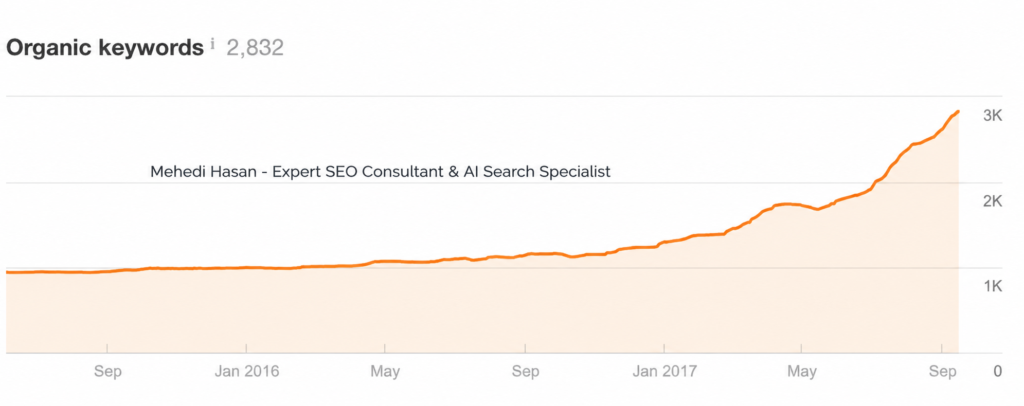
The campaign produced a substantial improvement in the website’s organic visibility.
The site eventually reached approximately:
4,712 Monthly Organic Visitors
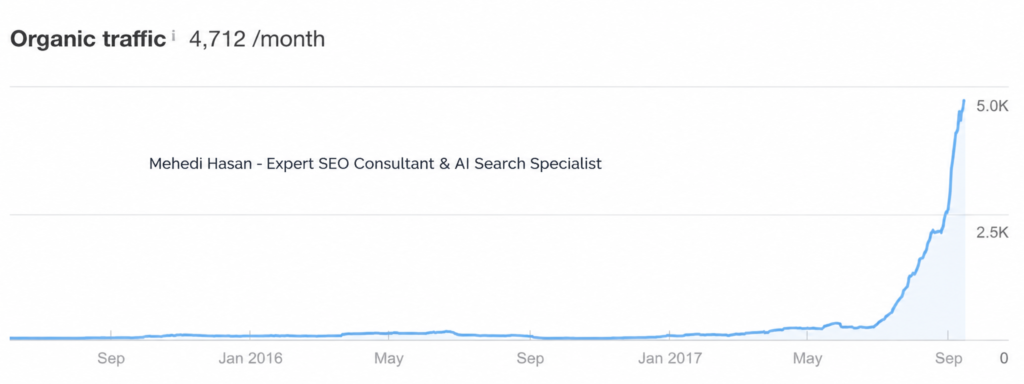
The improvement was driven by a combination of ranking gains across multiple search queries rather than dependence on a single keyword.
Several keywords that previously lacked strong visibility moved into more competitive search positions, including first-page opportunities.
As more relevant keywords entered traffic-generating positions, the cumulative impact produced significant organic traffic growth.
Key outcomes
Increased organic visibility
A larger number of relevant search terms began appearing prominently in organic search.
Growth in first-page rankings
Keywords targeted through the quick-win strategy improved toward positions with significantly greater click potential.
4,712 monthly organic visitors
The campaign developed the site’s organic search channel from limited traffic into a meaningful acquisition source.
Stronger content coverage
Content optimization expanded the range of queries the website could compete for.
Improved commercial keyword positioning
SEO activity was increasingly aligned with keywords capable of attracting users with stronger commercial intent.
Why the Strategy Worked
The results were not produced by one isolated SEO tactic.
The campaign worked because several elements were coordinated around the same ranking objectives.
1. Existing opportunities were prioritized
Rather than chasing only high-volume keywords, the strategy first identified keywords where the website already demonstrated relevance.
This reduced the distance between the website’s existing rankings and meaningful search visibility.
2. Keywords were selected strategically
Search volume alone did not determine priorities.
Commercial relevance, ranking feasibility, search intent and existing visibility were considered together.
3. Content and authority supported the same targets
New content, existing-page optimization and external authority building were aligned around priority keywords.
This created a more coherent SEO campaign than treating content and backlinks as unrelated activities.
4. Existing content was treated as an asset
Years of published material provided opportunities for optimization.
Instead of continuously creating new URLs, existing content could be strengthened and expanded where appropriate.
5. The campaign developed progressively
The strategy moved from achievable opportunities toward more competitive terms.
Early ranking improvements created a stronger foundation for targeting larger search opportunities later in the campaign.
Key SEO Lessons From the Campaign
This project highlights several principles that can apply to established ecommerce websites.
Existing rankings can contain significant hidden value
Keywords sitting outside Google’s highest positions may represent some of the fastest opportunities for organic growth.
More content is not always the answer
A site with years of content can still underperform if its pages are poorly aligned with search demand.
Updating, consolidating and optimizing existing content can sometimes produce greater returns than simply publishing more articles.
Commercial intent matters
SEO success should not be measured exclusively by traffic volume.
Keywords connected to products, categories and purchasing decisions should form an important part of an ecommerce SEO strategy.
Link building works best when it supports a broader strategy
Backlinks were used to reinforce pages already selected through keyword research and content analysis rather than being treated as an isolated ranking tactic.
SEO growth is cumulative
Ranking improvements across dozens of relevant queries can collectively generate far more traffic than depending on one highly competitive keyword.
Next Phase of Growth
After establishing stronger visibility, the logical next stage of the campaign is to expand into more competitive search opportunities.
Future priorities would include:
- targeting higher-volume commercial keywords;
- strengthening ecommerce category and product pages;
- expanding high-performing content;
- improving internal linking between informational and commercial pages;
- identifying additional competitor content gaps;
- consolidating overlapping or underperforming content;
- acquiring relevant authoritative backlinks;
- improving conversion paths from organic landing pages;
- monitoring rankings, traffic and revenue contribution by page.
The focus should gradually shift from securing initial ranking improvements to building sustained search visibility across the client’s entire commercial topic space.
Conclusion
This campaign demonstrates how an established ecommerce website can contain significant untapped SEO potential.
The website already possessed years of content and domain history. The problem was not simply a lack of content. The larger challenge was turning those existing assets into search visibility.
Through structured keyword research, quick-win prioritization, content optimization, new content development and strategic authority building, the site increased its organic presence and reached approximately 4,712 monthly organic visitors.
The central lesson is straightforward:
Successful ecommerce SEO is not about targeting every possible keyword. It is about identifying the right opportunities, improving the pages capable of winning them, and systematically building relevance and authority around those pages.