

Executive Summary
Competing for visibility in New York City’s local search market requires more than basic website optimization. Businesses operating across multiple locations must establish geographic relevance, improve their Google Maps presence, and connect with customers searching for nearby services.
This case study examines a location-focused SEO campaign for a New York City service provider operating in Brooklyn and Harlem.
The campaign combined localized keyword targeting, dedicated location pages, Google Business Profile optimization, business directory citations, and geographic rank tracking.
Key Performance Highlights
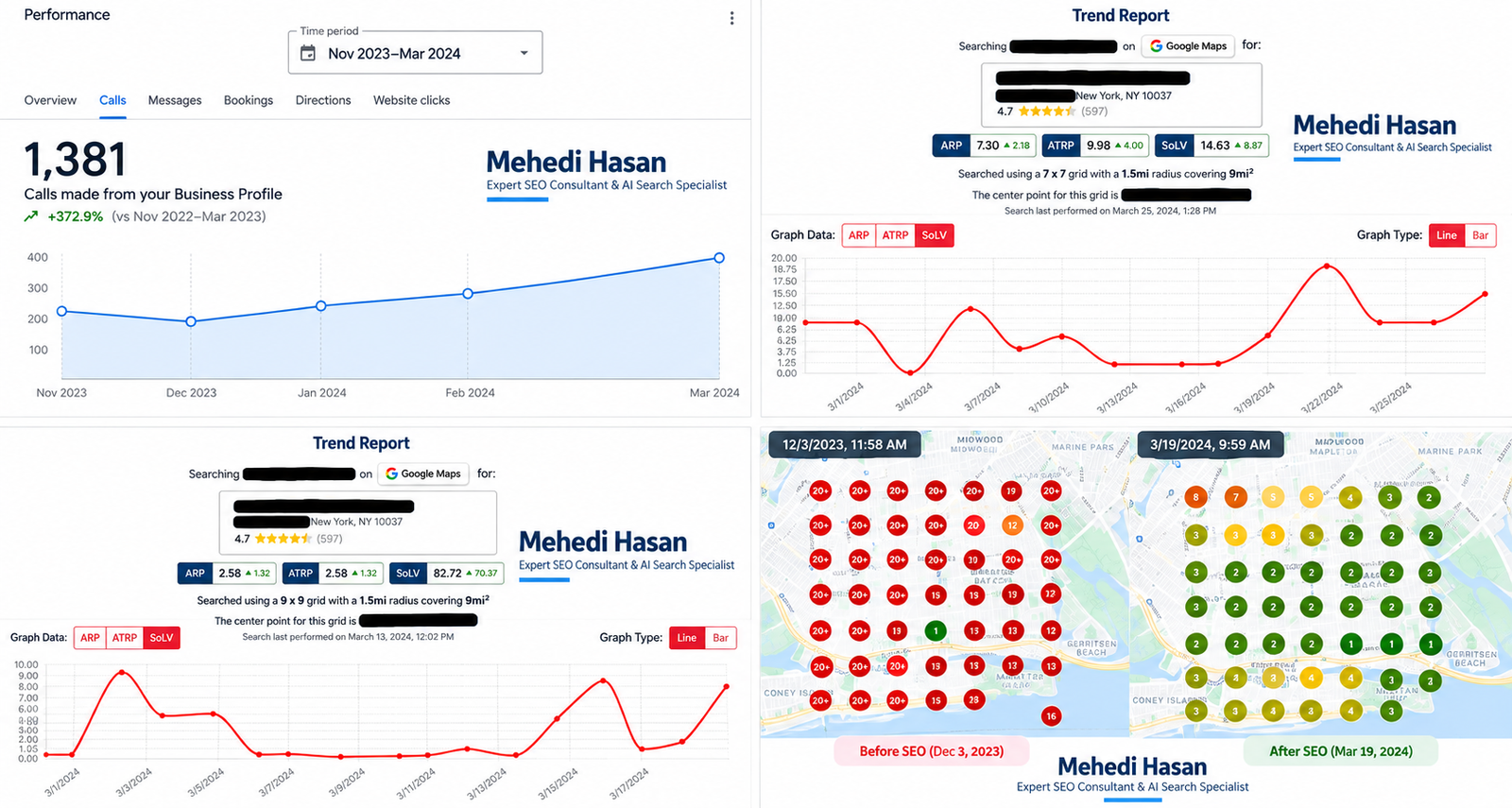
- 373% increase in phone calls reported for the Brooklyn location.
- 10% increase in phone calls reported for the Harlem location.
- Top-three Google Maps visibility reported for selected high-value local keywords.
- Improved local search relevance through location-specific website content.
- Stronger local business signals through directory listings and consistent business information.
1. Client Background
The client was a New York City service provider operating in two distinct geographic markets: Brooklyn and Harlem.
Although both locations served customers within the same city, each faced different local search conditions, competitors, and customer search patterns.
The business needed a strategy that would improve visibility for relevant searches near each location rather than relying on a single citywide SEO approach.
The central objective was to attract more local customers through Google Search and Google Maps, with particular emphasis on phone inquiries.
2. The Business Challenge
High Local Competition
New York City is a highly competitive search environment. Businesses must compete with established providers, local directories, and other nearby service locations for valuable positions in Google search results.
Location-Specific Search Intent
Customers searching for services in Brooklyn may receive different results from customers searching in Harlem.
A general NYC-focused optimization strategy may therefore fail to capture the full potential of either location.
Website Geographic Relevance
Each business location needed dedicated, relevant content to help search engines understand its service area, offerings, and connection to local search queries.
Google Maps Visibility
For businesses that depend on direct customer inquiries, Google Maps can be an important discovery channel, particularly for mobile users searching for nearby providers.
The campaign therefore prioritized visibility in geographically relevant searches.
3. Campaign Objectives
The local SEO campaign focused on five objectives:
- Improve Google Maps visibility for relevant service-related keywords.
- Increase the number of phone inquiries generated through local search.
- Strengthen the geographic relevance of the Brooklyn and Harlem locations.
- Improve website optimization and consistency of business information.
- Track local search performance and refine targeting based on ranking data.
The broader business goal was to convert improved local search visibility into more opportunities for customer acquisition.
4. SEO Strategy and Implementation
Phase 1: Hyperlocal SEO Targeting
The strategy began by treating Brooklyn and Harlem as separate local search markets.
Rather than optimizing exclusively for broad New York City searches, the campaign focused on searches within approximately one to two miles of each business location.
This geographic approach aimed to align the business with customers most likely to search for and contact a nearby service provider.
The location-specific strategy helped establish a clearer relationship between each business location, its surrounding service area, and relevant search queries.
Phase 2: Location-Specific Website Optimization
Dedicated website pages were developed or optimized for each location.
The optimization covered several important on-page SEO elements:
Title Tag Optimization
Page titles were refined to communicate the primary service and relevant location.
Heading Structure
Page headings were organized to improve topical clarity and help search engines interpret the content.
Image ALT Text
Relevant image descriptions were optimized to provide additional context and improve accessibility.
Semantic Content Optimization
Website content was refined to incorporate related services, geographic context, and relevant search terminology naturally.
Dedicated Location Pages
Separate pages helped distinguish the Brooklyn and Harlem service areas, reducing dependence on a single generic location page.
Together, these activities supported stronger local relevance and a more organized website structure.
Phase 3: Google Business Profile Optimization
Google Business Profile optimization was a central component of the campaign.
The strategy concentrated on aligning each profile with the services most relevant to its local market.
Reported activities included refining service information and reducing emphasis on less relevant offerings.
The objective was to strengthen the relevance of each listing for commercially valuable local searches.
This approach also supported a more consistent relationship between the business profiles and their corresponding website location pages.
Phase 4: Local Citation and Directory Optimization
The campaign strengthened the business’s local presence through relevant New York City directory listings.
A major focus was NAP consistency:
- Name: Consistent business naming across listings.
- Address: Accurate location information.
- Phone Number: Consistent contact details.
Directory listings can help customers discover a business across multiple platforms and reinforce consistent business information online.
For a multi-location provider, maintaining accurate details for each branch is particularly important.
Phase 5: Local Ranking Monitoring
The campaign used Local Falcon to evaluate geographic search visibility.
One of the metrics monitored was Share of Local Voice (SoLV), which measures visibility across a defined local search grid.
This allowed performance to be assessed geographically rather than relying solely on a single ranking position.
Local rank tracking was used to inform further optimization and evaluate visibility across the target service areas.
5. Campaign Results
The published case study reported substantial improvement in phone inquiries, particularly for the Brooklyn location.
Brooklyn: 373% Growth in Phone Calls
The Brooklyn location recorded a reported 373% increase in phone calls.
This represents a 4.73-fold increase relative to the baseline call volume.
The original report attributes much of the activity to users discovering the business through Google Maps on mobile devices.
This suggests that stronger local search visibility coincided with increased customer contact activity.
Harlem: 10% Growth in Phone Calls
The Harlem location recorded a reported 10% increase in phone calls.
Although the percentage increase was smaller, the original study describes the location’s overall call volume as significant.
Because absolute call counts were not provided, the relative contribution of each location to total business inquiries cannot be calculated.
Google Maps Ranking Improvements
The original campaign report also states that both locations achieved top-three Google Maps positions for selected high-value medical-related keywords.
This indicates reported improvements in local search visibility, although the underlying keyword list and location-grid reports would be needed to independently assess the ranking performance.
6. Performance Summary
| Performance Indicator | Reported Result |
| Brooklyn phone-call growth | +373% |
| Harlem phone-call growth | +10% |
| Brooklyn call-volume multiplier | 4.73× |
| Local Maps visibility | Top 3 for selected keywords |
| Geographic targeting | Approximately 1–2 miles per location |
| SEO monitoring platform | Local Falcon |
| Primary customer action | Phone calls |
The figures above are drawn from the original published case study. They should not be interpreted as independently audited results.
7. Why the Strategy Was Effective
The campaign illustrates several principles of location-based SEO.
Geographic Relevance
Treating each location as a separate search market allowed optimization to focus on local customer intent.
Alignment Between Website and Business Listings
Dedicated location pages and Google Business Profile optimization created a more consistent presentation of each location’s services.
Focus on High-Intent Searches
The campaign emphasized queries associated with customers looking for nearby services, rather than pursuing traffic volume alone.
Local Business Consistency
Directory optimization helped reinforce accurate business details across external platforms.
Geographic Performance Measurement
Local Falcon provided a way to monitor ranking visibility across multiple points within the target areas.
These activities were implemented together, so the available evidence does not establish the individual contribution of each tactic.
8. Business Impact
The most significant reported outcome was increased phone-call activity.
For service providers, phone inquiries can represent valuable opportunities to engage prospective customers, answer service questions, and schedule appointments.
The reported growth suggests that the campaign improved the business’s ability to attract local inquiries.
However, the original study does not disclose the number of qualified leads, booked appointments, completed transactions, or revenue generated.
The documented business impact is therefore best described as increased local search visibility and phone-call engagement, rather than verified revenue growth.
9. Key Lessons
This case study demonstrates the importance of coordinating several elements of local SEO.
A successful multi-location strategy should account for geographic search behavior, maintain dedicated and relevant location pages, optimize Google Business Profiles, ensure consistent business information, and measure performance at a local level.
It also highlights the value of evaluating SEO through customer actions such as phone calls rather than relying exclusively on search rankings.
The Brooklyn results show the scale of improvement that can be reported when local visibility and customer engagement are measured together.
10. Conclusion
The New York City campaign provides an example of how targeted local SEO can support stronger search visibility and increased customer inquiries in competitive urban markets.
Through location-specific optimization, Google Business Profile improvements, local citations, and geographic rank tracking, the campaign reported a 373% increase in phone calls for Brooklyn and a 10% increase for Harlem.
The broader lesson is that local SEO should connect search visibility with measurable business actions.
For multi-location service businesses, a focused geographic strategy provides a structured approach to improving local discovery and generating more opportunities for customer engagement.