

Executive Summary
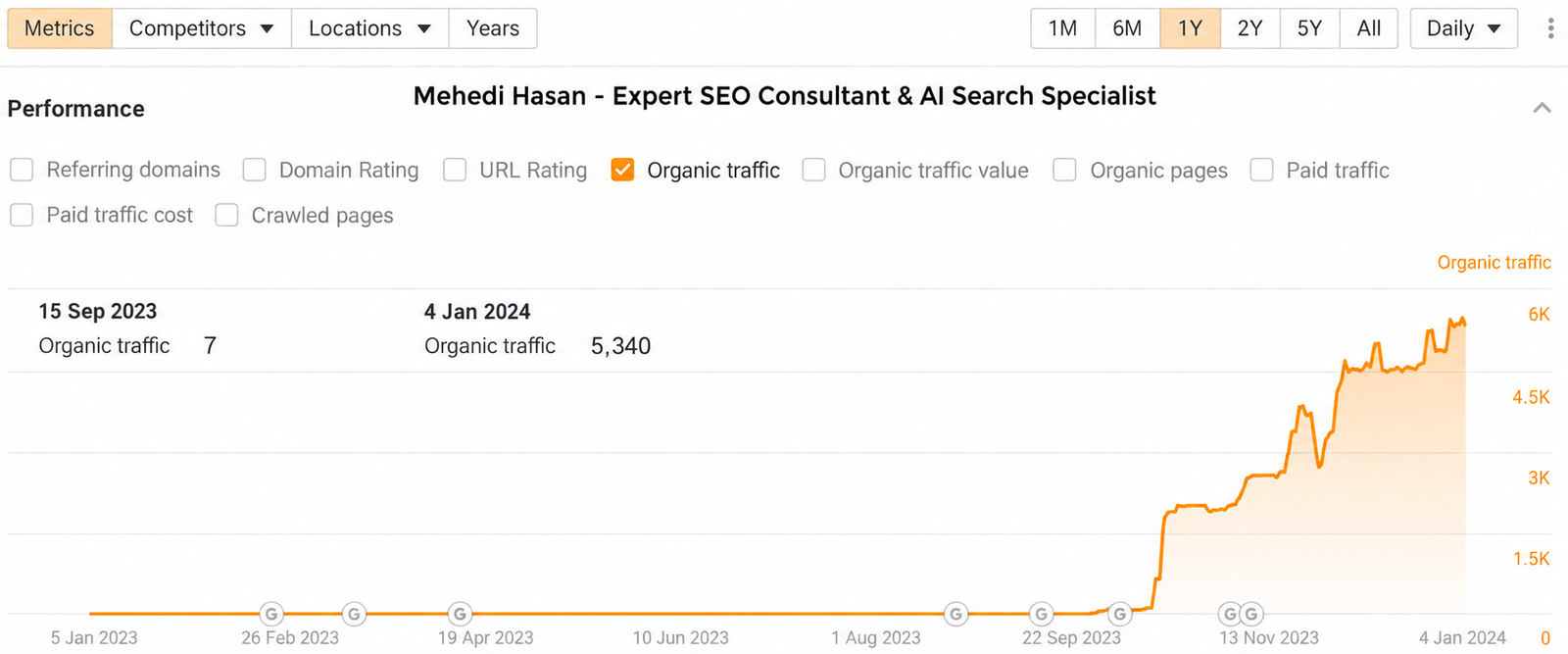
In September 2023, Mehadi Hasan began working on an SEO growth strategy for an emerging eCommerce business operating in the home improvement and interior décor sector.
The website had significant room to improve its organic search visibility, topical coverage and ability to attract users with strong commercial and informational intent.
The objective was not simply to increase rankings. The wider goal was to build a stronger organic acquisition system capable of attracting relevant visitors throughout different stages of the customer journey.
The strategy combined established SEO practices with Large Language Model Optimization, or LLMO, focusing heavily on search intent, semantic relevance, topical coverage, content quality and internal site structure.
Headline Results
- 76,185% increase in organic traffic
- 5,887% improvement in keyword rankings
- Stronger search visibility across the target market
- Expanded topical authority within the home improvement niche
- Improved alignment between website content and customer search intent
- Positive improvement in visitor-to-customer conversion performance
These results demonstrate the impact of combining technical and content-led SEO with a more advanced semantic and intent-focused optimization framework.
The Challenge
The client was an emerging eCommerce company competing in the home improvement market.
Like many growing eCommerce websites, the business faced several organic-search challenges.
The website needed greater visibility across both commercial and informational search queries. Existing content also needed stronger alignment with how potential customers searched for products, ideas, comparisons, solutions and purchasing information.
Several broader SEO opportunities were identified:
- Limited organic visibility
- Gaps within the existing content portfolio
- Insufficient coverage of important topics and subtopics
- Opportunities to improve keyword targeting
- Weak semantic relationships between related pages
- A need for stronger internal linking
- Incomplete alignment with user search intent
- Limited topical authority compared with established competitors
Rather than concentrating solely on individual keywords, the strategy focused on building broader relevance around the topics that mattered to the client’s target customers.
Project Objectives
The SEO campaign was built around five core objectives.
1. Increase Organic Traffic
Expand the website’s ability to attract visitors through non-paid search channels.
2. Increase Keyword Visibility
Improve rankings across a broader range of commercially and informationally valuable search terms.
3. Strengthen Topical Authority
Develop comprehensive content around the client’s core products, categories and customer problems.
4. Improve Search Intent Alignment
Ensure that each important page addressed what users were actually trying to accomplish when entering a query.
5. Support Conversions
Attract more relevant search visitors and improve the likelihood that those visitors would move toward a commercial action.
The SEO & LLMO Strategy
A hybrid strategy was developed combining traditional SEO principles with Large Language Model Optimization.
Instead of treating SEO as a process of simply inserting keywords into pages, the campaign focused on helping search systems understand:
- what each page was about;
- how topics were connected;
- which questions the content answered;
- what type of search intent each page served; and
- how comprehensively the website covered its market.
1. Comprehensive Content Audit
The first stage involved reviewing the website’s existing content.
The purpose of the audit was to understand what was already performing, where content gaps existed and where existing pages could be strengthened.
The audit focused on identifying:
- under-optimized pages;
- missing topics;
- overlapping content;
- opportunities for content expansion;
- search-intent mismatches;
- internal-linking opportunities; and
- pages with the potential to target additional semantic search terms.
This provided the foundation for the wider SEO roadmap.
2. Search Intent Analysis
Keyword volume alone does not explain why somebody performs a search.
For this reason, search intent became a central part of the strategy.
Queries were evaluated according to the likely goal behind the search, including:
- informational intent;
- commercial investigation;
- product discovery;
- transactional intent; and
- comparison-oriented searches.
Content was then structured to answer those needs more directly.
For example, users researching home improvement products may move through several stages before purchasing:
Problem → Research → Comparison → Product Evaluation → Purchase
Content was developed and optimized to support that journey rather than targeting isolated keywords without context.
3. Semantic Keyword Optimization
The strategy moved beyond exact-match keyword targeting.
Primary keywords were supported by related concepts, semantic variations, supporting questions and closely connected entities.
This allowed individual pages to provide a more complete answer around their main topic.
Rather than repeatedly using one phrase, content could naturally address a wider semantic landscape surrounding the subject.
This approach was particularly important for building relevance within the interior décor and home improvement niche.
4. Large Language Model Optimization
Large Language Model Optimization was integrated into the broader SEO strategy.
The goal was to develop content that was easier for modern search and language systems to interpret contextually.
The process emphasized:
- clear topical structure;
- semantically connected terminology;
- direct answers to important questions;
- logically structured headings;
- comprehensive topic coverage;
- contextual relationships between products and supporting topics;
- natural language rather than keyword stuffing; and
- useful content written around genuine user needs.
LLMO did not replace conventional SEO.
Instead, it complemented technical SEO, keyword research, content optimization and information architecture.
This combination helped the website develop deeper relevance around its core commercial topics.
5. Topical Authority Development
Building topical authority was one of the most important components of the project.
Instead of publishing unrelated articles, content was developed around strategically connected subject areas.
Detailed guides and supporting blog content expanded the website’s coverage of important home improvement and interior décor topics.
This created a structure where multiple pieces of content reinforced one another.
A simplified model looked like this:
Core Commercial Topic
↓
Category / Product Content
↓
Supporting Guides
↓
Questions, Comparisons & Educational Content
↓
Internal Links Back to Commercial Pages
This helped create stronger contextual relationships across the website.
Over time, the website was able to establish greater depth within its target niche rather than depending on a small number of individual pages.
6. Strategic Internal Linking
Internal linking was improved to distribute relevance and authority more effectively throughout the website.
Links were placed where users could naturally benefit from discovering related information.
The strategy connected:
- supporting articles to core pages;
- guides to relevant product or category pages;
- related informational resources;
- commercially important pages; and
- other contextually connected content.
A stronger internal linking architecture served two purposes.
First, it helped users move naturally through the website.
Second, it helped search engines understand the relationship and relative importance of pages.
7. Content Built Around the Customer Journey
The SEO strategy did not focus exclusively on users who were ready to purchase immediately.
Content was developed for several stages of the buying journey.
Awareness
Educational content helped users identify and understand a problem.
Consideration
Guides and informational resources helped visitors explore possible solutions.
Evaluation
More commercially focused content helped users compare products, options or approaches.
Conversion
Product and category pages addressed high-intent searches from users closer to making a purchase.
This created multiple organic entry points into the website instead of relying entirely on transactional keywords.
Results


The SEO and LLMO campaign produced substantial improvements in organic performance.
Organic Traffic
+76,185%
Organic traffic increased dramatically during the campaign.
The increase demonstrated that the website had expanded its search visibility far beyond its original baseline and was attracting users across a considerably broader range of queries.
Keyword Rankings
+5,887%
Keyword visibility also increased substantially.
The site began appearing for a much larger range of relevant terms, giving the business significantly greater exposure within its target market.
This growth was particularly important because sustainable SEO performance depends on ranking across a portfolio of relevant search terms rather than relying on only a handful of keywords.
Conversion Performance
The campaign also resulted in positive improvements in visitor-to-customer conversion performance.
This was an important indicator because traffic growth alone does not determine commercial success.
By improving search-intent alignment and attracting more relevant users, the strategy focused on the quality of organic traffic as well as its volume.
Before vs. After
| Area | Before the Strategy | After SEO & LLMO Implementation |
| Organic visibility | Limited | Significantly expanded |
| Organic traffic | Low starting baseline | +76,185% growth |
| Keyword visibility | Restricted keyword footprint | +5,887% improvement |
| Content coverage | Multiple topical gaps | Broader niche coverage |
| Search intent | Inconsistent alignment | Intent-led optimization |
| Internal linking | Underdeveloped | Strategically interconnected |
| Topical authority | Limited | Strengthened through guides and supporting content |
| Semantic optimization | Conventional keyword targeting | Broader contextual and semantic optimization |
| Conversion performance | Opportunity for improvement | Improvement reported |
Why the Strategy Worked
The performance was not dependent on one isolated SEO tactic.
The growth came from improving several interconnected elements simultaneously.
Search Intent Before Keywords
Content was designed around what users wanted rather than simply how frequently a keyword appeared.
Topic Coverage Instead of Isolated Articles
Related content was connected into broader topical ecosystems.
Semantic Relevance
Pages covered supporting concepts and related terminology rather than relying exclusively on exact-match keywords.
Strong Internal Architecture
Internal links helped both visitors and search engines understand the site’s content hierarchy.
Commercial and Informational Content Working Together
Educational content attracted users earlier in their journey while commercial pages served higher-intent searches.
SEO Combined With LLMO
Traditional SEO fundamentals provided the foundation while LLM-oriented content principles strengthened contextual depth and relevance.
Key Takeaways
This project provides several important lessons for businesses investing in modern organic search.
- Traffic growth requires more than keyword placement.
A website must demonstrate meaningful topical depth and satisfy search intent. - Topical authority compounds over time.
A connected library of relevant content can create stronger organic visibility than isolated articles. - Internal linking is a strategic SEO asset.
It can distribute authority, establish relationships between pages and guide visitors toward commercial content. - Semantic optimization expands ranking potential.
Covering related concepts gives search systems more context about the meaning and purpose of a page. - LLMO works best alongside SEO fundamentals.
Language-model-oriented optimization should complement technical SEO, content strategy and search-intent research rather than replace them. - Organic growth must support business outcomes.
Traffic is useful only when it attracts the right audience and contributes to conversion opportunities.
Conclusion
The campaign demonstrates how an integrated SEO and Large Language Model Optimization strategy can substantially expand an eCommerce website’s organic footprint.
By combining content auditing, semantic keyword research, search-intent optimization, strategic internal linking, topical-authority development and LLM-focused content optimization, the website achieved:
76,185% organic traffic growth
and
5,887% growth in keyword rankings.
The project also strengthened the website’s overall topical relevance and contributed to better visitor-to-customer conversion performance.
For eCommerce businesses competing in increasingly crowded search results, this case study shows the value of moving beyond isolated keyword optimization and building an interconnected search ecosystem around customer needs, topics and intent.