

Project Overview
Organic search visibility plays an important role in helping healthcare organizations connect with people seeking reliable medical information and services.
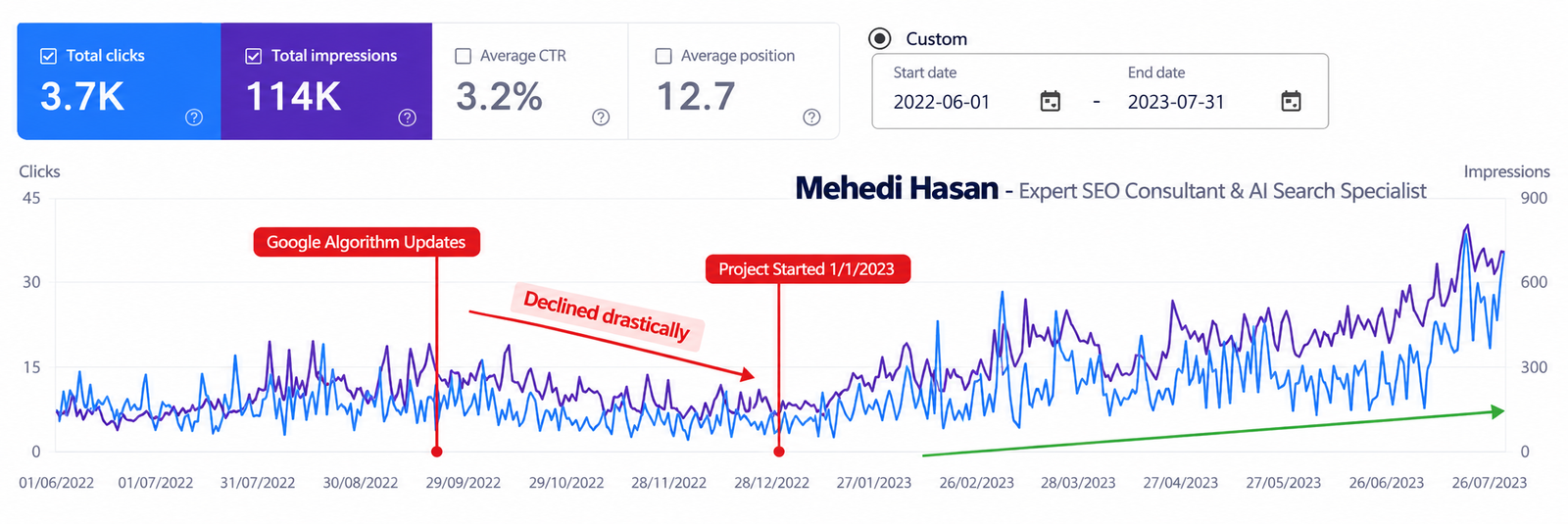
Following Google’s September 2022 Helpful Content Update, an established healthcare website experienced a significant decline in organic search traffic. Its existing content and optimization strategy needed to be reassessed to better meet user expectations and evolving search quality standards.
The project focused on recovering lost organic visibility, improving content relevance, strengthening website credibility, and creating a more sustainable foundation for search growth.
Key Performance Results
| Performance Metric | Reported Improvement |
| Organic Search Clicks | +310% |
| Search Impressions | +241% |
| Keyword Visibility | Improved rankings across targeted keyword variations |
| SERP Performance | First-page rankings and featured snippet placements |
1. The Challenge: Recovering from a Major Organic Traffic Decline
Google’s Helpful Content Update increased the importance of content that genuinely addresses users’ needs instead of prioritizing search engine rankings alone.
For healthcare websites, content quality is particularly important because medical information can influence decisions about people’s health and well-being.
The healthcare website faced several strategic challenges.
Declining Organic Search Visibility
The website experienced a sharp reduction in organic search traffic, creating a need to investigate its content quality, relevance, and overall search performance.
Content Relevance and Search Intent
Existing pages needed to be reassessed to determine whether they adequately answered the questions visitors were searching for.
Healthcare Content Credibility
Medical information required a stronger emphasis on accuracy, reliable evidence, and appropriate expert input.
On-Page SEO Alignment
The website needed improvements to its content structure and on-page optimization to better align with search intent and support organic visibility.
The primary objective was to restore search performance while improving the quality and usefulness of the website’s content.
2. The SEO Strategy: A Content-First Recovery Approach
The recovery strategy combined content evaluation, audience-focused improvements, credibility enhancement, and technical SEO adjustments.
Rather than concentrating exclusively on keyword placement, the approach prioritized the information users needed and the quality of their experience.
Phase 1: Content Evaluation and Improvement
The priority was to reassess existing website content.
Pages were reviewed from the perspective of users searching for healthcare information. The aim was to identify opportunities to improve clarity, completeness, relevance, and practical usefulness.
Key activities included:
- Reassessing existing content against user information needs.
- Improving explanations and addressing gaps in topic coverage.
- Making content more comprehensive and easier to understand.
- Reducing the need for visitors to perform additional searches to find essential information.
- Aligning content improvements with Google’s people-first content guidance.
Strategic purpose: Improve the usefulness of existing pages and establish a stronger foundation for organic search recovery.
Phase 2: Search Intent and Query-Based Optimization
Understanding what users actually search for was central to the optimization strategy.
Real audience queries were incorporated into content improvements to make pages more relevant to the questions, concerns, and information needs of potential visitors.
This approach helped align the website’s content with search behavior rather than relying exclusively on predefined keywords.
Key activities included:
- Incorporating relevant audience search queries.
- Improving the coverage of questions associated with target topics.
- Refining content to better satisfy informational search intent.
- Strengthening topical relevance across targeted keyword variations.
Strategic purpose: Increase the website’s ability to appear for relevant searches and attract users looking for specific healthcare information.
Phase 3: Developing People-First Healthcare Content
The next component involved creating new content designed around genuine audience needs.
The strategy emphasized useful information, clear explanations, and meaningful answers instead of publishing material primarily to attract search traffic.
Content development focused on helping visitors understand healthcare topics more effectively.
Key activities included:
- Developing content around relevant audience interests.
- Prioritizing clarity, usefulness, and informational value.
- Providing answers that addressed actual user concerns.
- Ensuring that content served a clear purpose for its intended audience.
Strategic purpose: Build a more useful content library capable of supporting long-term organic visibility.
Phase 4: Strengthening Expertise, Authority, and Trust
Credibility is especially important in healthcare SEO.
To strengthen content reliability, the strategy incorporated expert perspectives and evidence-based information.
This work supported the broader goal of providing accurate, trustworthy content in a subject area where misinformation can have serious consequences.
Key activities included:
- Incorporating relevant expert opinions.
- Supporting healthcare information with evidence-based material.
- Improving the credibility and informational quality of content.
- Reinforcing trust through more authoritative explanations.
Strategic purpose: Improve content trustworthiness and demonstrate a stronger commitment to accurate healthcare information.
Phase 5: Technical and On-Page SEO Refinements
Content improvements were supported by on-page and technical SEO adjustments.
These refinements focused on aligning individual pages with user intent and improving the overall search experience.
Key activities included:
- Refining on-page optimization around relevant search intent.
- Improving the relationship between page content and targeted queries.
- Applying technical SEO adjustments to support visibility.
- Improving the user experience through more effective page optimization.
Strategic purpose: Help search engines interpret relevant content while making pages more accessible and useful to visitors.
3. The Results: Significant Organic Search Growth
The published case study reports substantial improvements in search performance following the SEO recovery campaign.
310% Increase in Organic Search Clicks
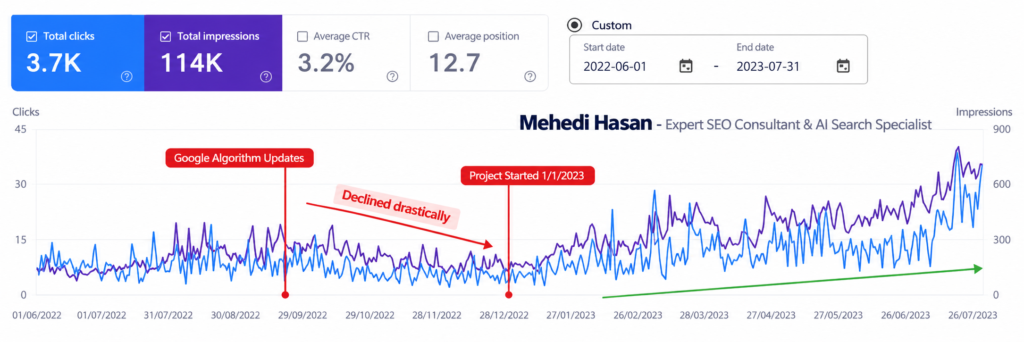
Organic clicks increased by 310%, representing a substantial improvement in the number of visits generated from Google Search.
This suggests that the website became more effective at attracting users through organic search results.
241% Increase in Search Impressions
Search impressions increased by 241%, indicating that the website appeared more frequently in Google Search results.
Greater impression volume suggests improved search exposure across relevant queries.
Improved Keyword Rankings
The campaign also reported stronger rankings across targeted keyword variations.
Multiple keywords reached the first page of Google Search, with some content appearing in featured snippets.
These improvements helped expand the website’s visibility across relevant healthcare searches.
Performance Summary
| SEO Indicator | Reported Outcome |
| Organic Click Growth | +310% |
| Search Impression Growth | +241% |
| Target Keyword Performance | Improved |
| Google First-Page Visibility | Achieved for multiple keywords |
| Featured Snippet Visibility | Achieved for selected queries |
Important measurement note: These results describe reported search performance improvements. The available source does not establish the exact campaign duration, conversion growth, patient acquisition, or revenue impact.
4. Why the Strategy Was Effective
The campaign illustrates several important principles of effective healthcare SEO.
Relevance Before Keyword Density
By focusing on actual audience questions, the website’s content became more closely aligned with what users wanted to learn.
Content Quality as a Recovery Priority
Improving existing material and creating useful new resources addressed the need for a more audience-focused content strategy.
Credibility in Healthcare Information
Expert perspectives and evidence-based explanations strengthened the quality and reliability of healthcare content.
Combining Content and Technical SEO
Content improvements were supported by on-page refinements, creating a more coordinated approach to organic search performance.
Continuous Performance Evaluation
The original strategy also emphasized monitoring keyword performance and making adjustments as search conditions evolved.
5. Key Takeaways
This healthcare SEO recovery project demonstrates how a structured approach to content quality and search relevance can support meaningful improvements in organic visibility.
Three lessons stand out:
- Content recovery begins with understanding user needs. Pages should provide useful, complete, and relevant information.
- Healthcare SEO requires a strong emphasis on credibility. Expert input and evidence-based information are essential components of responsible medical content.
- Sustainable organic growth requires ongoing refinement. Search performance should be reviewed regularly, with improvements informed by actual user behavior and search data.
6. Conclusion
The healthcare website’s reported recovery demonstrates the potential value of combining people-first content development, search-intent optimization, credibility improvements, and technical SEO.
With a reported 310% increase in organic clicks and 241% growth in search impressions, the project provides an example of how a focused SEO improvement program can contribute to stronger organic search visibility.
The broader lesson is that effective healthcare SEO depends on delivering accurate, relevant, and genuinely useful information while maintaining a technically sound website.