

Executive Summary
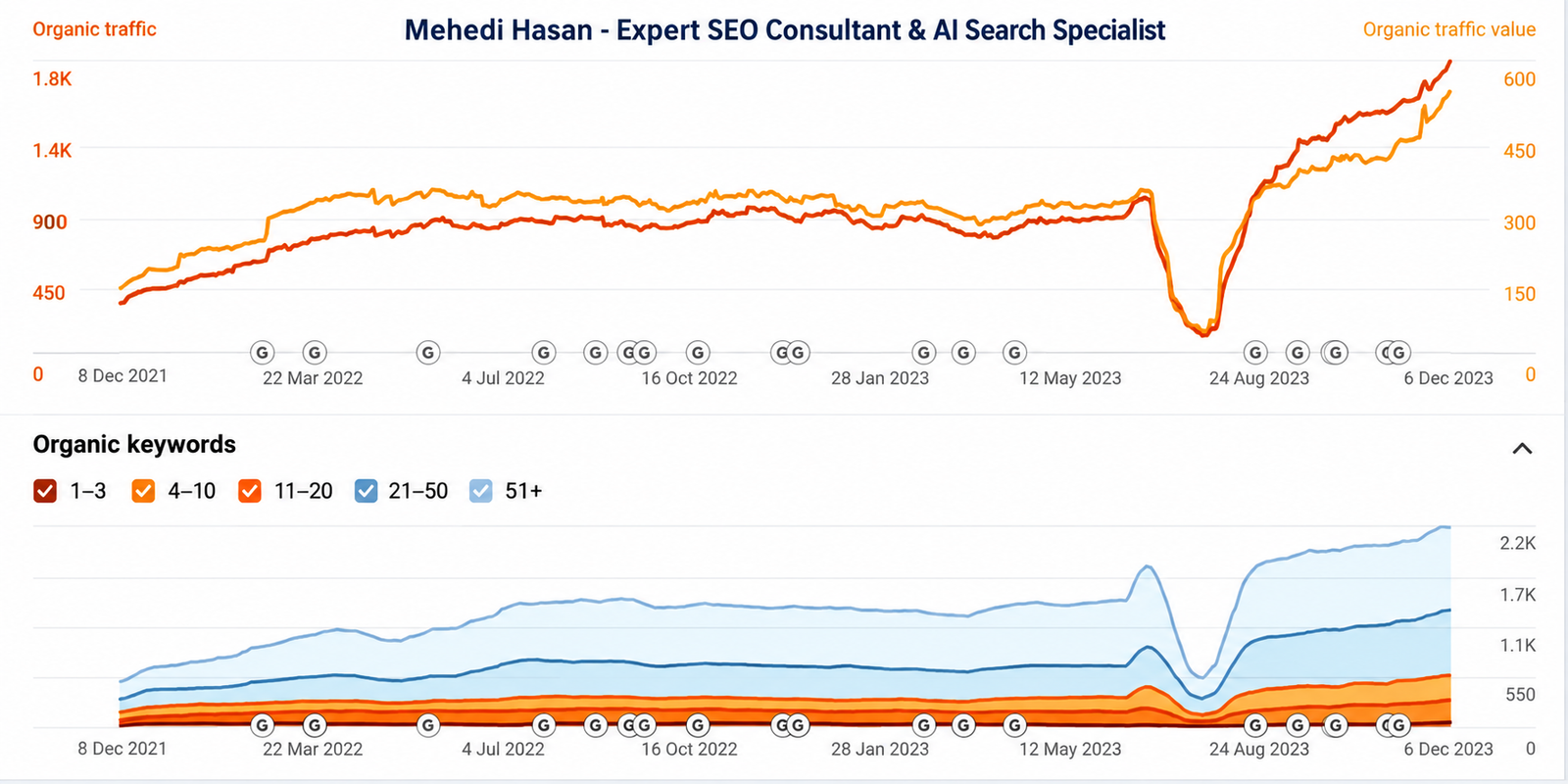
An established eCommerce business in the home decor industry experienced a major decline in organic visibility after being affected by a Google penalty.
The website lost important keyword positions, organic traffic dropped sharply, and the decline began affecting product visibility, customer acquisition, and online sales.
Mehadi Hasan was brought in to diagnose the SEO issues, develop a recovery strategy, and rebuild the website’s organic search performance.
Following a structured SEO recovery campaign, the website achieved a 96.52% increase in organic traffic within two months, alongside improved rankings for commercially valuable keywords and a recovery in sales performance.
Key Results
96.52%
Increase in Organic Traffic
2 Months
Initial Recovery Period
Improved Rankings
For High-Value Commercial Keywords
Revenue Recovery
Improved organic visibility contributed to a rebound in sales
The Client
The client was an established online home décor retailer operating in a competitive eCommerce market.
Organic search played an important role in the company’s customer acquisition strategy. Many prospective customers discovered products through non-branded Google searches before visiting category pages, product pages, and informational content.
Because of this dependence on search visibility, the Google penalty had a direct effect on both website traffic and commercial performance.
The Challenge
The website experienced a significant decline in Google rankings following the penalty.
Several important SEO problems had to be addressed simultaneously.
Organic Traffic Decline
Pages that previously attracted consistent search traffic lost visibility, resulting in a substantial reduction in organic sessions.
Loss of Commercial Keyword Rankings
Several high-intent keywords associated with the company’s products declined in ranking positions.
These were particularly important because they had strong potential to generate transactions.
Reduced Search Visibility
As rankings declined, fewer pages appeared prominently for relevant searches, reducing impressions and organic click-through opportunities.
Declining Sales
Because organic search was an important customer acquisition channel, the traffic decline also affected online sales and revenue.
SEO Trust and Authority Issues
The penalty indicated that the website required more than minor optimization.
The site’s technical structure, content quality, keyword targeting, user experience, and backlink profile needed to be reviewed as part of a broader recovery strategy.
The Objective
The project had two primary objectives.
The first was to recover the website from the effects of the Google penalty.
The second was to build a stronger SEO foundation that would allow the website to grow beyond its previous performance.
The strategy therefore focused on:
- identifying the underlying causes of the decline;
- restoring lost rankings;
- recovering organic traffic;
- improving commercially important keyword visibility;
- improving website quality and usability;
- strengthening search authority;
- and creating a sustainable SEO framework for future growth.
SEO Recovery Strategy
1. Comprehensive SEO Audit
The recovery process began with a detailed assessment of the website.
Rather than immediately making isolated SEO changes, the objective was to understand why performance had declined and identify which areas represented the greatest risk.
The audit reviewed areas such as:
- technical SEO health;
- crawlability and indexation;
- site architecture;
- internal linking;
- page performance;
- keyword targeting;
- content quality;
- search intent alignment;
- backlink quality;
- and overall website usability.
This provided a clear roadmap for prioritizing corrective actions.
2. Keyword Strategy Restructuring
The existing keyword strategy was reviewed to identify opportunities for both recovery and future growth.
Special attention was given to commercially valuable keywords, sometimes referred to as money keywords, because these searches were more likely to contribute directly to sales.
Keywords were evaluated according to factors such as:
- search intent;
- commercial relevance;
- ranking potential;
- competition;
- existing page performance;
- and conversion potential.
The goal was not simply to increase keyword rankings.
The focus was to improve visibility for searches capable of producing qualified visitors and customers.
3. Content Quality Improvement
Existing website content was reviewed and improved to better satisfy both search engines and users.
Low-value, outdated, or poorly optimized content can weaken a website’s overall search performance, particularly after a major ranking decline.
Content improvements focused on:
- satisfying search intent more accurately;
- improving topical relevance;
- removing unnecessary or weak content;
- strengthening page structure;
- improving headings and information hierarchy;
- improving internal linking;
- making product and category information more useful;
- and strengthening signals related to expertise, experience, authority, and trust.
Rather than optimizing content purely around keywords, the strategy focused on creating pages that genuinely answered what users were searching for.
4. User Experience and Site Architecture Improvements
SEO recovery was treated as more than a content and keyword exercise.
The website’s overall user experience was also addressed.
Site architecture and navigation were reviewed to make it easier for both visitors and search engines to understand the relationship between pages.
Optimization focused on:
- clearer navigation;
- stronger category structures;
- improved internal linking;
- better accessibility of important pages;
- improved page-loading performance;
- reduced friction during browsing;
- and a more intuitive customer journey.
These improvements supported both SEO performance and conversion potential.
5. Website Performance Optimization
Page speed and technical performance can directly affect user experience and indirectly influence SEO performance.
The site was reviewed for performance bottlenecks that could prevent visitors from navigating efficiently.
The objective was to create a faster and more stable browsing experience, particularly across commercially important pages.
Better site performance also helped reduce unnecessary visitor abandonment and supported engagement with product and category pages.
6. Authority and Backlink Improvement
The site’s backlink profile and external authority signals were also reviewed.
The strategy focused on improving the quality and relevance of links pointing to the website rather than simply increasing backlink volume.
Authority-building efforts were designed to:
- strengthen domain credibility;
- support important commercial pages;
- improve competitive positioning;
- diversify relevant referring sources;
- and rebuild trust signals around the website.
The emphasis was placed on quality, relevance, and authority rather than quantity.
Implementation Approach
The recovery campaign was handled in stages.
Phase 1: Diagnosis
SEO data was reviewed to identify where traffic, rankings, and visibility had deteriorated.
Phase 2: Prioritization
Issues were ranked according to their potential SEO and commercial impact.
High-risk technical and quality problems were addressed before lower-priority optimizations.
Phase 3: Recovery
Technical improvements, content optimization, keyword restructuring, UX improvements, and authority work were implemented.
Phase 4: Monitoring
Organic traffic, keyword visibility, engagement, indexing behavior, and commercial performance were monitored to measure recovery.
Phase 5: Growth
Once recovery signals became visible, the strategy shifted from damage control toward sustainable organic growth.
The Results
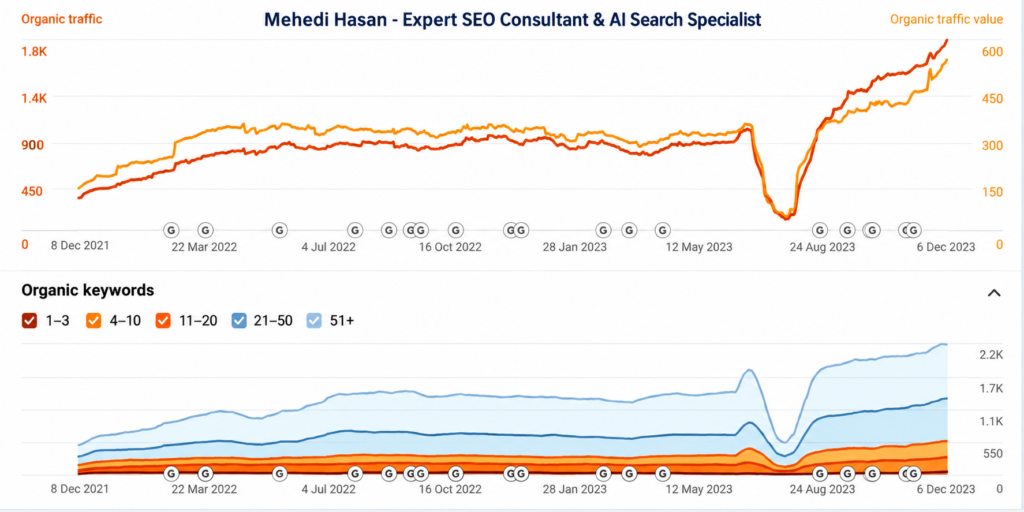
Within approximately two months, the website showed a substantial improvement in organic search performance.
96.52% Increase in Organic Traffic
Organic search traffic increased by 96.52%, demonstrating a significant recovery from the post-penalty decline.
Improved Money Keyword Rankings
Commercially important keywords regained visibility, improving the website’s ability to reach users actively searching for relevant home décor products.
Greater Search Visibility
As rankings recovered, the website gained greater exposure in Google search results, creating more opportunities for impressions and organic clicks.
Sales and Revenue Recovery
The improvement in qualified organic traffic contributed to a rebound in sales and revenue.
The result demonstrated that the SEO campaign was not focused simply on generating additional website visits.
The objective was to restore commercially meaningful organic traffic.
Before vs. After
| Area | Before SEO Recovery | After SEO Recovery |
| Organic Traffic | Significant decline | +96.52% increase |
| Keyword Rankings | Major ranking losses | Strong recovery |
| Commercial Keywords | Reduced visibility | Improved rankings |
| Search Visibility | Substantially weakened | Recovered and growing |
| Content Quality | Required improvement | Search-intent focused |
| Website Structure | Needed optimization | Improved architecture |
| User Experience | Performance friction | Faster, easier navigation |
| Authority | Needed rebuilding | Stronger authority signals |
| Sales Performance | Negatively affected | Recovery observed |
Why the Recovery Worked
The project succeeded because the strategy did not depend on a single SEO tactic.
A Google penalty or severe ranking decline is rarely solved simply by publishing more articles or acquiring more backlinks.
The recovery required coordinated improvements across:
Technical SEO
Making the website easier for search engines to crawl, understand, and evaluate.
Content Quality
Improving usefulness, relevance, intent alignment, and overall page quality.
Keyword Strategy
Focusing resources on searches with meaningful business potential.
User Experience
Making the site faster, clearer, and easier to navigate.
Website Authority
Strengthening the quality of external trust and authority signals.
Continuous Monitoring
Using performance data to refine the strategy as recovery progressed.
Together, these elements helped create a stronger website rather than simply attempting to regain lost rankings.
Long-Term SEO Strategy
Penalty recovery was only the first stage.
Once organic performance began improving, the next priority was protecting those gains and establishing sustainable growth.
The ongoing SEO framework included:
- monitoring organic traffic and keyword movement;
- continually updating important commercial pages;
- expanding content around relevant search topics;
- strengthening internal linking;
- monitoring technical SEO health;
- reviewing backlink quality;
- improving user experience;
- monitoring Google algorithm changes;
- and identifying new search opportunities.
This transformed the project from a short-term recovery campaign into a long-term organic growth strategy.
Key Takeaways
This project demonstrates several important principles of SEO recovery.
Diagnose Before Optimizing
Making random SEO changes after a traffic decline can create additional problems. A proper audit should identify the likely causes before major changes are implemented.
Focus on Business-Critical Keywords
Traffic alone is not the primary goal. Keywords connected to purchase intent and commercial outcomes deserve greater priority.
Content Quality Matters
Pages need to provide clear value and properly address the searcher’s intent.
Technical SEO and UX Work Together
Search engines need to access and understand the website, while users need to navigate it efficiently.
Authority Must Be Built Carefully
Backlink quality and relevance are more important than simply acquiring a large number of links.
Recovery Should Lead to Growth
A successful penalty recovery strategy should leave the website stronger than it was before the decline.
Conclusion
Recovering from a Google penalty required more than restoring lost rankings.
The project required a complete reassessment of the website’s technical foundation, content strategy, keyword targeting, user experience, and authority signals.
Through a structured SEO recovery strategy led by Mehadi Hasan, the home décor eCommerce website achieved a 96.52% increase in organic traffic within two months, restored visibility for valuable commercial keywords, and experienced a corresponding recovery in business performance.
More importantly, the campaign created a stronger SEO foundation capable of supporting sustainable organic growth rather than providing only a temporary ranking improvement.