

1. Executive Summary
A growing FinTech company specializing in debt consolidation faced a significant challenge: attracting qualified organic traffic in a highly competitive personal finance market.
Despite offering a financial solution designed to automate debt payments and provide customers with lower annual percentage rates (APR), the company struggled to establish a strong presence in organic search.
Its blog generated only 729 monthly organic sessions, limiting its ability to reach potential customers through informational searches.
The SEO campaign focused on building a scalable, search-driven content strategy. This included identifying relevant keywords, creating content aligned with user search intent, and increasing publishing frequency.
Over 13 months, the campaign delivered substantial improvements in organic search performance.
Key Results
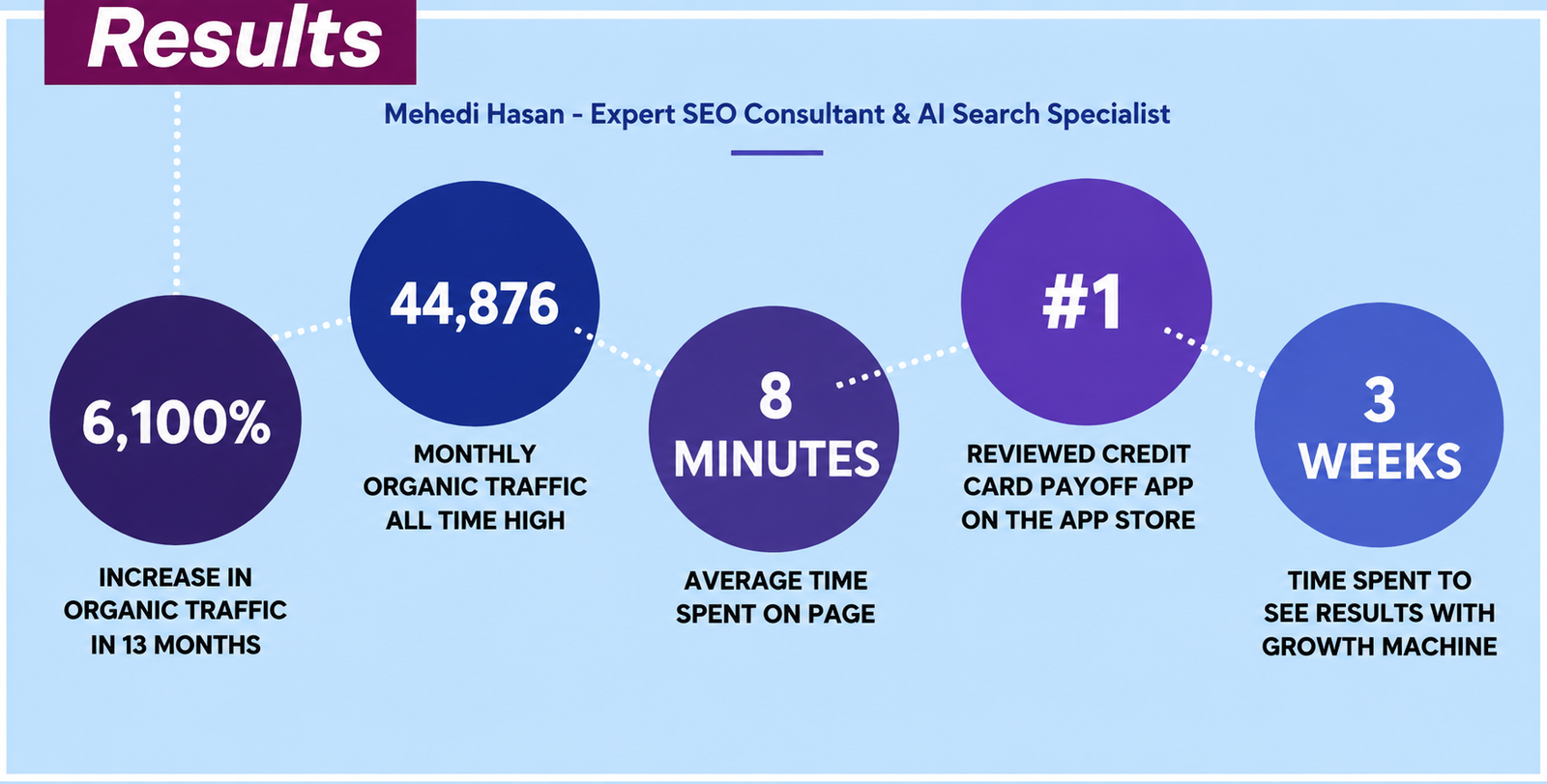
- 6,055.8% growth in reported monthly organic sessions.
- 44,876 monthly organic sessions, compared with 729 at baseline.
- 251 organic keywords achieving the #1 position in Google search results.
- Average session duration increased from approximately 2 minutes to more than 8 minutes.
- Publishing output expanded from 8 to 30 articles per month.
These results demonstrate the potential of consistent, search-focused content development to improve visibility in a competitive financial services market.
2. Client Background
The client was an emerging financial technology company offering debt consolidation solutions.
Its product aimed to simplify debt management by automating payments and helping customers manage borrowing costs through lower APR options.
Although the company had a relevant product offering, it faced established competitors with extensive content libraries, strong brand recognition, and significant search visibility.
Major financial information platforms such as NerdWallet and SoFi competed for many of the same search queries.
For a growing FinTech company, competing directly against these established brands required a focused SEO strategy built around relevant search demand and consistent content production.
3. The Business Challenge
The company’s main challenge was insufficient organic visibility.
With only 729 monthly organic sessions, its blog had limited reach and was not yet operating as an effective acquisition channel.
Three challenges shaped the SEO campaign.
Challenge 1: Limited organic traffic
The website attracted relatively few visitors through unpaid search, restricting opportunities to introduce potential customers to its financial products.
Challenge 2: Intense search competition
Established financial services brands dominated many high-value search results, making visibility difficult for a smaller company.
Challenge 3: Insufficient content coverage
The existing content strategy did not adequately address the range of questions, concerns, and informational needs of consumers researching debt management.
The business needed a repeatable strategy that could expand organic reach while attracting visitors interested in relevant financial solutions.
4. Campaign Objectives
The campaign was structured around four primary objectives.
Increase organic visibility: Improve the website’s presence in Google search results for relevant personal finance and debt management queries.
Grow qualified organic traffic: Attract consumers researching financial challenges that the client’s product could potentially help address.
Develop topical authority: Expand the blog’s coverage of personal finance and debt consolidation topics through consistent publishing.
Support customer acquisition: Create opportunities for organic visitors to discover the company’s debt management application.
5. SEO Strategy and Execution
Phase 1: Keyword Research and Search Intent Analysis
The strategy began with identifying keywords relevant to the client’s services and potential customers.
Keyword targeting included a combination of broader, higher-volume search terms and more specific long-tail queries.
This approach aimed to balance traffic potential with opportunities to compete for less saturated searches.
The keyword strategy also considered different stages of the customer journey, from early financial education to more specific debt management questions.
Phase 2: Content Strategy and Topic Development
The next priority was developing a content portfolio that addressed the financial concerns of the target audience.
The strategy covered both general financial education and specific debt management subjects.
Broader educational content created opportunities to attract users beginning their research, while more focused articles addressed particular financial questions and problems.
This approach expanded the range of relevant searches through which users could discover the brand.
Phase 3: Scaling Content Production
Publishing consistency was a central component of the campaign.
The content program initially produced approximately 8 articles per month.
As the strategy developed, publishing volume increased to approximately 30 articles per month.
This represented a 275% increase in monthly publishing output.
The expanded publishing schedule enabled the company to cover more relevant topics and pursue a wider range of search opportunities.
Importantly, the purpose of scaling production was to increase useful topical coverage rather than simply increase the number of published pages.
Phase 4: Building Search Visibility
The campaign used the expanding content library to improve the brand’s visibility across relevant search queries.
By combining keyword selection, search intent alignment, and consistent publication, the strategy sought to strengthen the blog’s presence in organic search results.
The approach was particularly relevant for a company competing against larger financial publishers with established search visibility.
6. Campaign Results and Performance Analysis
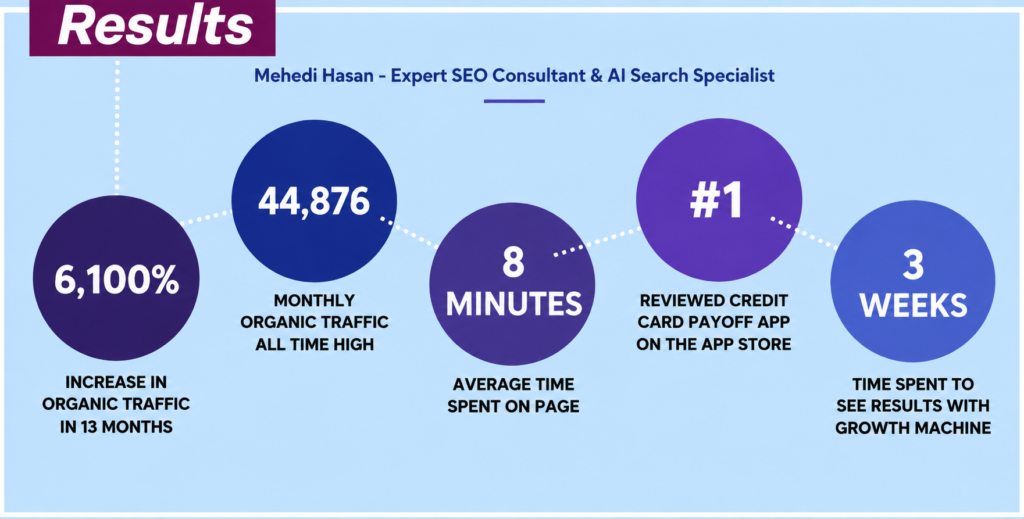
The reported results indicate substantial growth in organic search performance over the 13-month campaign.
Organic Traffic Performance
| Performance Metric | Before | After |
| Monthly organic sessions | 729 | 44,876 |
| Absolute monthly increase | — | 44,147 |
| Organic traffic growth | — | 6,055.8% |
| Campaign duration | — | 13 months |
Monthly organic sessions increased approximately 61.6 times relative to the starting level.
This was the campaign’s most significant reported performance improvement.
Keyword Ranking Performance
The blog achieved the #1 organic search position for 251 keywords.
This result indicates that the content strategy helped the website compete successfully for a substantial number of search queries.
However, the original report does not provide keyword-level search volumes, ranking histories, or the proportion of branded versus non-branded keywords.
User Engagement Performance
The reported average session duration increased from approximately 2 minutes to more than 8 minutes.
This represents an increase of more than four times the initial duration.
Longer sessions may indicate that visitors were engaging more deeply with the website’s content, although session duration alone does not establish content quality or conversion performance.
Content Production Performance
Monthly publishing volume increased from 8 to 30 articles.
This enabled broader topic coverage and created additional opportunities to attract users through organic search.
The available data does not isolate how much of the traffic growth resulted specifically from increased publishing volume versus other SEO improvements.
7. Business Impact
The SEO campaign improved the company’s ability to reach potential customers through unpaid search.
The growth in organic sessions increased the number of opportunities for consumers to discover the brand while researching personal finance and debt management.
The original case study also reports that blog visitors converted into application users and that the campaign supported app downloads and retention.
However, it does not disclose conversion rates, app installation totals, customer acquisition costs, or attributable revenue.
Accordingly, the strongest independently describable outcomes are improvements in organic traffic, keyword rankings, publishing scale, and user engagement.
The broader commercial impact is promising but cannot be quantified from the published information.
8. Key Strategic Insights
Search intent matters in competitive markets.
A combination of broad educational content and targeted long-tail topics can help smaller brands pursue search opportunities without relying exclusively on highly competitive keywords.
Content consistency supports scalable SEO programs.
Increasing publishing output from 8 to 30 articles per month expanded the campaign’s ability to address relevant search demand.
Organic visibility can improve significantly over time.
The increase from 729 to 44,876 monthly organic sessions illustrates the scale of growth reported during the 13-month campaign.
Traffic should be evaluated alongside business outcomes.
Organic sessions and rankings are useful indicators, but conversion data, customer acquisition costs, and revenue attribution are necessary to establish the full financial return of an SEO investment.
9. Conclusion
This FinTech SEO case demonstrates how a focused content strategy can support substantial organic search growth in a competitive financial services market.
Over 13 months, the company increased reported monthly organic sessions from 729 to 44,876, achieved first-position rankings for 251 keywords, and improved average session duration from approximately 2 minutes to more than 8 minutes.
The case highlights the value of targeted keyword research, content aligned with search intent, and consistent publishing.
For growing FinTech brands, these findings provide a useful example of how a structured SEO program can expand organic visibility and create additional opportunities for customer acquisition.