

Executive Summary
A newly established Malaysian e-commerce business operating in the competitive premium beverage market faced a significant challenge: increasing its organic search visibility while competing against established industry players.
Although the website had begun attracting visitors through branded searches, its ability to capture customers searching for products, categories, and relevant information without using the brand name remained limited.
The campaign focused on improving technical website performance, strengthening product and category pages, developing search-focused content, and identifying high-potential ranking opportunities.
Reported campaign outcomes included:
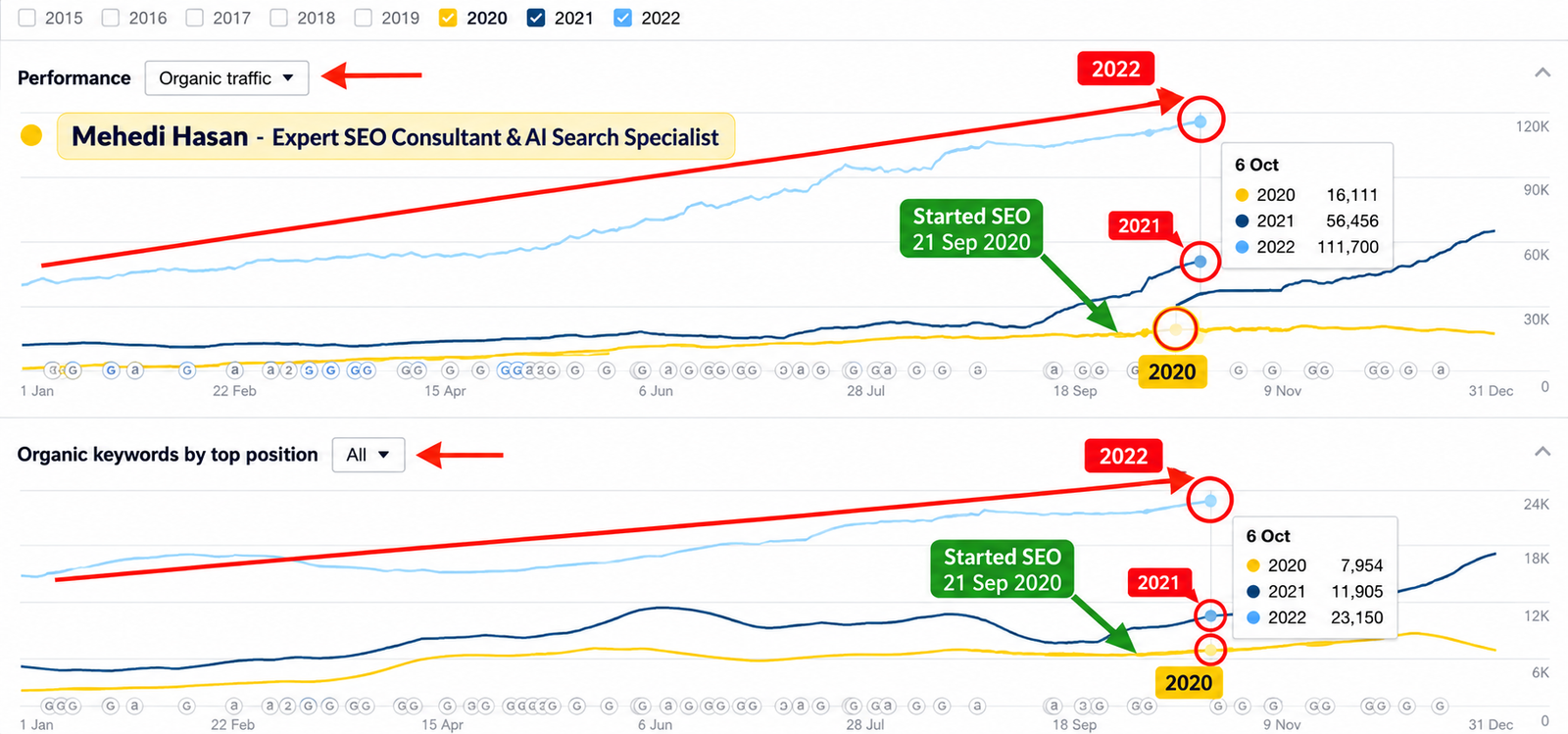
- 593% organic traffic growth from September 2020 to the reported 2022 level.
- 16,111 to approximately 111,700 monthly organic visits.
- 250% traffic growth during the first 12 months.
- 191% increase in the reported count of top-ranking organic keywords.
These results illustrate how a structured SEO campaign can help a relatively new e-commerce website build search visibility and compete more effectively within an established market.
1. Client Background
The client operated an e-commerce website specializing in premium alcoholic beverages in Malaysia.
The business entered a competitive digital market where established retailers already occupied valuable positions in Google’s search results.
As a relatively new website, the business lacked the established search authority, extensive content coverage, and optimized website structure necessary to compete effectively for commercially valuable non-branded keywords.
The client’s primary objective was to move beyond branded search traffic and develop a stronger, sustainable organic acquisition channel.
2. Business Challenges
Limited Non-Branded Search Visibility
The website’s initial organic presence depended heavily on branded search queries. This limited its ability to reach potential customers who were researching products or exploring purchasing options without knowing the client’s brand.
Strong Market Competition
Established competitors already had substantial search visibility, extensive product content, and stronger organic footprints.
Competing against these businesses required a targeted approach rather than relying on broad, highly competitive keywords alone.
Technical SEO Limitations
The website had technical issues that could affect crawlability, indexation, and overall search performance.
Duplicate content and broken pages were among the areas identified for improvement.
Underdeveloped Content Coverage
The website needed more relevant content to capture informational searches and strengthen topical coverage.
Product and Category Page Optimization
Commercially important product and category pages required improvements to their structure, content relevance, and keyword targeting.
3. Campaign Objectives
The campaign was designed around five primary objectives:
- Increase qualified organic traffic from Google.
- Improve rankings for relevant non-branded commercial keywords.
- Strengthen the website’s technical SEO foundation.
- Expand informational content to capture additional search demand.
- Improve the visibility and discoverability of important product and category pages.
The wider business objective was to develop organic search as a stronger customer acquisition channel.
4. SEO Strategy and Implementation
Phase 1: Comprehensive SEO Audit
The campaign began with a structured review of the website’s SEO performance and technical condition.
The audit focused on identifying barriers to organic visibility and establishing priorities for optimization.
Key areas included:
- Technical website errors and broken pages.
- Duplicate or overlapping content.
- Indexation and crawlability concerns.
- Product and category page structure.
- Existing keyword rankings and optimization opportunities.
The audit provided the foundation for a phased improvement plan.
Phase 2: Technical SEO Improvements
Technical optimization focused on resolving issues that could prevent search engines from efficiently accessing, understanding, and ranking website content.
The documented work included addressing duplicate content, broken pages, and weaknesses in the website’s underlying structure.
These improvements aimed to make the website easier to crawl and maintain while supporting stronger organic search performance.
Phase 3: Commercial Keyword Optimization
The next priority was improving the relevance of product pages for commercially valuable searches.
Instead of focusing exclusively on broad search terms, the campaign targeted queries aligned with the products and customers’ search intent.
This involved refining product-page content and strengthening keyword relevance so important commercial pages could compete for more appropriate searches.
Phase 4: SEO Content Development
A search-focused content strategy was introduced to expand the website’s reach beyond transactional searches.
Informational blog content was developed around relevant industry topics and customer interests.
The purpose was to attract visitors earlier in their research process, broaden keyword coverage, and strengthen the website’s relevance within its niche.
Phase 5: Search Results Feature Optimization
Selected content was optimized for additional visibility opportunities in Google’s search results.
The strategy included formatting and refining content for FAQ-related search features and rich-result opportunities where eligible.
This approach aimed to improve search-result presentation and increase the likelihood of attracting relevant clicks.
Phase 6: High-Potential Page Identification
The campaign used a technique described as sweet spot analysis to identify pages with opportunities for further ranking improvement.
The approach prioritized existing pages that showed ranking potential and could benefit from focused optimization.
Rather than treating every page equally, resources were directed toward pages with promising organic search opportunities.
Phase 7: Product and Category Restructuring
Product and category pages were restructured to improve their SEO organization and usability.
The work focused on creating clearer, more relevant pages that better supported both search-engine understanding and customer navigation.
This helped align the website’s commercial architecture with its organic growth objectives.
5. Results and Performance Analysis
Organic Traffic Growth
At the beginning of the campaign in September 2020, the website recorded approximately 16,111 monthly organic visits.
By September 2021, monthly organic traffic had increased to 56,456 visits, representing approximately 250% growth over the initial period.
The reported upward trend continued into 2022, when monthly organic traffic reached approximately 111,700 visits.
Compared with the initial baseline, this represented approximately 593% growth.
Keyword Visibility Growth
The original campaign report also documented an increase in the number of keywords occupying leading organic search positions.
The reported count increased from 7,954 in 2020 to approximately 23,150 in 2022.
This represents approximately 191% growth in the reported keyword count.
Although the source does not define the exact ranking-position range used for this metric, the reported change indicates broader organic keyword visibility.
Business Impact
The campaign expanded the website’s reported organic reach and improved its visibility across a larger range of relevant search queries.
The results suggest that a combination of technical improvements, commercial page optimization, and informational content development can support substantial growth in search visibility.
However, the published source does not provide verified revenue, conversion-rate, order-volume, or customer acquisition figures. Financial impact therefore cannot be quantified from the available information.
6. Key Strategic Insights
Technical improvements support content performance. Addressing website errors and structural problems can help search engines access and interpret valuable content more effectively.
Non-branded SEO creates additional acquisition opportunities. Targeting searches beyond the company name helps businesses reach potential customers who are unfamiliar with the brand.
Commercial and informational content serve different purposes. Product and category pages support purchase-oriented searches, while informational content broadens audience reach.
Prioritization improves campaign focus. Identifying high-potential pages allows SEO resources to be directed toward opportunities with stronger ranking potential.
Sustained optimization matters. The reported results developed across multiple measurement periods rather than appearing as a single short-term increase.
7. Conclusion
This campaign demonstrates the potential of a coordinated SEO strategy for a newer e-commerce website operating in a competitive market.
Through technical SEO improvements, targeted keyword optimization, content development, and product-page restructuring, the website’s reported monthly organic traffic grew from 16,111 visits in September 2020 to approximately 111,700 visits in 2022.
The outcome illustrates the value of combining technical improvements with relevant content and focused optimization of commercially important pages.
For businesses seeking to build a stronger organic acquisition channel, the central lesson is clear: effective SEO requires consistent execution, clear priorities, and performance measurement over time.